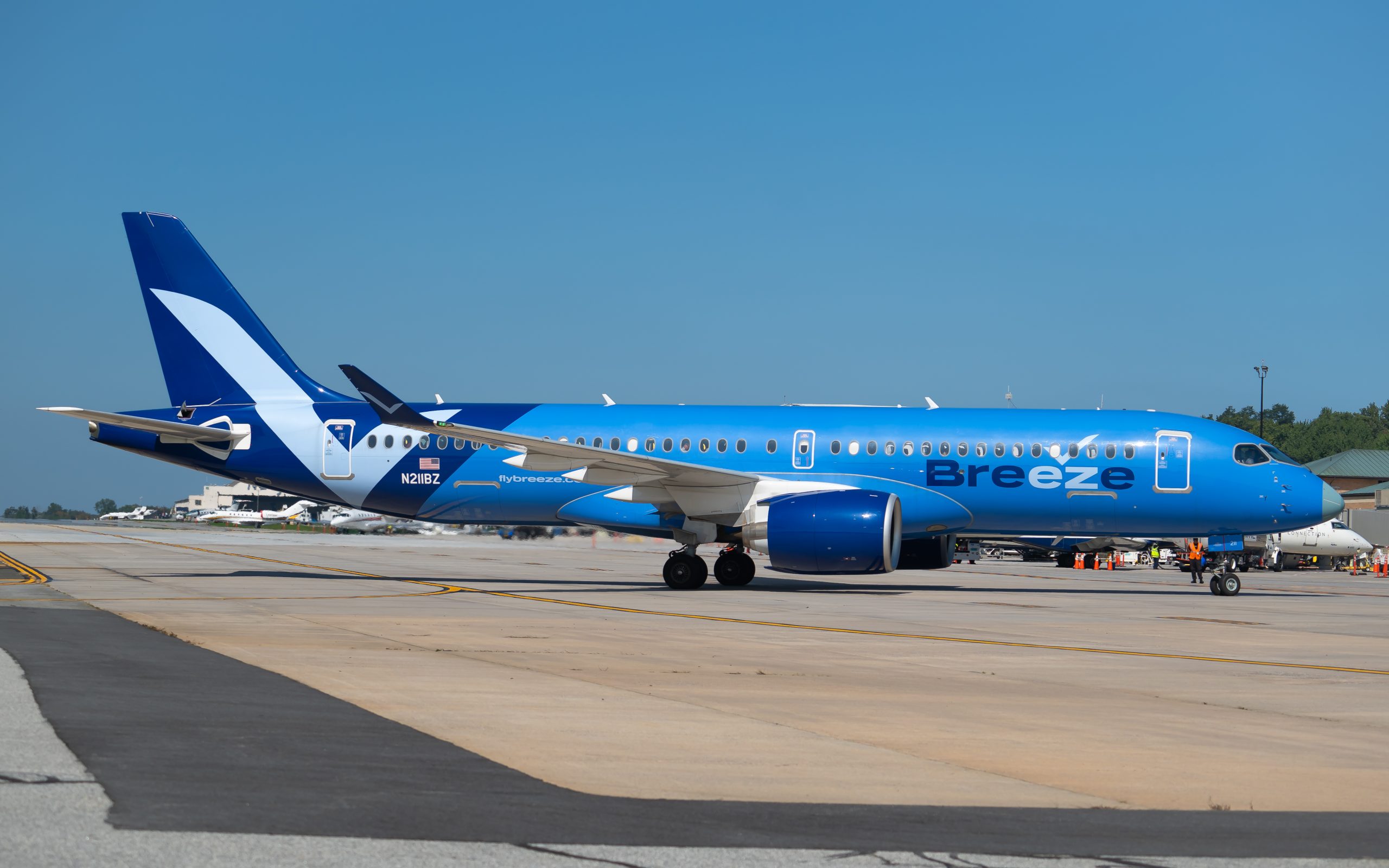
Breeze Airways is temporarily pulling back on five routes starting in early September 2026, with four of them scheduled to return by the start of October and a fifth — its international run to Cancún, Mexico — not resuming until December 19. Three other routes will keep flying through the same stretch but with fewer flights per week. None of the changes are being described as permanent; multiple outlets covering the schedule shift call it a seasonal pause with set return dates, separate from a longer-term network trim the airline has been making at a handful of other airports.
Key facts
- Five routes pause starting September 2–5, 2026; four return by October 2, the fifth (Charleston–Cancún) not until December 19.
- Paused: Fort Lauderdale–Salisbury, Fort Lauderdale–Wilkes-Barre/Scranton, Fort Myers–Albany, Orlando–Portsmouth, and Charleston–Cancún.
- Three routes cut frequency instead of pausing: Fort Lauderdale–Akron/Canton, Orlando–Madison, and Provo–Orange County.
- Breeze has not explained the changes publicly; trade outlets link them to below-average load factors and seasonal demand.
- Breeze’s projected September 2026 schedule is set to grow, up about 43.5% in flights year over year.
Which routes are paused, and when they come back
Four domestic routes stop flying in the first week of September and are due back October 2:
- Fort Lauderdale, Florida, to Salisbury, Maryland — normally twice weekly, and only two months old, having launched in July 2026.
- Fort Lauderdale to Wilkes-Barre/Scranton, Pennsylvania — also twice weekly and also launched in July 2026.
- Fort Myers, Florida, to Albany, New York — paused September 2 through October 2. According to aviation analytics firm Cirium, the route had been running at about a 70% load factor (roughly 4,900 of nearly 7,000 seats filled) from December 2025 through May 2026.
- Orlando to Portsmouth, New Hampshire — weekly service paused from September 5. The route launched in October 2024 and had been filling around 67.5% of its seats over the year through May 2026, roughly 11 points below Breeze’s systemwide average of about 78.51%.
Albany International Airport director Matt Hunter framed the Fort Myers pause as short-lived, saying it “is only taking a one-month pause, and we look forward to seeing it return before the start of winter.”
The longer suspension is on Breeze’s Charleston, South Carolina, to Cancún, Mexico route, which stops flying September 5 and isn’t scheduled to resume until December 19 — a much longer gap than the domestic routes.
Three routes are cut back, not stopped
A separate set of routes isn’t pausing at all — they’re simply running less often for a few weeks.
- Fort Lauderdale to Akron/Canton, Ohio — drops from two flights a week to one, September 5 to October 2.
- Orlando to Madison, Wisconsin — goes from three weekly flights to two, September 6 to 28.
- Provo, Utah, to Orange County, California — one of Breeze’s busiest routes at 18 weekly flights, loses just one of those flights, down to 17, September 6 to October 2.
Why this is happening, as best it can be pinned down
Breeze has not issued a public statement or press release explaining the September changes, and Simple Flying reported reaching out to the airline for comment without getting a response. Trade outlets tracking the airline’s schedule data, including figures from aviation analytics firm Cirium, tie the pauses to load factors below Breeze’s network average and to a seasonal dip in demand — but that’s outside analysis of the numbers, not something Breeze itself has said.
This isn’t the first time Breeze has used a short seasonal pause rather than dropping a route outright. The airline suspended its Vero Beach, Florida, to New Haven, Connecticut route from roughly June through September 2026, with that flight also due back on October 3 — a pattern that lines up with how the September pauses are being handled.
Not a sign the airline is shrinking
Despite the pauses and the frequency cuts, Breeze’s overall September 2026 schedule is on track to grow, not shrink — to about 6,823 flights, up roughly 43.5% from the 4,755 flights it ran in September 2025, with total seat capacity up about 46.3% year over year. That growth is tied to Breeze expanding its Airbus A220-300 fleet as it phases out its older Embraer E190 jets.
No current reporting points to Breeze approaching bankruptcy or shutting down — a different budget airline, Spirit Airlines, did stop flying entirely in 2026, but that is an unrelated carrier and not connected to Breeze’s schedule changes.
Two other Breeze stories from the same stretch, and why they’re not this one
Separately, Breeze is winding down service entirely — not pausing it — at five other airports between August 2026 and February 2027: Mobile, Alabama; Plattsburgh, New York; Oklahoma City; Tulsa, Oklahoma; and Montrose, Colorado, citing low passenger loads and competition. One report lists Orange County, California, among the airports in that six-airport exit. Other reporting says only one weekly flight is being cut on the Provo-Orange County route, not the route itself. That six-airport story was first reported in late July 2026 and predates the current September changes.
Breeze has also cancelled its Providence, Rhode Island, to Cancún route entirely for the coming winter season — a different city pair from the Charleston-Cancún route that is only paused, not cancelled, under the September changes.
And a separate seasonal pause affects a different Charleston altogether — Charleston, West Virginia, not the South Carolina city named above — on Breeze’s route to Newark, New Jersey. Confirmed by a Yeager Airport spokesperson, that pause takes effect after January 3, 2027 and is its own, later development.
If you’re booked on an affected route
No source has specified what refund or rebooking options Breeze is offering passengers on the paused or reduced routes. Anyone holding a ticket for travel during the affected windows should check directly with Breeze — through their booking confirmation or the airline’s customer service channels — to confirm their options before their travel date.