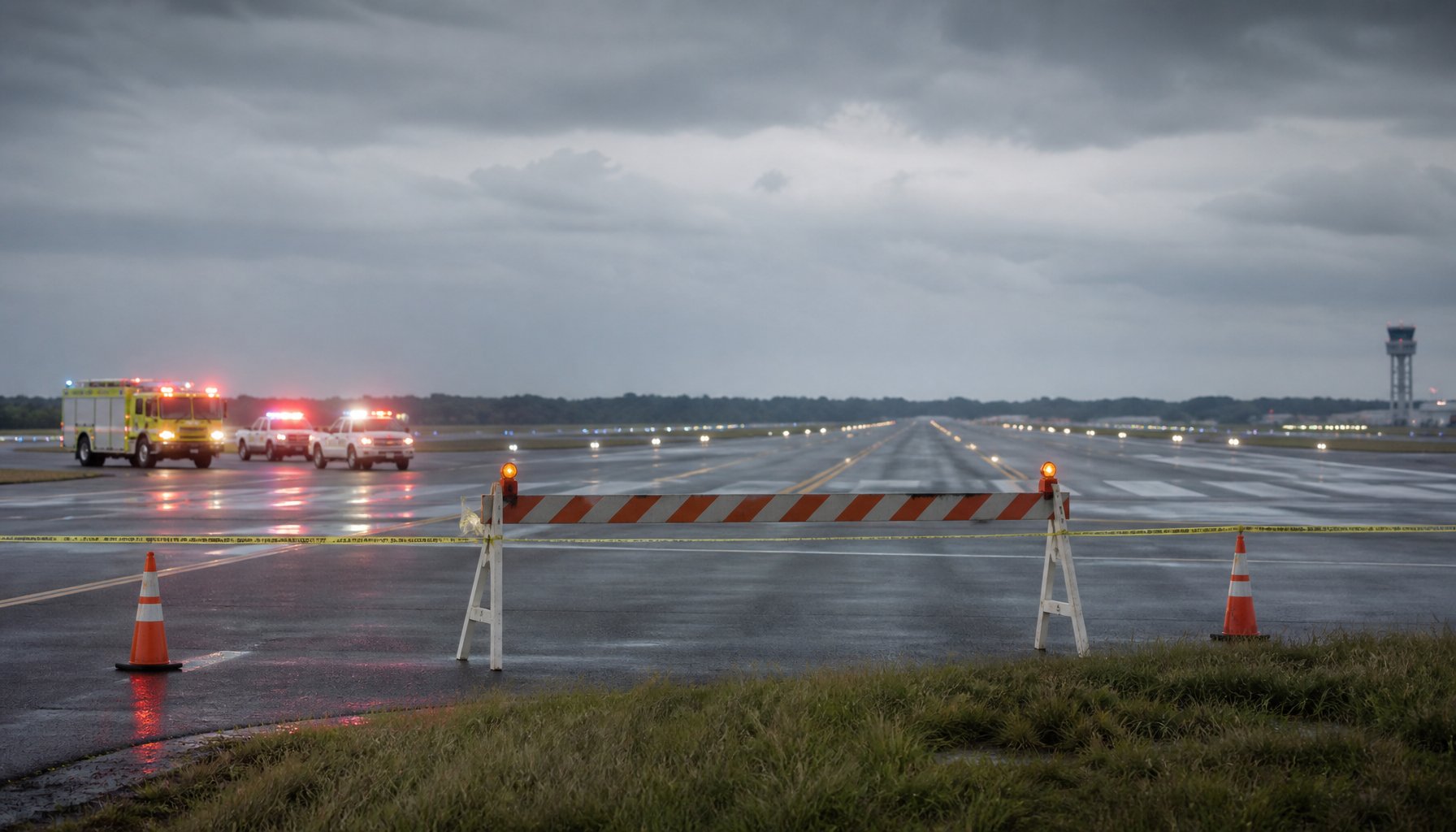
New data from the wrecked jet’s black boxes show the crew of the Amazon-branded cargo plane that crashed near Miami International Airport on Sept. 6, 2026 briefly tried to abort the landing and climb away — and then reversed that decision seconds before the plane ran off the runway.
The National Transportation Safety Board released the findings in an investigative update on Sept. 9, drawn from the flight data recorder and cockpit voice recorder, commonly called the black boxes, which were recovered from the Boeing 767-33A freighter and read out at the NTSB’s lab in Washington. The aircraft, flying as Amazon Air Flight 7598 and operated by cargo carrier 21 Air LLC, overran the runway, crossed a public road and struck vehicles, killing five aircraft-cleaning workers riding in a van and injuring five other people. The five workers who died — Rolando Aleman, 55; Yoel Rodriguez Naranjo, 53; Julio C. Pineda, 75; Carlos Acosta Fajardo, 53; and Javierkys Reyes Quevedo, 47 — were employees of Professional Ocean Service Corporation, an aircraft-cleaning contractor, county officials said. The death toll has not changed since the crash: it remains five dead, with three of the injured still hospitalized as of Sept. 9-10, two of them in critical condition. Renewed attention followed two rounds of NTSB disclosures: Tuesday, Sept. 8, brought preliminary flight-data findings showing an attempted go-around, and Wednesday, Sept. 9, brought the official investigative update and interviews with both surviving pilots.
Key facts
- Crash: Sept. 6, 2026, near Miami International Airport
- Aircraft: Boeing 767-33A freighter, flying as Amazon Air Flight 7598, operated by 21 Air LLC
- Deaths: 5 aircraft-cleaning workers, employees of Professional Ocean Service Corporation
- Injured: 5 others; 3 still hospitalized as of Sept. 9-10, 2 in critical condition
- NTSB update: released Sept. 9, based on flight data recorder and cockpit voice recorder data
- Cause: not yet determined; the NTSB calls its findings preliminary
- Final report: typically takes a year or more; no date set
What the black boxes show
Here is the sequence the recorders show, second by second:
- At touchdown, the nose gear and right main gear hit the pavement at about 158 knots groundspeed — well beyond the runway’s standard 3,000-foot touchdown zone.
- About 7 seconds later, the crew applied the brakes.
- About 11 seconds after touchdown, the left main gear came down, at about 134 knots.
- Within seconds of applying the brakes, the crew briefly increased the throttles toward go-around power — what the NTSB described as an apparent attempt to abort the landing and climb back into the air.
- About 4 seconds after that, they reversed the decision, pulling the throttles back to idle and reapplying the brakes.
- Neither the speed brakes nor the thrust reversers were ever deployed, according to the data.
- The final groundspeed recorded before the plane left the paved surface was 65 knots.
What the cockpit recording captured
The cockpit voice recorder tells a similar story from inside the cockpit. The recording also captured the autopilot disconnect about 1 minute 23 seconds before touchdown. One pilot can be heard warning the other, on and off for nearly two minutes spanning the approach and touchdown, that the plane was coming in too fast — without the recording capturing a consistent verbal response from the other pilot. The recorder also captured repeated automated warnings of “sink rate” and “too low terrain,” a request for flaps 30 that came later than the standard callout, and a spoken go-around call from the crew. That call came roughly 15 to 16 seconds after the sounds of touchdown — a few seconds after the crew had already reversed the brief throttle movement toward go-around power, about 11 seconds after touchdown, and pulled the throttles back to idle. The flight data and the cockpit audio point to two separate moments, not one: a physical attempt on the throttles first, then a spoken go-around call only after that attempt had already been abandoned, by which point the plane had already committed to landing and ran off the paved surface moments later. The NTSB has not said why the second pilot did not respond to the warnings.
No cause determined yet
The NTSB has been explicit that it has not determined a cause from these findings. Its Sept. 9 update describes the findings as preliminary and subject to change, and the agency says it has not determined what caused the crash — nor assigned any responsibility to either pilot. Investigators are still looking at several possible factors. Those include the aircraft’s mechanical systems, the weather at the time, how the flight crew performed and trained, air traffic control, and the plane’s maintenance and ownership history — and so far, none of them has been singled out. A final report with a probable-cause finding typically takes a year or more, and the NTSB has not set a date for one.
The pilots
Both surviving pilots — Captain Joseph Carroll, 55, who had logged 7,145 flight hours as of March 31, 2026, and First Officer Jaime Felipe Silva Molina, 37, who had about 2,655 hours as of late August — were released from the hospital with minor injuries and formally interviewed by NTSB investigators on Wednesday, Sept. 9. Investigator-in-charge Chihoon Shin said before the interviews that the crew’s own account was needed to understand how they were handling the controls, since the cockpit recorder captures sound, not the physical inputs pilots make. NTSB Chair Jennifer Homendy said the agency held back public release of the cockpit audio until after those interviews were finished, specifically so the recording would not influence what the pilots said. No content of what either pilot told investigators has been made public.
First lawsuit filed
The crash has also drawn its first lawsuit. On Sept. 9, the law firm Morgan & Morgan filed a wrongful-death suit in Miami-Dade County court on behalf of Yaraisi Santiso Morejon, the widow of victim Yoel Rodriguez Naranjo, one of the five cleaning-contractor employees killed. The suit names Amazon, 21 Air, the aircraft’s lessors, and both pilots as defendants, and alleges pilot error, inadequate training and a high-speed, tailwind-affected landing. Those are civil allegations made in a legal filing — not findings from the NTSB, which does not determine legal liability and has not concluded that pilot error played any role. Aviation attorney Steven Marks, quoted in a Sept. 10 article in Claims Journal, a trade publication covering the insurance and legal industries, said civil responsibility in crashes like this one typically lands on the airline that operated the flight — 21 Air, in this case — rather than the company whose branding was on the plane. He pointed to a 2019 crash near Trinity Bay, Texas, outside Houston, involving a Boeing 767 that also carried Amazon Prime Air branding: legal responsibility there was ultimately tied to Atlas Air, the plane’s operator, not Amazon. That is one attorney’s legal analysis, not a settled outcome or an NTSB finding.
21 Air’s safety history
21 Air, the contract carrier that flew the aircraft under Amazon Air branding, is controlled through an LLC tied to Houston Astros owner Jim Crane. Former 21 Air pilots and a former chief pilot have separately alleged safety concerns at the company in past years, including insufficient rest between flights and pressure not to file safety reports. Those complaints are documented, but no investigation has connected them to the Sept. 6 crash, and the NTSB’s review so far has not identified any link.
What happens next
The NTSB’s investigative team remains on site, reviewing the flight crew’s performance, 21 Air’s policies and procedures, and the contractual relationship between 21 Air and Amazon. Homendy has also raised, as part of the broader investigation, whether runway safety systems designed to stop overrunning aircraft — known as Engineered Materials Arresting Systems — should be required at more airports. A full investigative docket is expected eventually, but the final report identifying a probable cause remains a year or more away.