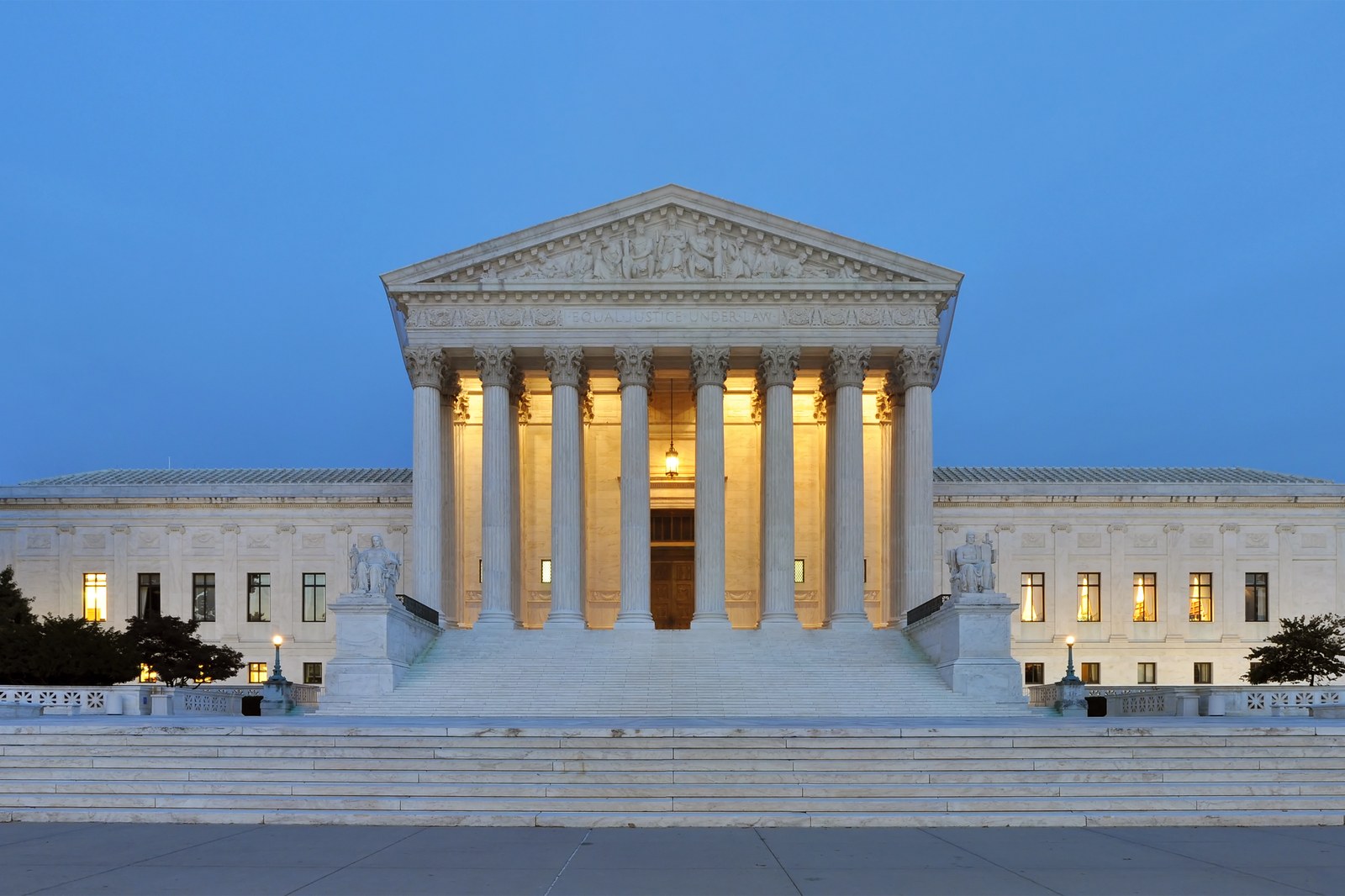
President Donald Trump used Truth Social on Saturday to attack the Supreme Court over its rulings this year on tariffs and birthright citizenship. “Over the last 6 months, with their faulty, political, and ridiculous decisions on TARIFFS and Birthright Citizenship, they have cost the United States of America Trillions of Dollars, and forever damaged the way people become Citizens of our great Country,” he wrote, according to Newsweek. Both rulings are public documents, and neither one blames the Court for a loss of that size. The tariff opinion does carry trillion-dollar numbers, but they are the government’s own projections, cited in its brief: that the tariffs would cut the national deficit by $4 trillion and that international agreements reached in reliance on them could be worth $15 trillion.
The post
Trump also wrote that the Court “lacked the Courage to MAKE AMERICA GREAT AGAIN.” He ended the post, “It has been a sad chapter in the life and times of America, but we will prevail!” Newsweek reported that it reached out to the White House for comment on Saturday. No response from the White House or the Supreme Court has been reported.
The tariff case
The ruling is Learning Resources, Inc. v. Trump, No. 24-1287, consolidated with Trump v. V.O.S. Selections, Inc., No. 25-250. The two cases reached the Court by different routes: the Learning Resources case came up on certiorari before judgment from the D.C. Circuit — the Court stepped in directly, before the appeals court had ruled — while the V.O.S. Selections case arrived on certiorari from the Federal Circuit, which had already ruled against the tariffs. They were argued November 5, 2025, and decided February 20, 2026. The question presented was “whether the International Emergency Economic Powers Act (IEEPA) authorizes the President to impose tariffs.” The Court’s answer, in full: “IEEPA does not authorize the President to impose tariffs. The judgment in No. 24-1287 is vacated, and the case is remanded with instructions to dismiss for lack of jurisdiction; the judgment in No. 25-250 is affirmed.” In plain terms: one of the two lawsuits was sent back to be dismissed because it had been filed in the wrong court, while the ruling against the tariffs stands in the other.
The syllabus — the summary prepared for readers by the Court’s Reporter of Decisions, which the Court notes is no part of the opinion itself — lays out the reasoning. IEEPA lets the president “investigate, block during the pendency of an investigation, regulate, direct and compel, nullify, void, prevent or prohibit . . . importation or exportation” — but, the Court wrote, “Absent from this lengthy list of specific powers is any mention of tariffs or duties. Had Congress intended to convey the distinct and extraordinary power to impose tariffs, it would have done so expressly, as it consistently has in other tariff statutes.” The opinion also points to Article I, Section 8, which gives Congress the power to “lay and collect Taxes, Duties, Imposts and Excises”: “The Framers did not vest any part of the taxing power in the Executive Branch.”
At issue were the 25% tariffs on most Canadian and Mexican imports and 10% on most Chinese imports — the drug-trafficking tariffs — plus a duty of at least 10% “on all imports from all trading partners,” with dozens of nations facing higher “reciprocal” rates. Six justices backed the judgment, though they did not all sign every part of it: Chief Justice Roberts wrote the opinion, with Sotomayor, Kagan, Gorsuch, Barrett and Jackson joining the core sections that decide the case, and Gorsuch and Barrett joining more of it than the others. Three dissented — Thomas filed his own dissent, and Kavanaugh filed a separate dissent joined by Thomas and Alito.
The citizenship case
The ruling is Trump v. Barbara, No. 25-365, taken up directly from the First Circuit, argued April 1, 2026, and decided June 30, 2026; the judgment below was affirmed. The question presented was “whether the Constitution guarantees citizenship to children born in the United States of parents who are unlawfully or temporarily present in the country.” The Court held: “Children born in the United States to parents unlawfully or temporarily present are ‘subject to the jurisdiction’ of the United States and are citizens at birth under the Fourteenth Amendment’s Citizenship Clause.”
At issue was Executive Order 14160, “Protecting the Meaning and Value of American Citizenship,” signed January 20, 2025, which had declared such children not “subject to the jurisdiction” of the United States; a district court had provisionally certified a nationwide class and preliminarily enjoined enforcement. The Chief Justice’s opinion was joined by four justices — Sotomayor, Kagan, Barrett and Jackson. A fifth, Justice Kavanaugh, filed an opinion concurring in the judgment and dissenting in part — agreeing with the outcome but not all of the reasoning. Three justices — Thomas, Alito and Gorsuch — dissented.
What is — and isn’t — known about the money
Neither opinion orders refunds. The majority left the question open, and Justice Kavanaugh, in dissent, said so plainly: “The Court says nothing today about whether, and if so how, the Government should go about returning the billions of dollars that it has collected from importers.” He added that the refund process was likely, as he put it after oral argument, to be a “mess.” What the public record shows is a customs filing with the Court of International Trade: Reuters described it as about $100 billion in refunds certified by Customs and Border Protection and sent to the Treasury for disbursement as of July 31 — money cleared for return, which is not the same as money already back in importers’ hands. Newsweek, citing the same filings as reported by the Financial Times, described about $100 billion in refunds to importers as of August, out of an estimated $166 billion collected. No source found, including the two opinions themselves, quantifies a cost in the trillions.
What’s still moving
After the tariff ruling, the administration turned to other legal authorities — including Section 301 of the Trade Act of 1974, a different trade law from the emergency power the Court rejected — to impose tariffs of 10 to 12.5 percent on imports from 60 trading partners, tariffs Newsweek reports are now themselves facing legal challenges. On citizenship, Newsweek has reported that a federal judge blocked enforcement of a new order restricting birthright citizenship earlier this month.