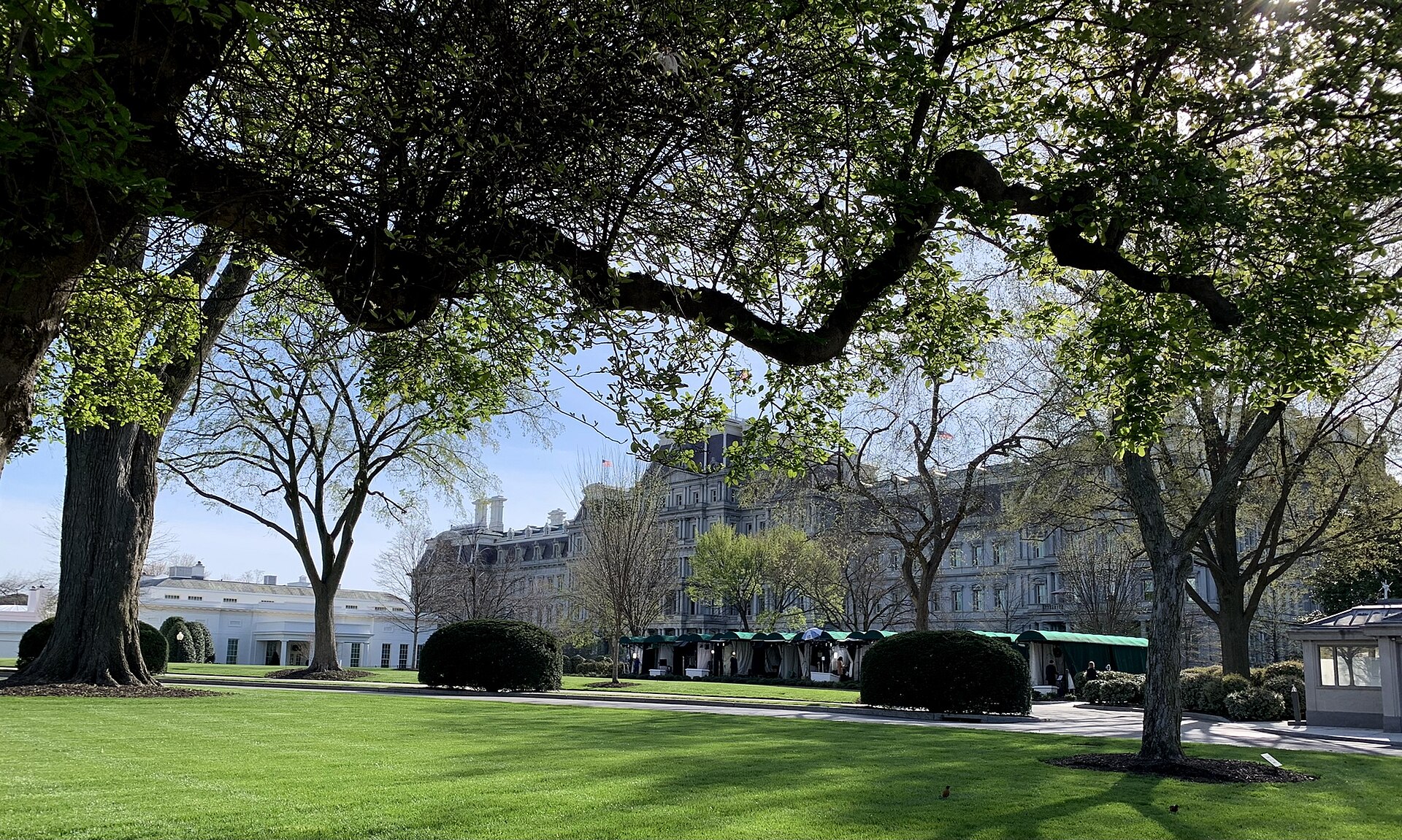
CNN, MS NOW and Politico, along with three of their White House reporters, sued President Trump and three top aides Monday, arguing that the administration’s ban on their reporters’ access violated the Constitution. A federal judge ordered the government to respond by Tuesday and set a hearing on the outlets’ request for a temporary restraining order for Wednesday afternoon.
What happened, according to the complaint
The lawsuit names Cable News Network, Inc., MS NOW Cable, LLC, and Politico LLC, along with three reporters — CNN’s Betsy Klein, MS NOW’s Akayla Gardner and Politico’s Cheyenne Haslett. The defendants, sued in their official capacities, are President Trump, White House communications director Steven Cheung, Secret Service Director Sean M. Curran and White House Chief of Staff Susan Wiles. The case was filed Sept. 21 in U.S. District Court for the District of Columbia and assigned to Judge Timothy J. Kelly.
According to the complaint, Trump announced on Truth Social at 3:04 p.m. EDT on Friday, Sept. 18, that he was “banning” journalists from the three outlets “effective immediately.” Trump said in the Oval Office later that day, according to a transcript the complaint quotes, that “[t]here’s something wrong with a country that can allow people to write purposely negative stories” and that “if they want to write them, that’s fine, but I don’t have to let them into my, into the people’s house.” Asked whether the ban would survive a court challenge, he said, “Well, we’ll see. . . . I think it’s good to point it out whether it survives or doesn’t.”
The complaint says the outlets’ hard passes were “apparently deactivated” that night, and the next day, Saturday, Sept. 19, Klein, Gardner and Haslett were turned away at the White House and had their passes taken. CNN had been assigned as the network pooler for Monday, Sept. 21, but the White House communications office removed it from the published pool schedule at 10:55 p.m. Sept. 20, the complaint says. As of Sept. 18, the complaint says, 40 CNN journalists and 22 MS NOW journalists held valid hard passes.
What the outlets want, and why
The complaint brings three claims: that the ban violated the Fifth Amendment’s due-process guarantee, since reporters got no notice, no stated standard and no chance to respond before their passes were revoked; that it is First Amendment retaliation for the outlets’ past coverage; and that it is First Amendment viewpoint discrimination in what the complaint calls a nonpublic forum. “The ban retaliates against Plaintiffs for past coverage of the Trump administration in violation of the First Amendment and should be enjoined and declared unlawful,” the complaint states.
The outlets are seeking a temporary restraining order. Their motion asks the court to bar the defendants “(save the President)” from enforcing the ban and to restore the access the outlets and their reporters held before Sept. 18. The complaint’s requested relief includes an order to “immediately restore the hard passes and White House access that Plaintiffs and their reporters held before September 18, 2026.”
The White House’s argument
The White House responded with a Sept. 21 release titled “White House Access Is a Privilege — Not a Right.” It says: “Last week, President Donald J. Trump removed CNN, MS NOW, and Politico from the White House grounds after years of false reporting” — the administration’s characterization of the coverage. “The First Amendment protects their right to publish; it does not entitle them to a hard pass, briefing room seat, or place in the press pool,” the release says, adding that access changes are “nothing new” and pointing to past restrictions by Democratic administrations, including the Obama White House’s treatment of Fox News in 2009.
The legal precedent
The outlets’ TRO memo cites Sherrill v. Knight, a 1977 D.C. Circuit ruling that a correspondent’s interest in a White House press credential is a First Amendment-protected liberty interest that “may not be denied without due process of law under the fifth amendment,” and that access to White House press facilities cannot be denied “arbitrarily or for less than compelling reasons.” It also cites Karem v. Trump, a 2020 D.C. Circuit decision upholding an injunction that restored a reporter’s suspended hard pass on fair-notice grounds.
The outlets’ memo points to a 2018 case before the same judge. In November 2018, hours after Trump told CNN’s then-chief White House correspondent Jim Acosta that he was “a rude, terrible person,” the memo says, the Secret Service took Acosta’s hard pass at the White House gate. On Nov. 16, 2018, Judge Kelly entered a temporary restraining order requiring the White House to restore it, finding that it likely had been revoked without the process the Fifth Amendment requires, according to the memo.
What happens next
Judge Kelly’s minute order directs the government to file any response to the TRO motion by Sept. 22. As of Tuesday morning, the court docket showed no response filed. The order sets a hearing on the TRO motion for 3:30 p.m. Wednesday, Sept. 23, to be held by videoconference with a public access line.
The White House Correspondents’ Association has said the ban “violates the First Amendment” and called “on the administration to immediately restore our colleagues’ access,” according to a Sept. 19 statement. A day earlier, WHCA President Jacqui Heinrich said the association “stands in defense of our colleagues at CNN, MSNOW, and POLITICO who are being singled out for doing their jobs.”