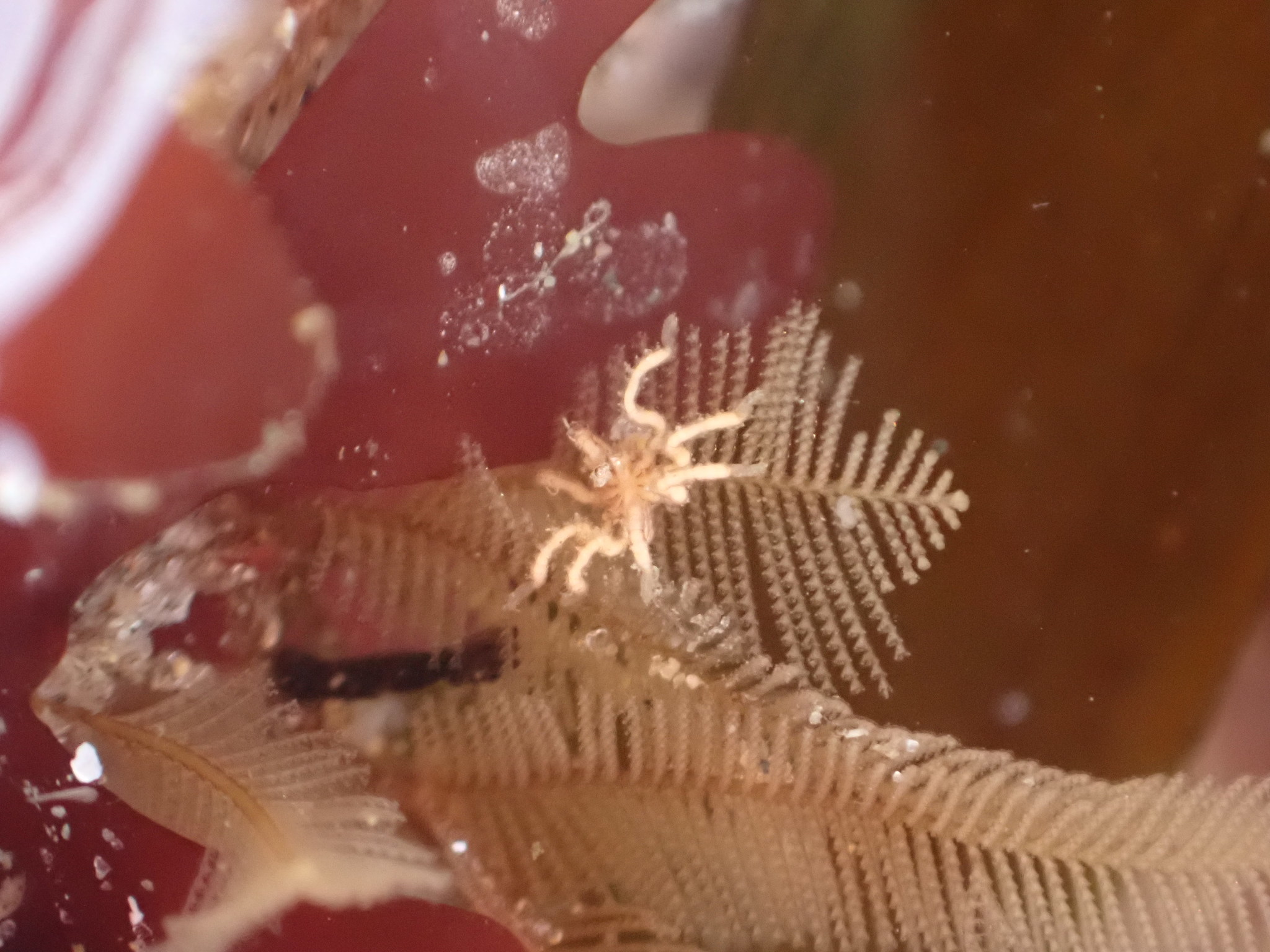
University of British Columbia researchers have described two new species of sea spider collected from the Salish Sea, the marine ecosystem that spans Washington state and British Columbia. Both species, Callipallene pilosuspedes and Tanystylum kiixin, are now listed as accepted in the World Register of Marine Species. The find is part of a broader study, published in the journal Organisms Diversity & Evolution, that examined seven species of coastal sea spider from the region.
The two new species
Callipallene pilosuspedes gets its name, according to the UBC release, from “a play on the Latin for ‘hairy feet,'” a reference to long, curved spines covering its lower legs, and has red eyes, a short proboscis with claws to grasp food, and “a triangular, three-lipped mouth covered in sensory tendrils.” It also has dexterous ovigers — a pair of limbs near the head that males use to carry eggs — that the animal was observed using as grooming tools, wrapping them around its legs and running comb-like spines over itself. Researchers found only one specimen of this species.
The second, Tanystylum kiixin, is named after an ancient Indigenous village site near where the specimens were first collected. The release says the name is “pronounced ‘kee-hin,'” and that the word comes from the sound of waves crashing at the base of the village site. Unlike Callipallene pilosuspedes, its ovigers are smaller and less dexterous, leaving it unable to groom itself effectively — researchers frequently found it covered with tiny parasites of its own, which lead author Cormac Toler-Scott described as “an ecosystem within an ecosystem within an ecosystem.” The paper’s abstract notes that Tanystylum kiixin “closely associates with the hydroid Plumularia setacea.”
What the study covered
The paper’s abstract describes “morphological and molecular phylogenetic analyses of seven species of coastal sea spider from the Salish Sea ecoregion, representing the first comprehensive scientific study of pycnogonids in this area.” Alongside the two new species, the team redescribed five already-known species: Achelia alaskensis, Achelia gracilipes, Anoplodactylus erectus, Anoplodactylus viridintestinalis, and Phoxichilidium quadradentatum. The work used scanning electron microscopy and molecular data, and the authors also produced a dichotomous key — a step-by-step identification key — for pycnogonids living in the Salish Sea and along the west coast of Vancouver Island, a tool meant to help other researchers tell the region’s sea spider species apart. UBC describes the two new species as the first described in the Salish Sea in almost a century.
What sea spiders are
Sea spiders, or pycnogonids, are marine arthropods related to scorpions, spiders and horseshoe crabs, though they never left the ocean. Per the UBC release, they evolved roughly 500 million years ago, can have as many as 12 legs, and feed using a sucking proboscis. They range in size from less than a centimetre to more than 70 centimetres in Antarctica, according to the release. They breathe through their skin, and males — not females — rear the young, carrying the eggs glued to their bodies in clusters using their ovigers.
Where the Salish Sea is
The Salish Sea, as the U.S. Environmental Protection Agency describes it, includes Puget Sound in Washington state as well as the Strait of Juan de Fuca and the Georgia Basin in Canada. The new species were collected between September 2023 and August 2024 from dives up to 18 metres (about 59 feet) deep, in a range of marine habitats and areas including Quadra Island, Vancouver, Bamfield and Victoria. The World Register of Marine Species lists the holotype — the single reference specimen that defines each species — of both from the Strait of Georgia, part of the Salish Sea on the Canadian side.
Why the survey matters
Toler-Scott, who did the work as part of his master’s degree in zoology at UBC, said: “I was interested in how sea spiders are impacted by climate change and human disturbance, because marine invertebrates in the Salish Sea are particularly at-risk, and I couldn’t find anything.” Identifying the species comes first, he said: “In order to understand how marine invertebrates are being impacted by things like climate change and how we can better protect these key elements of the ecosystem, we have to be able to identify them.” And more remain to be found: “I only had one field season but there’s definitely more diversity out there that we haven’t documented.”
Sources and further reading
- About Puget Sound
- Sea spiders of the Salish Sea: Comparative morphology and molecular phylogenetic analysis of seven coastal species (Arthropoda, Pycnogonida)
- Callipallene pilosuspedes Toler-Scott, Park, Gordon & Leander, 2026
- Hairy-legged red-eyed sea spiders discovered in the Salish Sea
- Tanystylum kiixin Toler-Scott, Park, Gordon & Leander, 2026