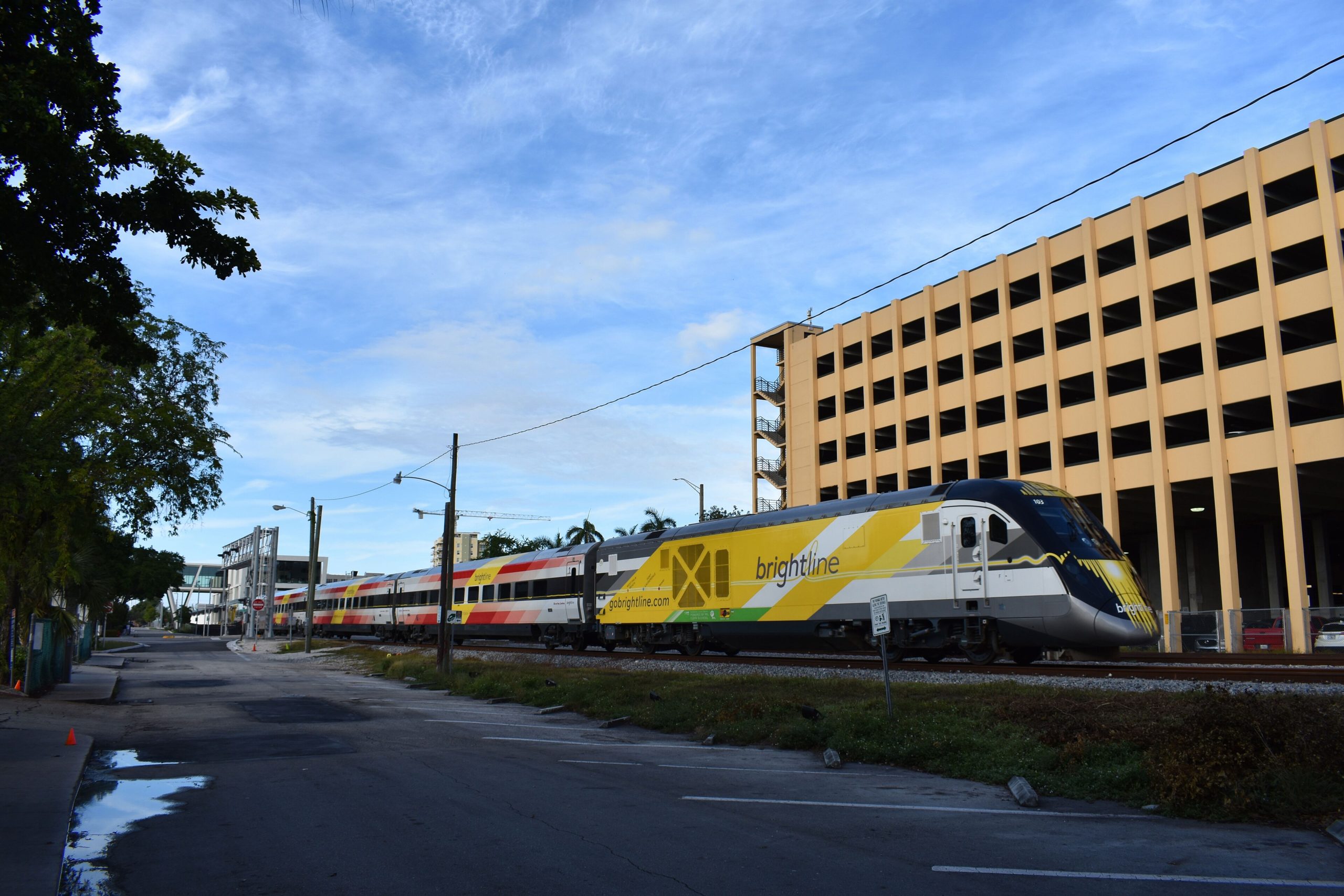
Parent holding companies of Brightline filed for Chapter 11 protection Sept. 24, 2026 — a bankruptcy process in which a company keeps operating while it reorganizes its debts under court supervision. The entity that runs the Miami-to-Orlando trains did not file; Brightline says its operations “are not impacted.”
Who filed and who did not
The petitions were filed Sept. 24, 2026, in the U.S. Bankruptcy Court for the District of New Jersey, lead case FIHPNP LLC, No. 26-20876. The debtors are “holding companies,” per the sworn first-day declaration of Patrick Goddard, Brightline Holdings’ and Brightline East’s president and the operating company’s chief executive.
Brightline Trains Florida LLC, which operates Brightline Florida’s train service, “will not file for Chapter 11 and will continue to operate in the ordinary course,” per Brightline’s release. Brightline Florida Holdings LLC and AAF Operations Holdings LLC, which indirectly hold the commuter-rail and Tampa development rights, are also not part of the case, per the release; Goddard’s declaration says Brightline West entities are not debtors either.
The declaration explains why (¶8): the cases were filed “not to address the operating business—which is not itself in chapter 11—but to address a holding company capital structure,” after results “materially lagged the Company’s original projections.” Entities managed by an affiliate of Fortress Investment Group are indirect owners of the majority of the debtors’ equity, the declaration states.
The debt and the deal
The debtor companies carry about $2.49 billion in long-term debt, including $1.12 billion in Brightline East notes and term loans of $775 million, $484 million and $112.6 million, per the declaration. Total funded debt across the debtors, operating company and other affiliates runs to roughly $7.1 billion.
To address that, the company, Assured Guaranty and an ad hoc group of mutual-fund bondholders signed a Restructuring Support Agreement, or RSA — an agreement in which key creditors commit in advance to back a restructuring plan. The RSA provides for $490 million in new financing (loans) to go to the operating company after the parent companies come out of bankruptcy, subject to the bankruptcy court’s review and approval, according to Assured Guaranty’s statement: $140 million in additional senior debt and $350 million in junior debt, per Brightline’s release, with Assured committing $70 million of the senior piece.
To fund the case, the operating company — not the bankrupt parent entities — would borrow the debtor-in-possession financing for the period of the bankruptcy case, if the court approves it: up to $257.7 million in senior secured notes, per the financing motion, reaching the parents via intercompany notes. Under the proposal, debtor BLTF Holdings would reaffirm its existing pledge of the operating company’s equity as collateral, and other debtor affiliates would give limited guarantees; they are “not guaranteeing the full loan amount,” per the motion. Assured’s statement rounds the financing to $258 million (up to $178 million from Assured), ranking pari passu — equal in rank — with the operating company’s existing senior debt.
Assured says the Chapter 11 filings “do not alter any of the payment obligations to such AG-insured OpCo senior bonds.” The operating company and some bondholders also agreed to a temporary interest-payment deferral for a fee, an option to be offered to all senior bondholders. Assured will guarantee timely interest payment either way for insured bonds — slightly over half the operating company’s senior tax-exempt debt, giving Assured “the majority debt voting position” among those bondholders, per its statement.
Brightline’s release draws a distinction on the rest of the debt: the $2.2 billion Series 2024 tax-exempt bonds and Assured’s insurance policy “remain in place” through the restructuring, while the $985 million Series 2025B commuter bonds and the $925 million and $285.7 million AAF Operations Holdings Series 2024 and 2024A bonds “remain outstanding, with no reduction in aggregate principal amounts.”
Riders and workers
“Brightline’s Miami-to-Orlando high-speed rail operations are not impacted,” the release states.
Trailing 12-month ridership stood at 3.6 million through July 2026, according to the declaration, across roughly 235 miles of track, six stations and up to 36 daily one-way trains at up to 125 mph. The company says ridership and revenue are both up 14% year to date through August versus 2025. About 520 employees work for Brightline Management, the debtor company serving as day-to-day operations manager for the operating company and other affiliates, mostly running trains, stations and hospitality services. The release does not address tickets, fares or the loyalty program.
The Tampa extension
The planned 84-mile Orlando-to-Tampa extension belongs to Brightline Tampa LLC, a subsidiary of non-debtor AAF Operations Holdings, per the declaration. Brightline’s release says the company “will continue to pursue” expansion “from the Orlando station to Tampa,” without a new route, funding source or schedule. The declaration says AAF Operations Holdings missed a bond interest payment due July 15, 2026, on bonds guaranteed by Brightline Tampa and secured partly by Tampa assets; those bonds remain outstanding with no reduction in principal, per the release.
What happens next
The bankruptcy court holds a first-day hearing Monday, Sept. 28, at 10 a.m. ET. Under the financing motion’s proposed milestones — conditions of the agreement, not requirements of law — interim approval is due within four business days of the filing, and the parents must file a plan and disclosure statement within 60 days. The plan’s effective date can be extended to no later than 365 days after the filing.
Sources and further reading
- Assured Guaranty Statement Regarding Brightline Florida Financial Restructuring
- Brightline Florida Reaches Agreement on Financial Restructuring, Securing $490 Million in New Financing Commitments and Significantly Reducing Debt
- Declaration of Patrick Goddard in Support of Chapter 11 Petitions and First Day Papers, In re FIHPNP LLC, et al., No. 26-20876 (MEH) (Bankr. D.N.J.)
- Motion of the Debtors for Entry of Interim and Final Orders Authorizing Postpetition Financing, In re FIHPNP LLC, et al.
- In re FIHPNP LLC, et al. — case dates (first-day hearing Sept. 28, 2026)