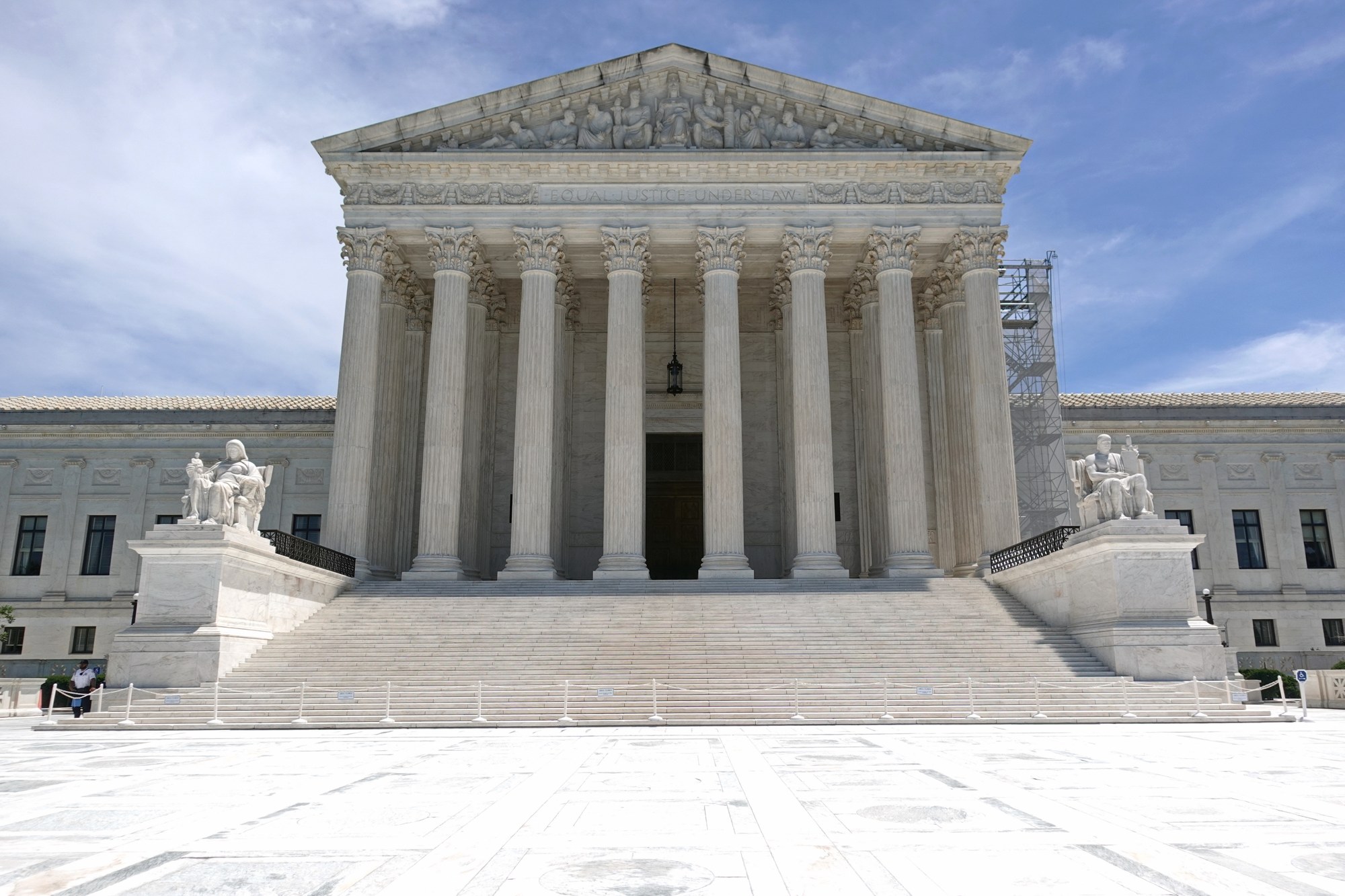
The Supreme Court on Tuesday, Sept. 29, paused a federal judgment that had limited how the Department of Homeland Security removes people to countries other than their own. The Court also agreed to decide the underlying case itself, with arguments set for its December session. The First Circuit had lifted its own hold on that judgment on Sept. 23; the Supreme Court paused it again six days later.
What the order did
According to the Court’s docket, the application for a stay “is granted,” and the district court’s Feb. 25, 2026 order and judgment “are stayed.” The Court also treated the government’s application as a petition for certiorari and granted it, in No. 26-426. The stay ends when the Court sends down its own judgment.
Justices Sonia Sotomayor, Elena Kagan and Ketanji Brown Jackson “would deny the application for stay,” the docket says. No written opinion or reasoning appears on the docket, so the Court has not said why it acted. The order does not decide whether the policy is lawful.
The justices will consider whether the district court had the power to hear the case and to grant relief covering the whole class, and whether the policy itself is lawful.
What was paused
The judgment came from Judge Brian E. Murphy of the District of Massachusetts, for a class of people with final removal orders. In it, the court declared that class members have “the right to meaningful notice before removal to any third country” and “the right to a meaningful opportunity to raise a country-specific claim against removal.” It also declared unlawful the third-country removal policy, as embodied in a DHS memo of March 30, 2025 and an ICE memo of July 9, 2025, and set that policy aside.
What the policy says
The DHS memo, issued by then-Secretary Kristi Noem, says that if a third country gives diplomatic assurances the State Department finds credible, the person “may be removed without the need for further procedures.” Otherwise officers “will not affirmatively ask whether the alien is afraid.” A person who states a fear is screened by U.S. Citizenship and Immigration Services, generally within 24 hours.
The ICE memo says the agency “will generally wait at least 24 hours following service of the Notice of Removal.” In “exigent circumstances,” it may act “six (6) or more hours after service,” provided the person has “reasonable means and opportunity to speak with an attorney prior to removal.” Such a faster removal must be approved by the DHS General Counsel, or the Principal Legal Advisor where the DHS General Counsel is not available, the memo says.
With the judgment stayed, the administration is free to follow that guidance again while the case is decided.
How it got here
- March 30, 2025: DHS issues its memo.
- April 18, 2025: The district court issues a preliminary injunction. The Supreme Court stays it on June 23, 2025.
- July 9, 2025: ICE issues its memo.
- Feb. 25, 2026: Judge Murphy enters final judgment.
- March 16, 2026: The First Circuit stays the judgment pending appeal.
- Sept. 18, 2026: A First Circuit panel upholds most of the judgment, including the notice and opportunity-to-object declarations.
- Sept. 23, 2026: The First Circuit dissolves its March 16 stay of the judgment.
- Sept. 24, 2026: Solicitor General D. John Sauer files the government’s application.
- Sept. 29, 2026: The Supreme Court grants the stay.
What each side argued
In its application, the government said, “This is the third time the government has been forced to seek emergency relief from the district court’s orders in this case,” calling third-country removals “an essential tool to remove certain aliens, including some of the worst criminal aliens.” It noted, “This Court granted relief on both previous occasions.”
The migrants’ lawyers answered that the government was trying “to relitigate the now-dissolved preliminary injunction (PI) that this Court stayed in 2025, rather than confront the fundamentally different posture of the case today,” and pointed to “the significant harm resulting from deporting thousands of longtime U.S. residents, many with no criminal history, to third countries without regard to the persecution or torture they face there.”
Reactions
DHS General Counsel James Percival said in a statement Tuesday afternoon, quoted by NBC News: “A bad day for criminal illegals and open borders activists alike.” Attorney General Todd Blanche wrote on X, as reported by The Washington Post: “This is [an] entirely lawful and a critical tool for immigration enforcement.”
Trina Realmuto of the National Immigration Litigation Alliance, which represents the plaintiffs, told NBC the action “means that people facing removal to third countries are once again at immediate risk of being sent to places where they have no meaningful opportunity to seek protection.”
The scale
The figures come from different sources and periods. NBC cited the Migration Policy Institute as saying about 15,000 people were deported to third countries in 2025, with Mexico receiving the majority. The Post, citing court records, reported that DHS has sent more than 25,000 migrants to third countries since February of last year.