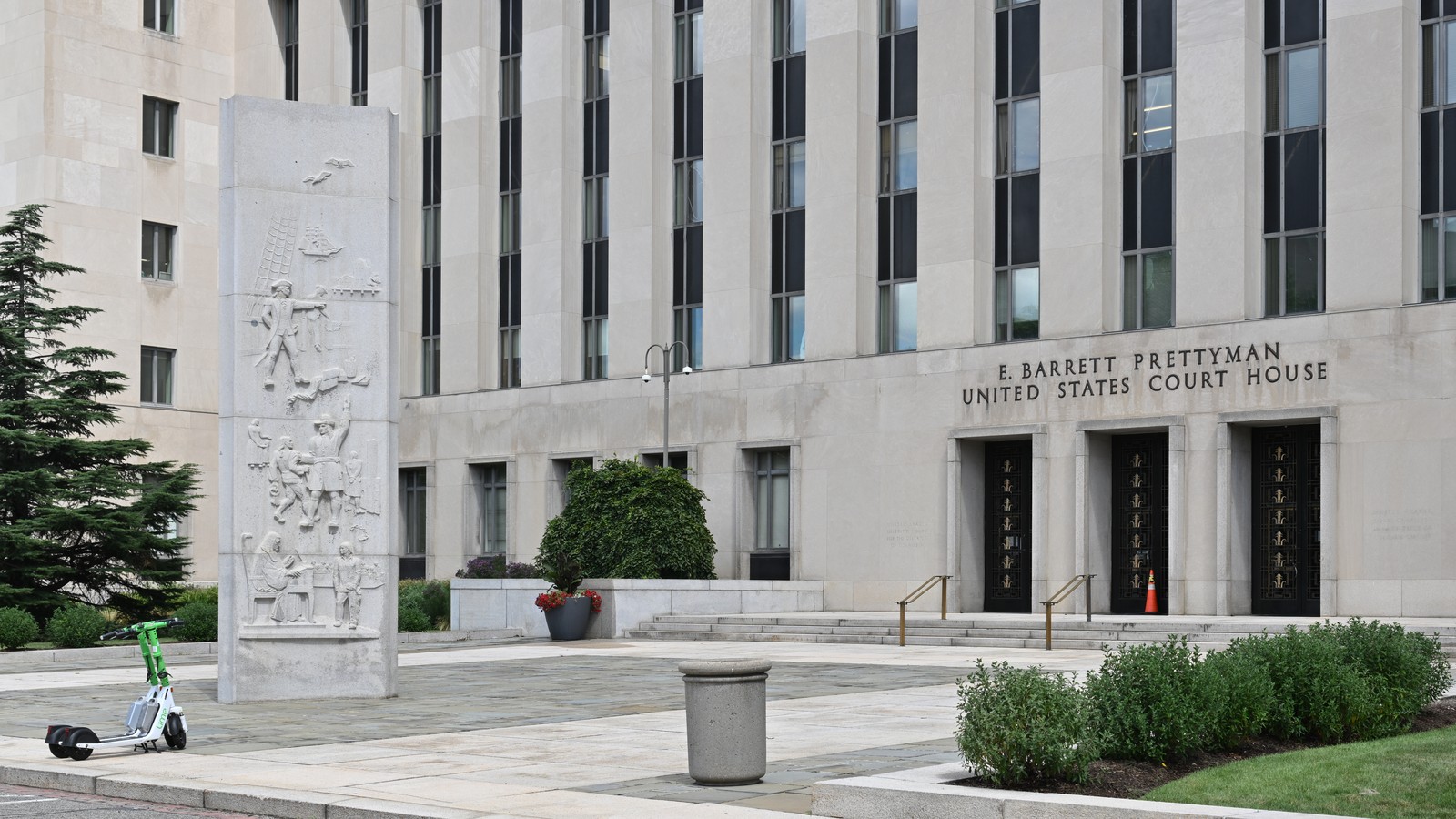
As of about 1:48 a.m. EDT Thursday, Oct. 8, 2026, two lawsuits filed Wednesday ask federal courts to stop the use of federal money for a series of television ads featuring President Donald Trump. As of that time, no court ruling on either suit had been reported. On the DNC’s docket page no judge, motion or hearing date was visible, and no White House statement on the suits themselves had been located beyond NBC’s report that the White House pointed it to Trump’s Oct. 5 post. That is a statement about that hour, not a claim that nothing has happened since.
The Democratic National Committee (DNC) sued first, in the U.S. District Court for the District of Columbia. The Associated Press reported on Oct. 7 that “a coalition including the nonpartisan watchdog Common Cause filed a separate lawsuit” later the same day. What follows about what happened, and why the DNC says it was unlawful, is the DNC’s allegation, not a finding. No response from the administration appears on the DNC’s docket page.
The case the DNC filed
The case is Democratic National Committee v. Trump, Civil Action No. 1:26-cv-3506, filed Oct. 7. The defendants are Trump in his official capacity, the White House Office, the Office of Management and Budget (OMB) and the Department of Homeland Security (DHS). The DNC brings two kinds of claims: under the Administrative Procedure Act (APA) against OMB and DHS, and what lawyers call “ultra vires” claims against Trump and the White House Office. “Ultra vires” means acting beyond legal authority. The complaint itself says the President and the White House Office “are not agencies for purposes of the APA,” and the APA count is brought only against OMB and DHS.
The complaint’s opening paragraph says Trump “personally directed” the activity, the White House Office “crafted” the campaign, OMB “shifted $20 million to pay for it,” and U.S. Customs and Border Protection (CBP), a part of DHS, “carried it out.”
What the complaint says happened, in order
According to the complaint, the White House Office has made campaign-style videos since at least August 2026. It says Trump then decided to air ads on television paid for with public money and personally told OMB Director Russ Vought to find a way to fund them. It says OMB approved $20 million of CBP funds on Sept. 19, placing them in a budget line it prints as “Comme[mo]rative Events,” and that on or about Sept. 20 the administration contracted with a marketing firm, LMD Agency, for a $20 million “National Media Campaign.” The complaint says a second firm, LMO Advertising, bought the airtime.
The complaint says the money comes from the One Big Beautiful Bill Act (Pub. L. No. 119-21). It reads the funds as apportioned to line item 6043, with the spend plan to be finalized under sections 90001, 90002 and 90004 of that law. It describes section 90004 as apportioning funds for CBP border security technology and surveillance upgrades and for “commemorating efforts and events related to border security.” AP separately reported that the Homeland Security money tapped for the ads comes from a $175 million package Congress gave the department for immigration enforcement.
The complaint describes five ads, each of which it says ends with the words “Paid for by the U.S. Government.” Per the complaint:
- Sept. 23: The first ad, titled “The Country He Loves” and nicknamed the “Love Me Ad” after the song it uses, runs through images of Trump over audio of him criticizing communism and socialism. The complaint says the White House’s YouTube channel posted this ad in full on Sept. 11 without the government notice, weeks before it aired on television.
- As early as Sept. 24: The “Maduro Ad” focuses on the U.S. military operation to capture Nicolás Maduro in Venezuela. The complaint says it has aired in multiple versions, from 30 to 60 seconds long.
- Weekend of Sept. 26 and 27: The “Final Battle Ad” shows Trump walking down a hallway while a voiceover says, “This is the final battle.” The complaint says it is “nearly identical” to an ad his campaign paid to air on Jan. 12, 2024. It names two differences: the 2024 ad ends with a graphic reading “Join President Trump’s Fight for America” followed by his 2024 campaign logo, while the new one carries the government disclosure.
- Sept. 27: The “Mount Rushmore Ad” shows Mount Rushmore in footage the complaint says was taken during a July 3, 2026, speech by Trump, and uses remarks from him.
- Sept. 30: The “American Military Power Ad” is built around the Iran war.
AP’s account of the count differs from the complaint’s. AP wrote that “on Tuesday, a fifth ad began airing” with a government-paid notice and that it promoted Trump’s military actions to capture Maduro. The complaint dates the Maduro Ad to as early as Sept. 24 as its second ad, says the fifth is the Sept. 30 ad, and says the Maduro Ad aired again on the morning of Oct. 6. It is not clear whether AP’s “fifth ad” is a version of the Maduro Ad rather than a new one.
The complaint says that between Sept. 23 and Sept. 27 the ads aired nearly 90 times on national networks and at least 2,311 times on local stations. It cites the tracking firm iSpot.TV for an estimate of $337,000 on national placements and AdImpact for $1.4 million on local airings. It also names networks including ABC, NBC, MS Now, CBS, CNN, Fox News and Newsmax, and programs such as “Meet the Press” and “Dancing with the Stars.”
The complaint then turns to Oct. 5. It says Trump posted that he would no longer use federal funding and would instead have MAGA Inc., a super PAC, pay for the ads. It says a White House official similarly said, “MAGA Inc. will pay for the . . . ads moving forward.” The complaint alleges the “Maduro Ad” still aired on the morning of Oct. 6 with the government disclosure, the “Final Battle Ad” aired that evening during “Dancing with the Stars,” and the same ad aired again on Oct. 7 during “Fox & Friends.” It alleges that “at least $100,000 in public funds has been spent” since the pledge, and that “several millions of dollars” of the $20 million had not yet been spent.
On reimbursement, the accounts use different wording. The complaint says Trump “explained that he would not reimburse the federal government for any federal funding already spent,” in its account of events after the Oct. 5 post. AP reported that on Oct. 6 Trump “hasn’t committed to reimbursing any money that has already been spent, telling reporters ‘we’ll decide.'” NBC News reported that he did not say whether the government would be reimbursed. These may refer to different remarks.
The complaint also alleges the administration has more ads ready. It says there are “at least 13 campaign-style political ads” in a Dropbox account controlled by LMD Agency, and that the administration “has indicated that the propaganda ads will continue and intensify as Election Day approaches.”
The law the complaint relies on
The complaint quotes a provision of the Consolidated Appropriations Act for fiscal year 2026 (Pub. L. No. 119-75, section 718): “No part of any appropriation contained in this or any other Act shall be used directly or indirectly, including by private contractor, for publicity or propaganda purposes within the United States not heretofore authorized by Congress.”
In its paragraphs 15 to 18, the complaint says the Government Accountability Office (GAO) guidance covering this kind of ban identifies three activities: self-aggrandizement, covert propaganda and purely partisan materials. As the complaint quotes that guidance, “purely partisan materials” are those “designed to aid a political party or candidate.” The complaint argues each ad is “purely partisan,” “self-aggrandizement,” or both. These are the DNC’s characterizations.
The complaint also cites the Antideficiency Act and the Purpose Statute. NBC News described them on Oct. 7 as bars on spending money Congress has not appropriated and on using funds for purposes other than those Congress approved. The complaint further argues that the $20 million was meant for something else. It says a House report described the commemorative-events spending as for “Line-of-Duty death memorials, Department or agency anniversaries, and commendation ceremonies.” The complaint argues that the “commemorating” language in section 90004 does not cover these ads.
What the DNC asks the court to do
The DNC asks the court to declare that Trump, the White House Office, OMB and DHS “acted unlawfully by developing and airing the propaganda ads using Congressionally appropriated funds.” It also asks for declarations that the actions were ultra vires and were arbitrary, capricious or otherwise not in accordance with law.
It asks the court to “Enjoin President Trump, the White House Office, OMB, and DHS from continuing to use appropriated funds to develop and air propaganda ads,” and to award costs and attorneys’ fees. The list also ends with a request for any other relief the court deems appropriate.
The named items in the DNC complaint’s relief list do not specifically ask the court to order repayment of money already spent, or to undo the $20 million transfer or the contract. The second suit’s complaint asks the court to vacate OMB’s Sept. 19 apportionment and DHS’s contract and to order steps to recover funds outlaid but not yet expended (see the section on the second lawsuit).
Why the DNC says it can sue
A party suing in federal court has to show it is harmed. The complaint pleads the DNC’s injury in its fourth paragraph, which says the use of public money “deprives the DNC of a fair electoral process by adding public funds to the resources available to support Republican candidates.”
It relies on a 2026 Supreme Court decision, Bost v. Illinois State Board of Elections, for the point that candidates have an interest in a fair election process, and on National Republican Senatorial Committee v. FEC for the close relationship between parties and candidates. It also alleges a competitive harm. Its argument is that when taxpayer money pays for the ads, MAGA Inc. keeps its own money for other races. In one place the complaint says that super PAC has spent more than $25 million this cycle; in another it says the group has reported spending $30 million on the U.S. Senate race in Texas alone. Whether a court accepts these theories has not been decided.
DNC Chair Ken Martin said in a statement, as AP reported, that Trump is misusing taxpayer dollars in “a last-ditch attempt to save Republicans in November.” AP and NBC each quoted him as adding: “Americans deserve better than to have their hard-earned tax dollars used for Trump’s illegal schemes.”
The second lawsuit
The second suit, Common Cause et al. v. Department of Homeland Security, is Case No. 1:26-cv-08882 in the U.S. District Court for the Southern District of New York, filed Oct. 7, 2026; its complaint runs 41 pages. The plaintiffs are Common Cause, Robert Hunter (whom the complaint describes as the Democratic Party’s nominee for Alabama House District 28), SEIU Local 32BJ and Empire State 32BJ SEIU PAC. The defendants are DHS and its Secretary, Markwayne Mullin; OMB and its Director, Russell Vought; the Executive Office of the President; and White House Chief of Staff Susie Wiles, each in an official capacity. The complaint lists lawyers from Democracy Forward, Campaign Legal Center Action and Public Integrity Project Action. AP described the filing as made by Democracy Forward on behalf of Common Cause, a New York public employee union and a Democratic state legislative candidate in Alabama; Democracy Docket described the plaintiffs as Common Cause, a Democratic state legislative candidate and two SEIU groups. Democracy Docket noted that Democracy Forward represents the plaintiffs and that Democracy Docket’s founder, Marc Elias, chairs Democracy Forward’s board.
The second complaint centers on how the money was found. It alleges that OMB’s Sept. 19 apportionment shifted funds appropriated to DHS, allocating an additional $20 million for commemorative events related to border security, a category it says Congress included to honor officers who died in the line of duty, mark department anniversaries and honor victims of crime, and that DHS signed a $20 million contract the next day. Its prayer for relief asks the court to declare the use of public funds for the ads illegal and unconstitutional; to vacate and set aside OMB’s Sept. 19 apportionment and DHS’s contract with LMD Agency; to temporarily restrain, stay and preliminarily and permanently enjoin the use of appropriated funds for the ads; and to order the defendants to take all available steps to recover funds that have been outlaid but not yet expended by any entity that contracted with DHS. Democracy Docket also reported that the complaint says the ads had aired nearly 14,000 times, generating an estimated 1.39 billion impressions and costing about $12.6 million as of Wednesday morning.
Omar Noureldin of Common Cause told AP the group does not trust that Trump will stick to outside money: “We are not going to take the president’s word for it.” He told NBC News the group wants to ensure “that no president, regardless of party, can hijack public funds to fund political self-promotion without congressional approval.” Skye Perryman, who leads Democracy Forward, told AP that taxpayers “shouldn’t have to foot the bill for the president’s politics.”
What the White House and others have said
The White House’s own Sept. 25 release, “Presidential Public Service Announcements Are Nothing New,” defends the ads. It says: “The announcements are very clearly not campaign ads; President Trump is not on the ballot and there is no call to action.” It adds: “When prior Administrations utilized the airwaves, it was called ‘public education.’ When this Administration promotes pride in our country, many of those same voices call it ‘propaganda.'” And it closes: “Patriotism isn’t partisan. These public service announcements are unapologetically American, clearly disclosed, and aimed at the country — not a line on the ballot.”
AP and NBC reported the same defence. AP wrote that the White House described the ads as public service announcements akin to what past administrations have done to promote various policies; AP then added its own observation that the recent ads differ from many past public service announcements because they are not aimed at helping members of the public benefit from specific government programs. NBC reported that the White House called the ads “clearly not political” and said they were about “reminding Americans to love their country.” Democracy Docket reported the administration’s description of the ads as “educational and unapologetically patriotic.”
The complaint quotes the release as well, and disputes its characterization of the ads. (In its quotation, the complaint renders “there is no call to action” as “there is not call to action”; the release text reads “no.”) The complaint also quotes a White House official as saying the ads are “reminding viewers that there has been a lot done during the first year and a half.”
AP reported that the ads have faced bipartisan backlash, and NBC reported criticism from lawmakers on both sides of the aisle, many of whom questioned their legality. AP reported that Trump called the ads “positive promotion for our Great U.S.A.” NBC reported that Federal Communications Commission Chair Brendan Carr said the week before the suits were filed that the ads did not merit FCC review, saying they were not “anything at all out of the ordinary.”
Asked by NBC whether the ads still running were paid for before or after Trump’s pledge, the White House would not say. Asked about the lawsuits, it pointed NBC to Trump’s Truth Social post.
The money
The figures come from different trackers, dates and scopes:
- The complaint cites iSpot.TV for $337,000 in national placements and AdImpact for $1.4 million in local airings, for Sept. 23 to 27.
- NBC reported that AdImpact estimated at least $10 million had been spent through Monday, Oct. 5.
- AP reported on Oct. 7 that the ads had cost more than $12 million to run, according to AdImpact, and that DHS awarded a $20 million contract.
- The second complaint, per Democracy Docket, puts the cost at about $12.6 million as of Wednesday morning, Oct. 7.
NBC reported that CBP leadership was cut out of the decision to run the ads.
AP and NBC each cite a person familiar with the campaign who said ad buys placed before Trump’s pledge will end the week of Oct. 5, after which outside groups will pay. Neither report names the person.
What is not known
- Judges and hearings: The CourtListener docket page for the DNC case, whose own last-updated stamp reads Oct. 7, 5:16 p.m., lists only the complaint and its attachments. No judge, motion or hearing date was visible, and the page says it may not be up to date. No docket page for the New York case had been located as of about 1:48 a.m. Thursday; its complaint asks for a temporary restraining order, but whether any motion has been filed or any judge assigned was not found.
- Whether the pre-pledge buys have ended: The only statement is from an unnamed person, and the White House would not say how the ads still airing were paid for.
- Government responses: NBC reported that DHS and OMB did not immediately respond to requests for comment, and that when asked about the lawsuits the White House pointed it to Trump’s Oct. 5 post. No substantive statement from DHS or OMB on the lawsuits had been found as of about 1:48 a.m. Thursday.
- More ads: The complaint says at least 13 ads exist and more may air before the November election. Whether and when any of them will air has not been stated.
- The ad count: AP calls an ad that began airing on Oct. 6 the fifth; the complaint counts differently, as described above.
- Legality: AP reported that legal experts have suggested the ads run afoul of the federal propaganda statute, without naming them. No court has been reported to have ruled, and the claims remain allegations. No GAO finding about these ads has been reported.