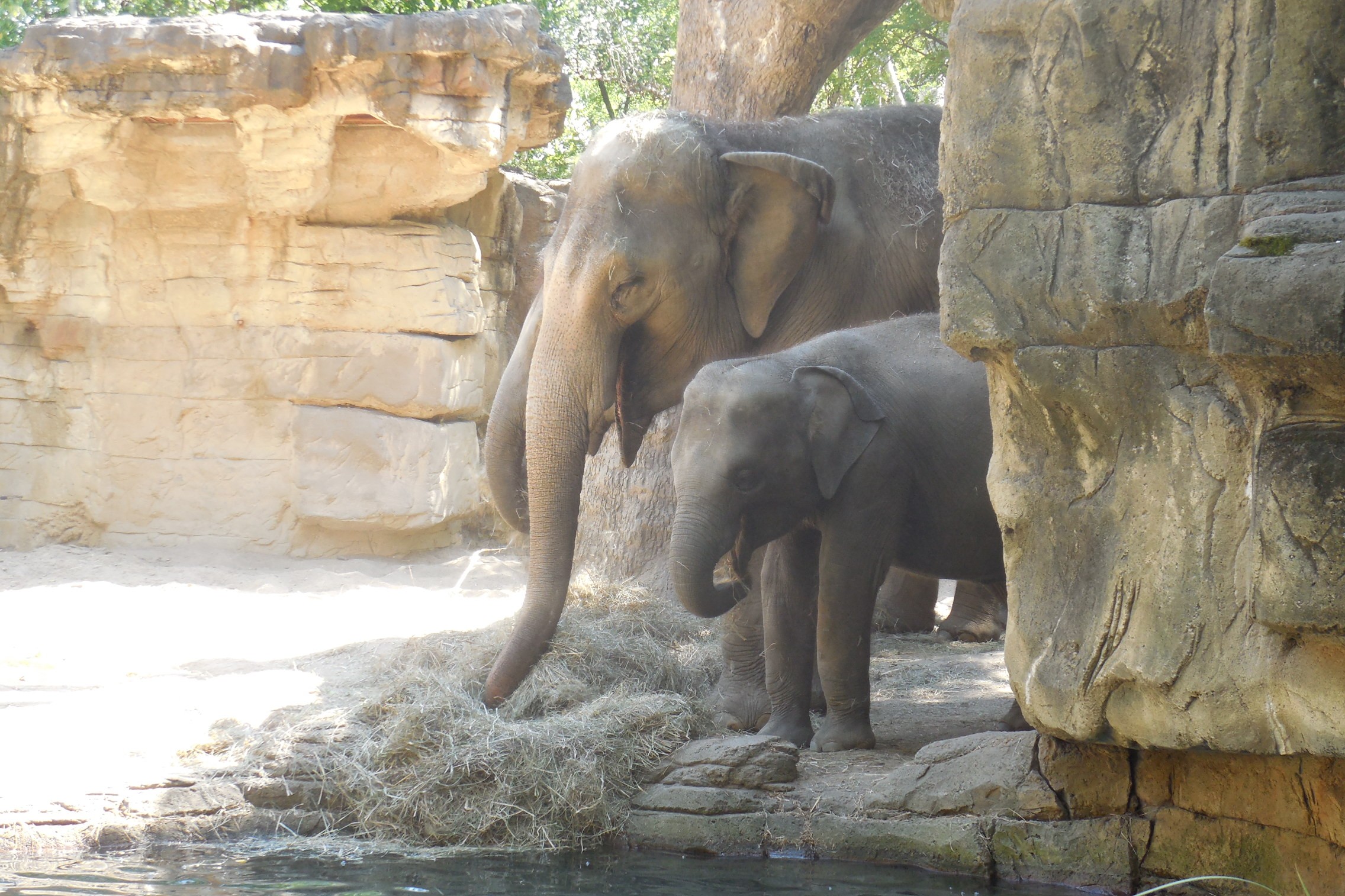
As of Thursday, Oct. 8, 2026, the Saint Louis Zoo said that Jet, an Asian elephant calf born Nov. 23, 2024, received the third dose of an experimental mRNA vaccine against elephant endotheliotropic herpesvirus, known as EEHV, on Sept. 30.
The zoo has not reported any result that shows the vaccine protects Jet.
What the zoo announced
In a release posted Thursday, the Saint Louis Zoo said Jet “is the first Saint Louis Zoo elephant to receive a breakthrough mRNA vaccine” for EEHV. According to the release, “Jet received the third dose of a multi-round vaccine on Wednesday, Sept. 30.”
The zoo said the vaccine was developed by virologists at Baylor College of Medicine, and that Jet “is one of the world’s first Asian elephant calves to receive” it. The release says he “is doing well post-vaccination.”
Dr. Kari Musgrave, the zoo’s director of animal health, said in the release: “This vaccination is a critical step forward in the decades-long effort to protect Asian elephants from EEHV.”
The zoo describes Jet as the first Asian elephant born there through artificial insemination. His mother is Jade.
What EEHV is and why the zoo cares
According to the zoo, EEHV was discovered in 1995 and affects both wild elephants and elephants in human care. Young elephant calves, the release says, are “especially vulnerable, facing a 60-80% mortality rate.” St. Louis Public Radio, in its own report on Thursday, said calves face “reported mortality rates of 60% to 80%.”
The Houston Zoo, in a July 28, 2026 release, described EEHV as a virus that “can cause a rapidly progressing hemorrhagic disease in young elephants.” It said the virus “remains the leading cause of death in juvenile Asian elephants in North American zoos.” The same release said that “Early detection, aggressive treatment, and continued research have significantly improved outcomes, but prevention has remained a critical unmet need.”
The zoo says Kenzi, a 6-year-old Asian elephant that lived there, died of EEHV in 2018, and that she was “the only Saint Louis Zoo elephant to pass away from the disease.”
The first Journal of Virology paper’s summary says EEHV causes fatal hemorrhagic disease in 65% of infected juvenile Asian elephants and that fewer than 50,000 Asian elephants remain worldwide.
How the vaccine was developed
In general, mRNA vaccines give cells instructions to make a piece of a virus so the immune system can learn to recognize it. The first Journal of Virology paper on the elephant vaccine says it encodes four EEHV1A proteins involved in the virus’s entry into cells, called gB, gH, gL and gO, with each mRNA individually encapsulated in lipid nanoparticles.
The zoo’s release says researchers at Baylor College of Medicine and veterinarians from the Houston Zoo began developing an mRNA EEHV vaccine in 2009. Adult elephants at the Houston Zoo received the first doses in 2024, and the Saint Louis Zoo says “zoos throughout North America have adopted the vaccine on an experimental basis over the past two years.”
The Houston Zoo said in June 2024 that Tess, a 40-year-old Asian elephant there, received the first dose on June 18 of that year. That announcement said the vaccine’s effectiveness would be measured by evaluating antibody levels in her blood while monitoring for side effects such as injection site swelling or allergic reaction. It also said preclinical trials had given “positive preliminary results.”
What the published studies report
The Houston Zoo and Baylor College of Medicine described two papers in the Journal of Virology in their July 28, 2026 release, which calls them the first peer-reviewed publication describing an mRNA vaccine given to elephants. Both papers are open access. No independent expert is quoted in the sources cited here; the authors include Baylor’s Dr. Paul D. Ling.
The first paper reports a trial in nine Asian elephants: three that already had antibodies to EEHV1A and six that did not. Animals received up to four 400-microgram intramuscular doses three weeks apart, with blood samples taken through day 192. The authors report that in some of the elephants without prior antibodies, antibody levels against a viral protein complex reached up to 50% of the levels seen in elephants with prior exposure. They wrote that “No adverse side effects, including anaphylaxis, were observed following the initial vaccination” and that one elephant developed mild swelling at the injection site after the booster dose, which “self-resolved within 4 days.” Blood cell counts and serum chemistries stayed within normal ranges.
The second paper describes two juvenile male elephants, aged 6 and 7, that moved from Dublin Zoo to the Cincinnati Zoo and Botanical Garden in November 2023 and tested negative for EEHV1A antibodies. Both received an experimental vaccine in October 2024 and a booster in November. In February and March 2025 they developed EEHV1A viremia, meaning the virus appeared in their blood, with viral loads below 6,000 viral genome equivalents per milliliter. The paper says both had no hematological abnormalities and no clinical signs, and the viral loads resolved without treatment. It also says antibody titers started to decline by day 102 after the booster. Its abstract says “the extent to which this vaccine confers protective immunity remains an open question” and that the findings “suggest that immunity generated against the EEHV proteins … can confer protective immunity and mitigate disease severity.” The abstract describes two animals and no comparison group, so two recoveries cannot show how often the vaccine protects.
Dr. Paul D. Ling, a professor at Baylor College of Medicine whose partnership with the Houston Zoo dates to 2009, said the studies “provide the first published evidence that vaccination can induce protective immune responses against EEHV and may prevent the severe disease associated with primary infection.” He added: “While additional research is still needed, this represents a significant step toward protecting vulnerable elephant calves from a disease that has challenged the elephant community for decades.”
The Houston Zoo and Baylor release also said “the work is far from complete.” Researchers are developing next-generation EEHV vaccines for Asian elephants and exploring approaches for African elephants.
What the Saint Louis Zoo says it will do
The zoo said Jet currently has maternal antibodies, “but they will steadily decline in the next year or two.” The vaccine, it said, “will provide additional protection until he has natural exposure to the virus and elicits his own immune response.” That is the zoo’s expectation; it has not reported antibody results.
The zoo’s animal care and veterinary teams “will continue to closely monitor Jet and regularly assess his post-vaccination antibody levels through blood testing.”
The zoo also pointed to its other EEHV work. In 2021 the zoo joined North American elephant facilities in EEHV research with its own testing laboratory, which it says can test elephant blood samples “within hours of collection.” Its animal health team also maintains a plasma bank that “can be used to help treat EEHV cases at zoological institutions across the country.”
What is not known
Neither the zoo nor St. Louis Public Radio has reported Jet’s antibody results. The zoo’s release calls Jet’s Sept. 30 dose “the third dose of a multi-round vaccine.” St. Louis Public Radio calls it his “third and final dose of the vaccination series,” attributing that to the zoo. The release does not say whether more doses are planned or what Jet’s schedule is; the first paper’s trial used up to four doses three weeks apart in other elephants. The zoo has not said how long any protection from the vaccine would last.
The published studies concern EEHV1A, one strain of the virus, and the sources cited here do not report protection against other strains.
The papers’ safety observations come from nine elephants in the first trial and two in the second; they are not a safety finding for Jet’s doses or a long-term safety assessment. The 2024 Houston Zoo announcement said preclinical trials showed the vaccine could induce antibodies “with no adverse side effects,” and the Saint Louis Zoo says Jet is doing well.
The zoo describes the vaccine’s use as “on an experimental basis,” and its release does not say whether any regulator has approved it.
Sources and further reading
- Evaluation of a multiantigen mRNA vaccine against EEHV1A in Asian elephants (Journal of Virology)
- First evidence of clinical protection from an EEHV1A mRNA vaccine in naturally infected juvenile elephants (Journal of Virology)
- Houston Zoo and Baylor College of Medicine: first evidence of protection from an EEHV mRNA vaccine
- Breakthrough Vaccine Helps Protect Saint Louis Zoo Elephant Calf Jet from Deadly Virus