Two American economists, Robert E. Hall of Stanford University and Michael Woodford of Columbia University, won the 2026 Nobel economics prize on Monday, Oct. 12. They were honored for research that rebuilt the economic models behind central-bank and government policy so that they start from how households and companies make decisions.
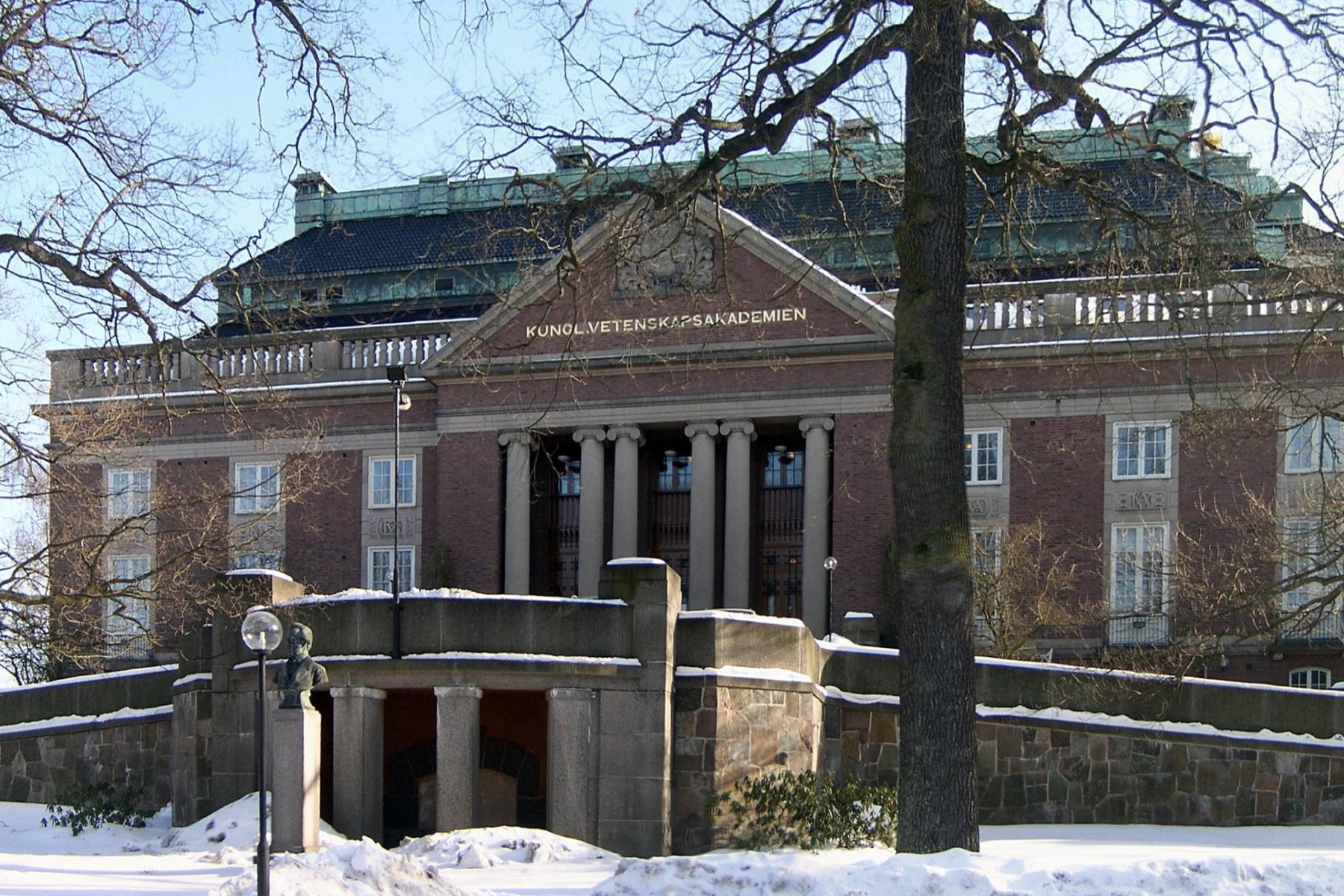
The Royal Swedish Academy of Sciences said it honored them for microeconomic foundations of macroeconomic stabilization, meaning policies meant to even out the economy’s swings, such as peaks and troughs in unemployment, growth and inflation. The Academy’s page calls the award the Sveriges Riksbank Prize in Economic Sciences in Memory of Alfred Nobel, and AP calls it the Bank of Sweden Prize. It was established in 1968 by Sweden’s central bank and was not one of the original prizes Alfred Nobel set up, and AP noted that purists say it is technically not a Nobel Prize. It is presented alongside the other Nobel Prizes. The prize carries 12 million Swedish kronor, about $1.2 million, which the Academy’s press release says is to be shared equally between the two laureates.
Only three women have won the economics prize, the most recent being Claudia Goldin in 2023, according to Reuters and AP. Monday’s announcement was the last of the 2026 prizes, following medicine, physics, chemistry, literature and peace, which were announced the week before.
Who won and what for
Hall was born in 1943 in Palo Alto, California, and the Academy’s page lists him as a professor at Stanford. Ynetnews describes him as an emeritus professor and a senior fellow at the Hoover Institution. He is 83, according to Reuters. Ynetnews reported that he chaired the National Bureau of Economic Research committee that dates U.S. business cycles, and Reuters reported that he has advised the U.S. Treasury, the Justice Department and the Federal Reserve Board.
Woodford was born in 1955 in Chicopee, Massachusetts, and is a professor of political economy at Columbia. He is 70, according to Reuters. Ynetnews described him as known for New Keynesian economics, a strand of Keynesian economics, and for a 2003 book, Interest and Prices, on the theory of monetary policy. Woodford said by phone from New York that the prize was a tremendous honor and a surprise, AP reported.
Both men earned their doctorates at the Massachusetts Institute of Technology, according to the Academy’s press release.
What the work is, in plain words
In the Academy’s description, older macroeconomic models leaned on statistical links between big totals such as inflation, output and consumption. Hall and Woodford rebuilt those models from the ground up, starting with the decisions of households and firms and showing how those choices add up to what the whole economy does. That is what the Academy means by microeconomic foundations.
That matters because people look ahead. A family deciding how much to spend, or a business deciding what to charge, is guessing where incomes, prices and interest rates are going. The Academy said that when households and firms are forward-looking, well-timed fiscal and monetary policy measures can reduce the peaks and troughs of the economy.
AP reported specifics on each man’s work. In a 1982 paper with Frederic Mishkin, Hall found that roughly 80 percent of households made spending decisions based on their expectations of the future, while the rest lived hand to mouth. AP also reported that Hall’s work found forecasting future consumer spending to be virtually impossible, and that economist Olivier Blanchard said this is not good news for forecasters or policymakers. AP reported that Woodford showed businesses set prices based on where they expect interest rates to go.
The 1970s problem
The Academy’s background is that Keynesian models, the school of thought about how governments can steady the economy, seemed to fail during the oil crises of the 1970s, when high inflation came without lower unemployment. Many economists came to doubt stabilization policy. The Academy said the laureates’ work helped revive the case for it.
AP reported that Timo Boppart, a member of the prize committee, described the Keynesian recipe as one that worked well until it did not. AP also reported that Woodford, unlike traditional Keynesian models, recommended raising interest rates to cool inflation after energy price shocks.
Expectations, forward guidance and interest rates
Two ideas from this work show up in everyday economic news. The first is expectations. Reuters reported that Woodford used Hall’s 1978 consumption paper. The Globe and Mail described that paper as arguing that households’ spending closely tracks what they expect.
The second is forward guidance, which means a central bank signaling in advance the likely path of its interest rates. Reuters reported that Woodford told a news conference that forward guidance helped bolster monetary policy from 2009. He also said, according to Reuters, that policymakers should not treat stabilization as an exercise independent of what people understand.
The Federal Reserve’s own statement of Aug. 9, 2011 shows the kind of signal this means, though it is not presented here as the laureates’ work. The Fed kept its federal funds target range at 0 to 1/4 percent and said economic conditions were likely to warrant exceptionally low rates at least through mid-2013. Clear communication of that sort, in the framing AP and Reuters give to forward guidance, is meant to steer what households and firms expect.
Why it matters now
Reuters wrote that central banks are dealing with an energy shock tied to the Iran war, coming after the surge in inflation in 2022.
John Hassler, the chair of the prize committee, said, according to the Academy’s press release and AP, that the work gives a stable theoretical foundation for models now used by central banks and governments around the world, and leaves them better equipped to deal with shocks such as energy crises or sudden changes in household consumption.
Reuters described Fed Chair Kevin Warsh as a skeptic of forward guidance. AP, in a report carried by Fortune, said Warsh has said the trend toward forward guidance went too far and that he is trying to scale back how much the Fed talks about its thinking and intentions.
What is not known
The Academy’s background page discusses Hall’s 1978 article, the 1982 article by Hall and Frederic Mishkin and Woodford’s 2003 book, and does not rank which carried the most weight. Stanford and Columbia published releases on Monday with statements from their presidents, Jonathan Levin and Jennifer L. Mnookin.
What comes next
The laureates will receive their prizes at the Nobel ceremony on Dec. 10, the anniversary of Alfred Nobel’s death in 1896, according to AP.