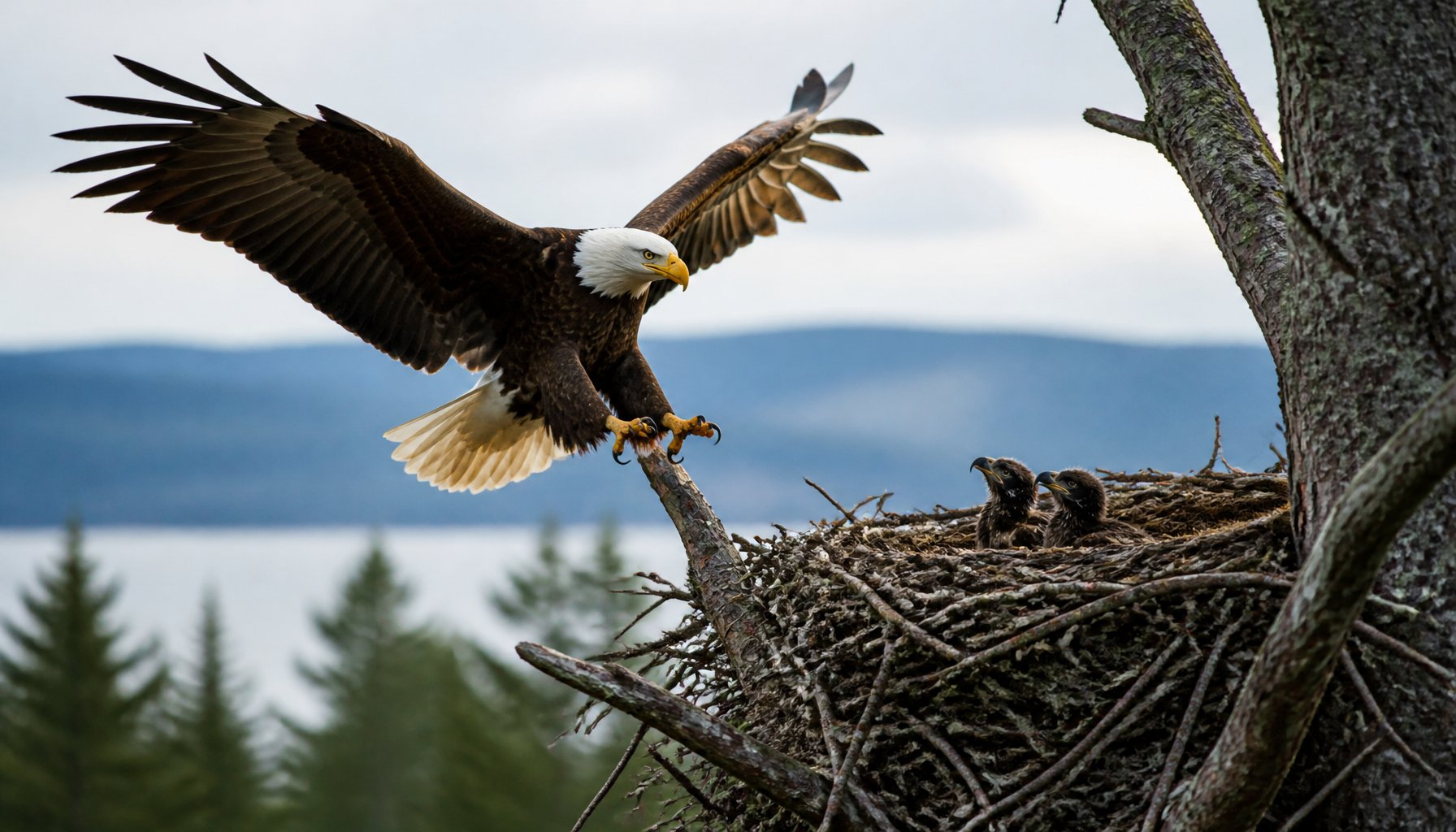
Update — August 13, 2026: A necropsy found Jackie had a blood clot in her wing and kidney plus organ abnormalities, though veterinary teams could not determine the primary underlying cause despite consulting specialists nationwide. The article previously reflected no cause had been named and the center had not said what else was still under consideration, which has since changed.
Jackie died in the overnight hours of August 9, 2026, after more than three weeks of treatment, the California Department of Fish and Wildlife said. This article covers her illness and care up to that point; the account of her death is in a separate article.
Jackie, the bald eagle who spent years captivating fans of a livestreamed nest near Big Bear Lake, California, had been doing better. Then, on August 3, 2026, her veterinary team said her blood test numbers had gotten worse again — and they still could not say what was making her sick.
Jackie was found grounded and unable to fly near Big Bear Lake’s north shore on July 17, 2026, and was transported to the Ojai Raptor Center in Ojai, California, the next day, July 18. Friends of Big Bear Valley (FOBBV), the nonprofit that runs the eagle-nest camera watched by fans across the country, said a brief clash with two younger eagles had preceded her collapse. Vets later found no physical injuries from that fight — instead, they discovered severe anemia and inflammation affecting her kidneys, and they believe she was already sick before the confrontation grounded her.
Key facts
- Found grounded near Big Bear Lake on July 17, 2026; taken to the Ojai Raptor Center on July 18
- Main problem: severe anemia, measured by “packed cell volume” (PCV)
- Healthy PCV is above 30%; Jackie’s was 8% before a transfusion, rose to 16–17%, then fell to 13% by August 3, below 10% by August 7 and below 6% on Saturday, August 8, before rising to 9% on Sunday, August 9
- Received a blood transfusion from Spirit, a bald eagle at the California Living Museum
- Cause of illness still unknown; several likely culprits already ruled out
- Estimated age: about 14 (bald eagles typically live 15–28 years in the wild)
What’s actually wrong with her
The core problem is anemia — not enough healthy red blood cells. Doctors track this with a measurement called packed cell volume, or PCV, which shows what percentage of the blood is red blood cells. A healthy eagle should read above 30%.
Jackie’s PCV was measured at 8% before the transfusion, improved to 16–17% by late July, then dropped again to 13% as of the August 3 update, below 10% by August 7 and below 6% on Saturday, August 8, before rising to 9% on Sunday, August 9, according to the center’s updates as reported by ABC7 — meaning her anemia has worsened, not resolved. Vets had said they wanted to see that number climb back toward the 30% mark and hold there before they would call it a real turn toward recovery. It never did.
Jackie was estimated to be about 14 years old; bald eagles typically live 15 to 28 years in the wild.
To keep her alive, she received a blood transfusion using blood donated by Spirit, a resident bald eagle at the California Living Museum in Bakersfield.
Vets have ruled out several likely culprits: lead poisoning, zinc poisoning, rodenticide (rat poison), a fungal lung infection called aspergillosis, and chronic kidney disease. That last one is a different question from the kidney inflammation doctors noted early on — the inflammation was a symptom they were treating, not a diagnosis they were confirming. A CT scan showed no obvious signs of cancer or metal objects, and X-rays turned up no fishing hooks or sinkers.
Even so, the center said in its August 3 update that the actual cause remains unknown, and that additional advanced diagnostic tests — including expedited lab work — were underway. Those tests came on Wednesday, August 5: the center said Jackie underwent a contrast CT scan and a bone marrow biopsy, recovered well from the anesthesia, and is back in her recovery enclosure receiving supplemental oxygen. On Friday, August 7, the center said those procedures had provided “important new information” but not a complete picture: her blood values had declined again, with the PCV falling below 10%, and she was back in intensive care on oxygen therapy with around-the-clock monitoring. Further specialized testing, including heavy-metal testing, is still pending, and the veterinary team is consulting specialists at the University of Georgia, UC Davis and elsewhere before deciding the next steps. In an update on Sunday, August 9, reported by ABC7, the center said “the past 24 hours have been incredibly difficult”: her PCV had fallen below 6% on Saturday and risen to 9% on Sunday, a small improvement that leaves the reading critically low, and it called her condition “unstable” and “extremely serious.” The center said nine veterinarians are now involved along with representatives of the U.S. Fish and Wildlife Service and the California Department of Fish and Wildlife. A necropsy performed after Jackie’s death by San Diego Zoo Wildlife Alliance pathologists found she had a large blood clot in her wing and kidney, along with liver, kidney and lung abnormalities and an inadequate bone marrow response; despite consulting specialists nationwide, veterinary teams were unable to determine the primary underlying cause of her illness.
Along the way there were real signs of hope: Jackie moved out of intensive care — where she had needed oxygen therapy — into a regular hospital unit in late July, was eating on her own, and had become more alert and “feisty” during feedings, according to updates the center posted. The center cautioned at the time that leaving intensive care didn’t mean she was out of danger — and the latest setback shows why: she is back in intensive care.
Timeline of Jackie’s illness
- July 17, 2026 — Found grounded near Big Bear Lake’s north shore after a brief clash with two younger eagles
- July 18, 2026 — Transported to the Ojai Raptor Center
- Late July 2026 — PCV improves to 16–17%; moves out of intensive care, eats on her own, becomes more alert
- July 23, 2026 — Last day eaglets Sandy and Luna were seen on the nest camera
- August 3, 2026 — PCV drops again to 13%; cause of illness still unknown
- August 5, 2026 — Contrast CT scan and bone marrow biopsy; she recovers well from the anesthesia and returns to her enclosure on supplemental oxygen, with the findings under review
- August 7, 2026 — PCV falls below 10%; she is back in intensive care on oxygen, her condition critical, with the week’s test findings giving the team new information but no cause
- August 8, 2026 — PCV falls below 6%, the lowest reading yet
- August 9, 2026 — PCV rises to 9%, still critically low; the center calls her condition unstable and extremely serious
Is this definitely Jackie?
The Ojai Raptor Center’s own donation page refers to its patient only as “Adult Bald Eagle 26-519” and says it cannot independently confirm the bird’s identity — a standard caveat for a wild bird brought in without tags or a microchip to check.
FOBBV and most news outlets treat the eagle as Jackie based on the circumstances of the rescue: she was found near the pair’s home territory, and Jackie has been absent from the nest camera since. Nothing in the reporting so far contradicts that identification; it simply hasn’t been formally verified.
What’s happening at the nest without her
Jackie’s mate, Shadow, has kept guarding their territory near Big Bear Lake, including fending off visiting younger eagles, and has been seen around the nest area daily.
The couple’s two eaglets from this year, named Sandy and Luna, hatched in April 2026 and have since fledged — left the nest to fly on their own. They haven’t appeared on camera since July 23, and FOBBV says it can’t confirm whether they’ve moved on to independent life elsewhere or are simply staying out of camera view.
What comes next — and how to help
Nobody involved offered a prognosis, and the setback described here made clear that the earlier signs of improvement were not a guarantee of recovery. Before her death, FOBBV had said that if Jackie recovered she would be returned to her home near the Big Bear nest, but only once she was healthy enough to hunt and defend herself, and no timeline was ever given.
During her treatment the Ojai Raptor Center took donations through its Bald Eagle Rehabilitation Campaign to help cover her care, noting that it receives no ongoing government funding for specialized treatment of birds of prey, and asked the public and media not to call, text, email or show up looking for updates so its veterinary staff could work. Updates were posted through Friends of Big Bear Valley’s channels.