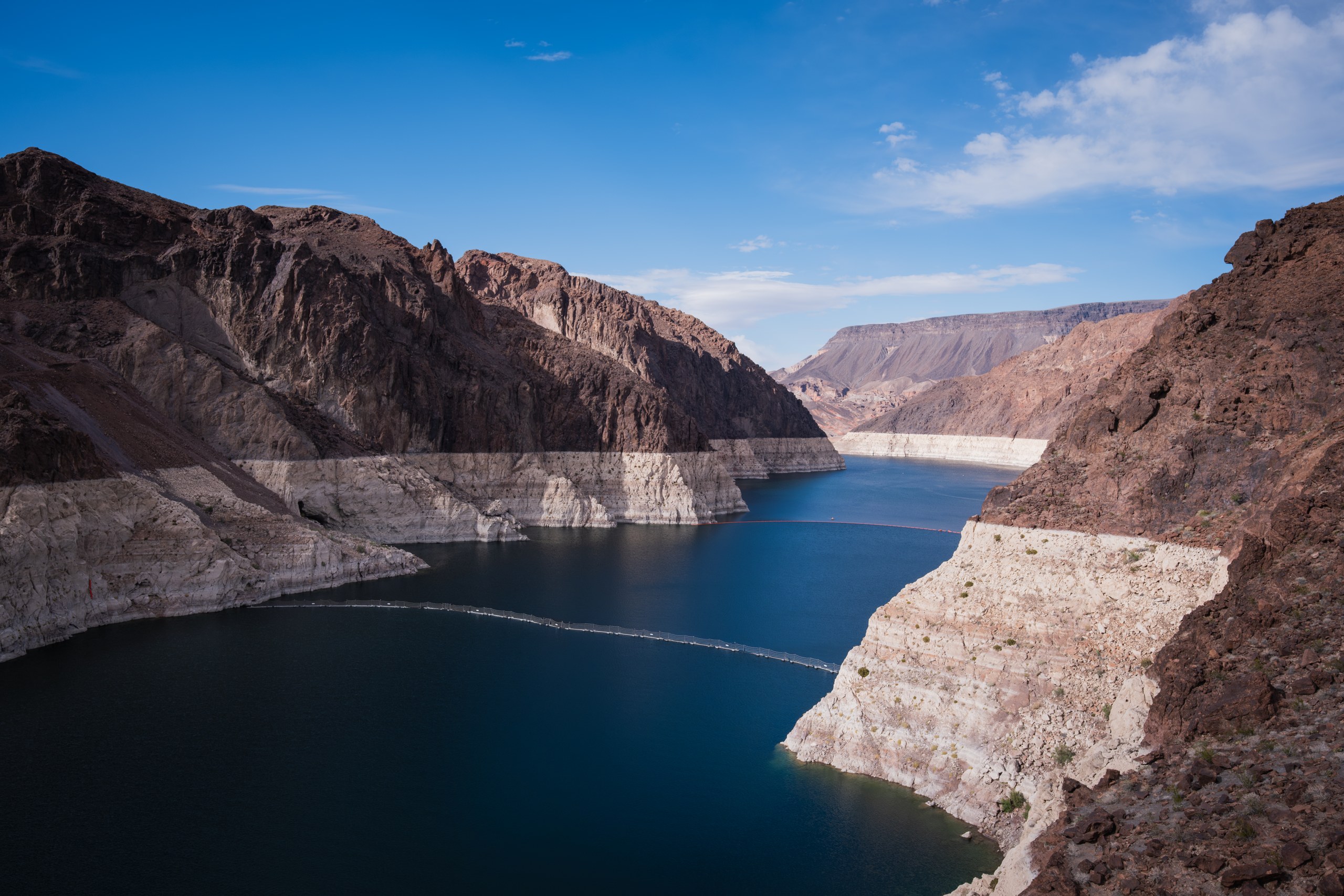
Lake Mead, the reservoir behind Hoover Dam, fell to its lowest surface level since it began filling in the 1930s. The Bureau of Reclamation’s own daily tracking — its Lower Colorado River Daily Report — put the reservoir at 1,040.24 feet above sea level on August 9, 2026. That’s below the reservoir’s previous record low, set July 28, 2022 and reported as either 1,040.50 or 1,040.58 feet depending on the outlet. News outlets differ on the exact figure for the new low and on which day in early August it was first reached, so this article quotes Reclamation’s own daily reading rather than picking among them.
Set against Reclamation’s own year-earlier reading — 1,055.54 feet at the end of August 2025 — the lake has dropped roughly 15 feet in about a year. News outlets that covered the record as it was being set in the first week of August reported slightly different figures for the exact day and the exact hundredth of a foot — different agencies and outlets don’t all read the gauge at the same moment — but none of that changes the trend: the lake is lower than it has been since it started filling nine decades ago.
The “ghost town” people are searching for
If you came here looking for a ghost town that just reappeared, here’s the honest answer: no ghost town surfaced at Lake Mead this month. The town people mean is St. Thomas, Nevada, inside Lake Mead National Recreation Area, and its ruins have been sitting above the waterline continuously since around 2002 — not since this year, and not since this week. What changed in August 2026 was the water, not the ruins.
St. Thomas was founded in 1865 by Mormon settlers at the confluence of the Muddy and Virgin rivers and grew to a town of about 500 people with a school, a church, a post office and stores. Lake Mead’s rising water, backed up behind the newly built Hoover Dam, first reached the town in 1935; the last resident paddled away from his flooding home in 1938, and at its deepest point the town sat about 60 feet underwater. It has resurfaced and gone back under more than once over the decades — former residents held reunions there in 1945, 1963 and 2012 — which is part of why a “ghost town” headline about it recirculates almost every year regardless of what the water is actually doing.
You can visit today. According to the National Park Service’s trail page for the site, a 2.5-mile round-trip walking trail leads from a parking area at the end of Old St. Thomas Access Road, just past mile marker 46 on Northshore Road. The trail itself is not maintained, and NPS warns hikers to start early or late in the day in summer because of the heat. Disturbing the ruins — moving or removing artifacts, climbing on the remaining structures, or marking them up — is illegal.
Why it’s falling
Reclamation and the outlets covering the drop point to the same long-running cause: a persistent, multi-year megadrought on the Colorado River combined with water use that has outpaced what the river supplies. This year that was made worse by what Time reported as the worst snowpack on record in the Colorado River Basin — the mountain region whose winter snow feeds the river — during a stretch that included the warmest March in Colorado in 132 years.
Reclamation had already flagged the strain a year in advance. In an August 2025 announcement, it declared a Level 1 Shortage Condition for Lake Mead covering all of 2026, cutting water allocations for the year:
- Arizona: down 18% of its share, or 512,000 acre-feet
- Nevada: down 7%, or 21,000 acre-feet
- Mexico: down 5%, or 80,000 acre-feet
Those are cuts to how much water each state and country may draw overall — for farms, cities and everything else — not a household-by-household ration; it is not known whether, or how, an individual water bill or tap changes because of it. Reclamation warned at the time that the operating rules governing the river expire at the end of 2026 and that the seven states that depend on it need to reach a new agreement.
Federal forecasters cited by the Las Vegas Review-Journal expect Lake Mead to set a new record low nearly every month through 2028.
One independent data tracker, ReservoirBench, which says it draws on Reclamation’s own daily data, put the lake at about 27% of capacity in early August 2026; Casino.org independently gave roughly the same figure. Treat that percentage as the trackers’ number — it is not quoted here from a Reclamation page.
Timeline
- 1865: St. Thomas is founded by Mormon settlers at the confluence of the Muddy and Virgin rivers, growing to about 500 people with a school, a church, a post office and stores.
- 1935: Lake Mead’s rising water, backed up behind the newly built Hoover Dam, first reaches St. Thomas.
- 1938: The last resident leaves the flooding town, which eventually sits about 60 feet underwater at its deepest.
- 1945, 1963, 2012: Former residents hold reunions at the site.
- Since around 2002: St. Thomas’s ruins stay above the waterline continuously — the exposure is not new in 2026.
- July 28, 2022: Lake Mead sets its previous record low, reported as either 1,040.50 or 1,040.58 feet depending on the outlet.
- August 15, 2025: Reclamation declares a Level 1 Shortage Condition for Lake Mead covering all of 2026, cutting water allocations for Arizona, Nevada and Mexico.
- End of August 2025: Reclamation records the lake at 1,055.54 feet.
- Early August 2026: Lake Mead falls below its previous record low; outlets differ on the exact day and the exact figure.
- August 9, 2026: Reclamation’s daily report puts the lake at 1,040.24 feet.
What it does not mean
Hoover Dam itself is not damaged, and nothing in the reporting on this record low says its generators have been shut down. There is a threshold where that would change: if the reservoir ever fell to 1,035 feet, 12 of the dam’s 17 turbines would no longer be able to run, cutting hydropower capacity by about 70%. Do the arithmetic honestly: Reclamation’s August 9 reading of 1,040.24 feet is only about five feet above that line, after a drop of roughly 15 feet over the past year. It is not known when, or whether, the lake will reach 1,035 feet — only where that line sits and what would happen if the water ever gets there.
One more thing this isn’t: the “Hoover Dam explosion” video that still circulates online is not from 2026. It shows a transformer fire at the dam on July 19, 2022, which Reclamation confirmed at the time — nobody was hurt, the grid was never at risk, and the fire was out in about half an hour.
What’s still unresolved
Whether the water cuts already ordered for 2026 will be followed by tighter restrictions in 2027 has not been settled; federal officials have floated the idea of larger mandatory reductions and releasing water from an upstream reservoir to protect Hoover Dam’s power supply, but no final decision has been reported. What’s confirmed is simpler: the lake hit a new low, and the ghost town has been there to see for more than two decades.