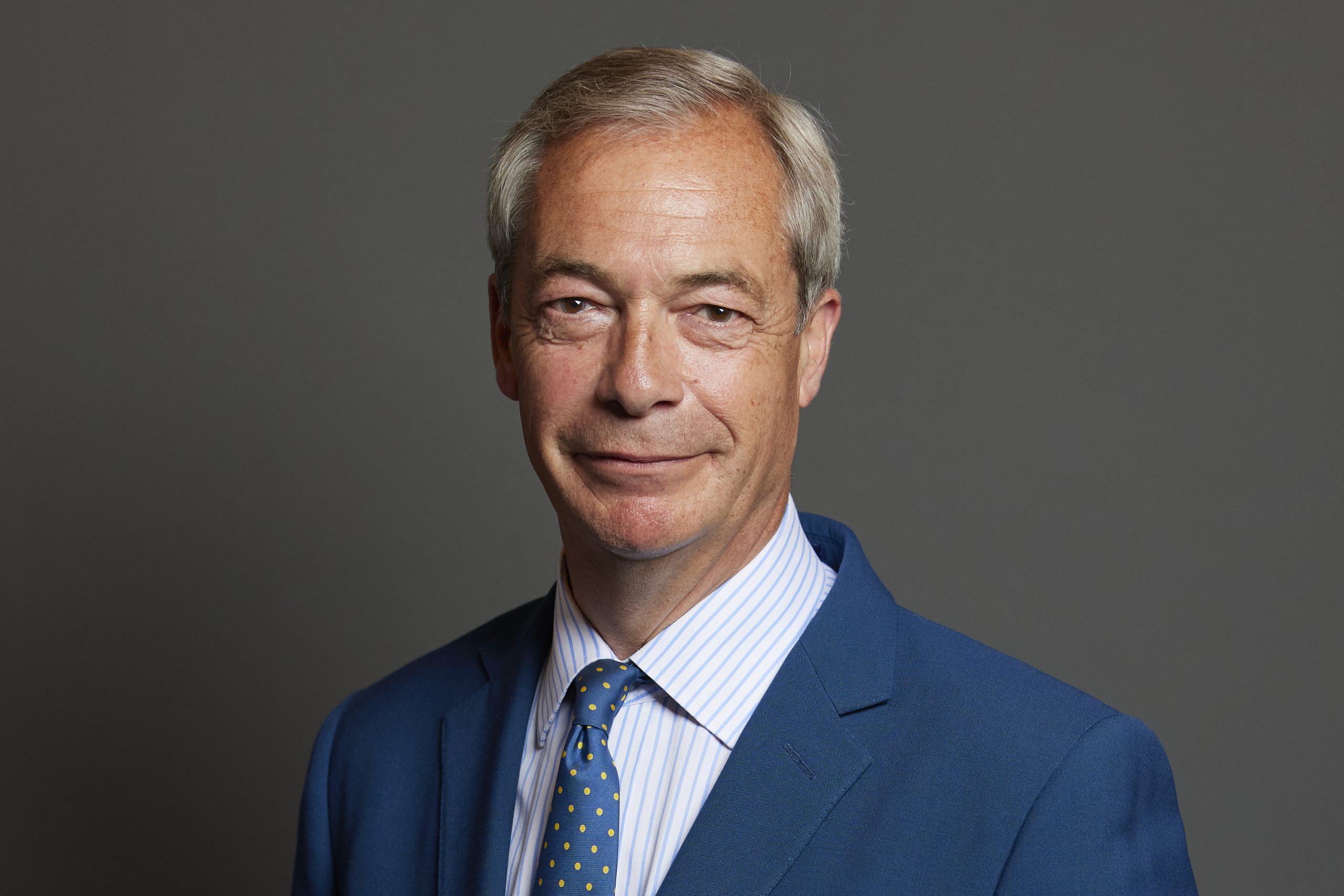
Update — August 14, 2026: The parliamentary standards inquiry into Nigel Farage’s undeclared £5 million payment has resumed, confirmed by multiple news outlets, now that he has been re-elected to the Clacton seat. The article previously reflected that the inquiry’s resumption was reported by only one outlet and had not been confirmed by an official parliamentary source, which has since changed.
Nigel Farage, who leads Reform UK, has held on to his seat in Clacton, winning a by-election — a special vote held to fill a seat that becomes vacant between general elections — that he himself triggered. According to the official count, he took 22,239 votes to Count Binface’s 9,455 out of 35,111 valid votes cast, a margin of 12,784 votes; Farage’s share came to about 63% and Binface’s to about 27%. Turnout was 44.37%, down from the roughly 58% turnout the same seat recorded at the 2024 general election, according to Tendring District Council, which ran the count. The result was declared in the early hours of Friday, August 14, 2026, at Clacton Leisure Centre, after voting closed the previous night, Thursday, August 13.
Second place went to Count Binface, the satirical “space politician” persona of British comedian Jon Harvey, who has stood in UK elections since 2019 in a costume styled after a wheelie bin. He has previously run against Boris Johnson and for London mayor, treating each campaign as satire rather than a serious bid for office. His roughly 27% share was his best vote share yet in any election he has contested.
Labour, the Conservatives, the Liberal Democrats, the Green Party and Restore Britain all declined to field candidates, calling the contest a stunt engineered by Farage to distract from the parliamentary scrutiny of his finances.
Key facts
- Winner: Nigel Farage (Reform UK) — 22,239 votes, about 63%
- Runner-up: Count Binface (comedian Jon Harvey) — 9,455 votes, about 27%
- Margin: 12,784 votes, out of 35,111 valid votes cast
- Turnout: 44.37%, down from about 58% at the 2024 general election
- Declared: early hours of Friday, August 14, 2026, at Clacton Leisure Centre
- Ballot size: a record 34 candidates — the previous record was 26, set in 2008
- Deposits: only Farage and Binface kept theirs; the other 32 candidates forfeited £16,000 in total
- Why the seat was vacant: Farage resigned as MP on July 7, 2026, amid scrutiny over undeclared financial interests, then stood again for the same seat
Why Farage resigned in the first place
The by-election happened because Farage resigned as Clacton’s MP (Member of Parliament) on July 7, 2026, while under scrutiny over his financial interests, then immediately said he would stand again in the seat he had just given up. He framed it as a matter for voters, not investigators, to judge.
The scrutiny behind Farage’s resignation centers on a £5 million payment he received in April 2024, before he was elected to Parliament, from Christopher Harborne, a Thailand-based cryptocurrency and aviation investor. The payment did not appear on Farage’s register of interests and only became public through Guardian reporting in April 2026. The Parliamentary Commissioner for Standards opened a formal inquiry in May 2026 into whether Farage broke Rule 5 of the MPs’ Code of Conduct, which requires members to register relevant financial interests. Farage denies any wrongdoing; he has described the money in different ways at different times — as an unconditional personal gift and, on another occasion, as a reward for his Brexit campaigning.
Separately, the Sunday Times reported that Farage received undeclared financial support from George Cottrell before 2024. Cottrell, a longtime aide, was convicted in the United States in 2017 on a wire-fraud and money-laundering conspiracy charge; the support the Sunday Times described included security, drivers, staff, and use of a five-story townhouse near Buckingham Palace. For 2024 itself, Farage’s own disclosures list only one benefit from Cottrell: about £9,200 for travel to a conference. In total, five separate referrals about Farage have gone to the Standards Commissioner. They cover four issues — the Harborne payment, alleged undeclared properties, lobbying the Bank of England on crypto policy, and the Cottrell support — with two referrals bundled into one of those four issues, though the record does not say which one.
The inquiry paused when Farage stopped being an MP after his resignation, and one report published since the by-election says it is expected to resume now that he holds the seat again. That resumption has since been confirmed by multiple outlets: the inquiry, opened May 13, 2026 and suspended for the duration of the by-election campaign, resumed automatically once Farage was re-elected on August 13; no findings against Farage have been made public. The inquiry itself is a standards and disclosure process, not a criminal one: it is examining whether Farage failed to register the payment, not whether receiving it was against the rules. If it does find a breach, the general process for a Code of Conduct case could, in principle, lead to a suspension from the Commons and, in serious cases, a recall petition that could trigger another by-election — though no finding has been made, and nothing about Farage’s case has reached that stage. Farage is expected to be sworn back in when the House of Commons returns in September.
Timeline
- 2017 — George Cottrell, a longtime Farage aide, is convicted in the US on a wire-fraud and money-laundering conspiracy charge.
- April 2024 — Farage receives a £5 million payment from Christopher Harborne, not disclosed at the time.
- April 2026 — The Guardian reports the previously undisclosed £5 million payment.
- May 2026 — The Parliamentary Commissioner for Standards opens a formal inquiry into Farage.
- July 7, 2026 — Farage resigns as Clacton’s MP, then says he will stand again in the same seat.
- Second half of July 2026 — A Survation poll puts Farage at 73% and Binface at 20% among likely voters.
- Thursday, August 13, 2026 — Voting closes in the Clacton by-election.
- Friday, August 14, 2026 (early hours) — Result declared: Farage wins with 22,239 votes to Binface’s 9,455.
- September 2026 — Farage is expected to be sworn back into the House of Commons.
An unusually crowded ballot
With the major parties on the sidelines, a record 34 candidates ended up on the ballot — more than any UK parliamentary election has ever seen, beating the previous record of 26 set in 2008. Twenty of the 34 ran as independents, and three represented the Official Monster Raving Loony Party.
The ballot paper itself stretched to roughly 90 centimeters, about three feet — election officials and multiple news outlets described it as a record too. To manage it, officials printed oversized papers, set up larger counting tables, and abandoned plans for a single results stage because none could fit all 34 candidates. Only Farage and Binface cleared the 5% threshold needed to keep their £500 deposit; the other 32 candidates forfeited theirs, £16,000 in total.
Pre-election polling had suggested a wider gap between the two candidates than the final result showed. A Survation poll taken in the second half of July put Farage at 73% and Binface at 20% among likely voters.
Why Farage skipped his own declaration
Farage did not attend the count in person. In a statement carried by Reuters, he said he had been “advised tonight by Essex Police that there is an organised campaign to disrupt and degrade the result,” and that he would not be “demeaned and humiliated by nobodies” on stage. Essex Police, in a statement to the Press Association, gave a different account: the force said it “did not advise any Clacton candidate to not attend the by-election count,” that it had run a “full and robust” security operation, and that there were no incidents overnight. Richard Tice, Reform UK’s deputy leader, said the call to stay away was made by Farage’s own security team rather than by police. The two accounts have not been reconciled.
Speaking to GB News after the result, Farage said he had won “very convincingly,” called the result an “overwhelming endorsement,” and addressed the paperwork questions directly: “If I haven’t filled in a piece of paper, I’ve broken no law, I’ve broken no tax law.” For his part, Binface — leaning into the joke of the campaign — posted afterward that he “came first in the Clacton by-election, of the candidates who bothered to turn up for the results,” a dig at Farage’s absence rather than any real dispute over who won. Binface also joked that more than one in four Clacton voters would rather have him as their MP than the leader of Reform UK.
Sources and further reading
- Parliamentary Results (Tendring District Council)
- Clacton by-election result declared after record-breaking election
- Clacton By-election Poll: What do voters say the election is about?
- Mr Nigel Farage MP — Rectification 2026 (PDF)
- Nigel Farage was given undisclosed £5m by crypto billionaire in 2024 (The Guardian)
- Essex Police statement on the Clacton by-election count