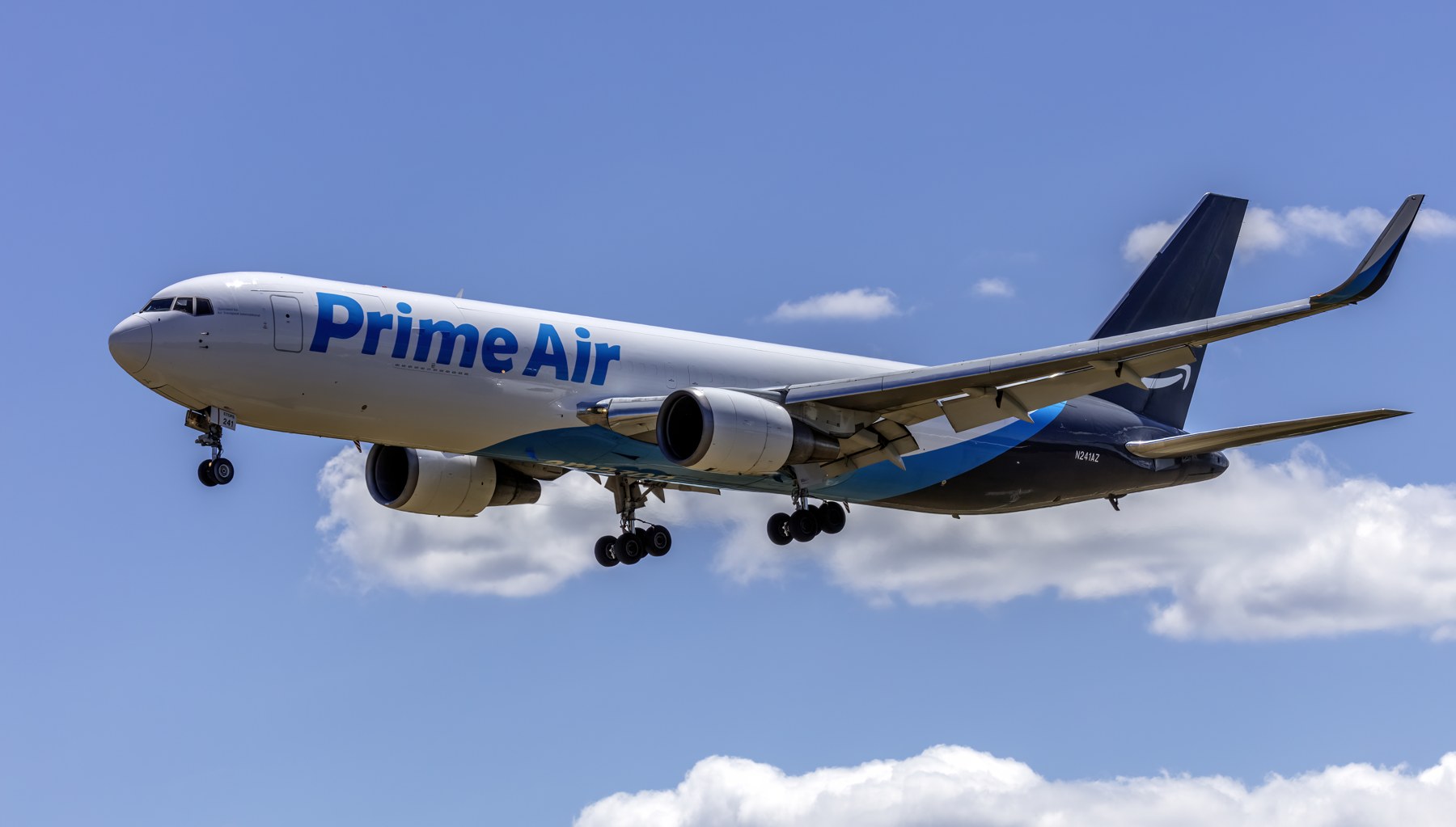
A Boeing 767 cargo plane flying for Amazon’s Prime Air network overran the runway while landing at Miami International Airport on Sunday, September 6, 2026, crossed the airport boundary, struck several vehicles on a road used by airport-area workers, and caught fire. At least five people were killed and five more were injured — three of them critically — officials said.
The aircraft was flying as 21 Air Flight 7598, operated and crewed by 21 Air, a North Carolina-based cargo airline that flies freighters on behalf of Amazon Air under the Prime Air brand. Amazon did not operate or crew the flight itself, and the aircraft was a full-size, piloted cargo jet — not a delivery drone.
Key facts
- When: Sunday, September 6, 2026, around 2 p.m. Eastern
- Where: Miami International Airport, Runway 30
- Flight: 21 Air Flight 7598, flown for Amazon’s Prime Air brand — not operated by Amazon itself
- Aircraft: Boeing 767-300 freighter, registration N1997A, about 32 years old
- Route: San Juan, Puerto Rico, to Miami
- Casualties: at least five killed, five injured (three critical)
- Cause: not yet determined; NTSB and FAA investigating
- Flight disruption: more than 160 flights canceled, roughly 325 delayed
Timeline
- Sunday, Sept. 6, ~2 p.m. ET — Flight 7598 overruns Runway 30 on landing, crosses the airport boundary, strikes vehicles, and catches fire
- Sunday, Sept. 6, afternoon — Miami International Airport orders a full ground stop and closes its runways and taxiways
- Sunday, Sept. 6, ~5 p.m. ET — Ground stop is lifted; a ground delay program continues into Monday
- Monday, Sept. 7 — NTSB investigators arrive at Miami International, a team of about 32; Chairwoman Jennifer Homendy briefs reporters. The board says the jet came to rest roughly 1,300 feet past the end of runway 30 and struck two vehicles — a van carrying seven people and an SUV. Investigators expect to spend the week documenting the scene and collecting perishable evidence. No cause has been determined.
- Coming weeks — NTSB preliminary report expected
What happened
The plane departed Luis Muñoz Marín International Airport in San Juan, Puerto Rico, and was landing at Miami International Airport at around 2 p.m. Eastern when it overran Runway 30. It crossed the airfield boundary onto a roadway beyond the airport perimeter, struck multiple ground vehicles, and came to rest in a field near an Amazon warehouse, where it caught fire.
More than 60 Miami-Dade Fire Rescue units and roughly 200 emergency personnel responded to fight the fire and treat and search for victims. Some people in the struck vehicles were trapped and had to be cut free by technical rescue teams. Of the five injured, three were taken to a trauma center in critical condition and two others were hospitalized with less severe injuries.
Authorities have not released the names of the five people killed or the five who were injured — nor have they said whether those killed were aboard the aircraft, in vehicles on the ground, or some combination of both. Officials say it’s simply too early to know.
Not the 2019 crash
This is a separate event from the 2019 crash of Atlas Air Flight 3591, which also involved an Amazon-Prime-Air-branded Boeing 767 and killed three people near Trinity Bay, Texas. The two crashes share a cargo brand and an aircraft type, but that’s essentially where the similarities end — separate planes, separate operators, flown seven years apart, in different states.
What caused it — and what hasn’t been determined
No official cause has been released. The Federal Aviation Administration and the National Transportation Safety Board have both said the crash remains under investigation. The NTSB launched a “go-team,” with Chairwoman Jennifer Homendy on scene in Miami; she is expected to brief reporters on Monday, September 7, to lay out the scope of the investigation — not to announce findings or a cause.
Investigators are looking at several factors, none of them confirmed: where on the runway the plane touched down, whether a tailwind was a factor, weather conditions at the time (witnesses described dark storm clouds and strong wind, though not rain), and the aircraft’s maintenance history. Outside the official investigation, one aviation attorney cited by a single news outlet has floated a theory that is not an NTSB or FAA finding: that a tailwind of roughly 20 to 30 knots during nearby thunderstorms may have contributed to the overrun.
One detail investigators are examining: Miami International Airport’s runway does not have an Engineered Materials Arresting System, a crushable safety bed designed to stop a plane that runs off the end of a runway. Sixty-nine other U.S. airports have one installed.
The aircraft
The plane, registration N1997A, was a Boeing 767-300 freighter about 32 years old. It was originally built as a passenger jet and flown by other airlines for more than two decades before being converted into a cargo freighter in 2015. It was powered by two General Electric CF6-80C2B6F engines.
Effect on travelers
Miami International Airport ordered a full ground stop and closed its runways and taxiways after the crash; the ground stop was lifted by around 5 p.m. that evening, but a ground delay program continued into Monday because of the disabled aircraft. More than 160 flights were canceled and roughly 325 were delayed, with some inbound flights diverted to Orlando International Airport. Travelers flying in or out of Miami should check their flight status directly with their airline before heading to the airport, since delays tied to the disabled aircraft were still affecting the schedule into Monday.
What happens next
A preliminary report from the NTSB typically takes several weeks to complete. Whether Miami’s runways have fully returned to normal operation had not been confirmed as of September 7, 2026.