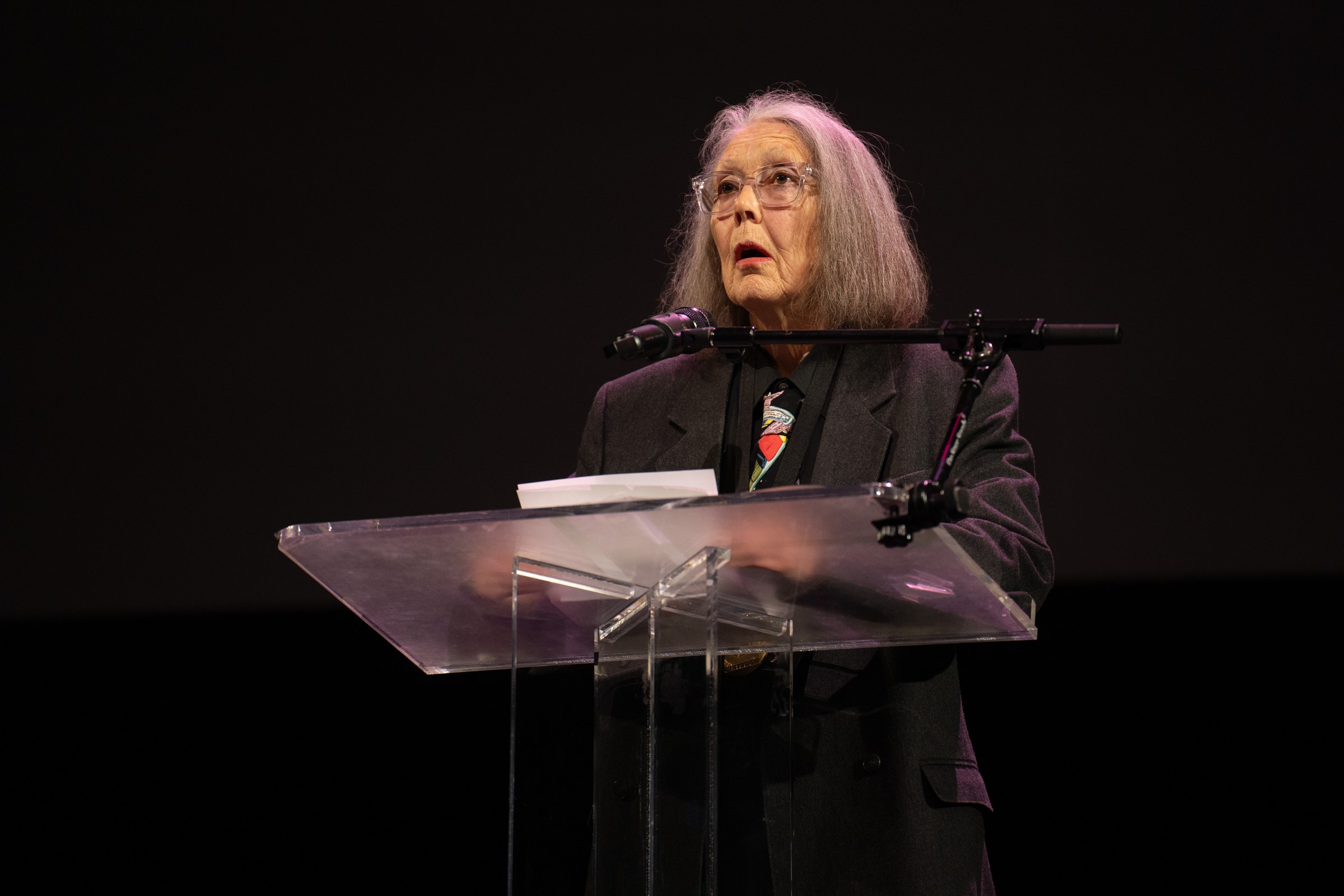
The Swedish Academy named the Canadian writer Anne Carson the winner of this year’s Nobel Prize in Literature on Thursday, Oct. 8, 2026, in an announcement in Stockholm.
Who won, and why
The Academy’s citation says Carson won “for her bold and inventive oeuvre that, in playful dialogue with the classical tradition, has created new forms for contemporary literature.” An oeuvre is a writer’s body of work. The prize is awarded to her alone. Ingrid Carlberg, the Academy’s permanent secretary, made the announcement.
In plainer terms, the Associated Press says Carson won for works that “fuse the classical and the modern and blur the boundaries of poetry and prose.” For a reader new to her, the AP points to “Autobiography of Red,” a verse novel that reimagined the myth of Hercules and the monster Geryon as a love story. According to a spokesman for Alfred A. Knopf, which published it in 1998, it has sold nearly 100,000 copies in the U.S. alone.
The Nobel committee’s pages list her as born on June 21, 1950, in Toronto, and writing in English. The AP describes her as a “Canadian poet, essayist and translator” and gives her age as 76. The AP report, carried by the Santa Rosa Press Democrat, was published at 7:07 a.m. EDT.
Who Anne Carson is
Carson has combined writing with scholarship. The Swedish Academy, as quoted by the Globe and Mail, says she has “throughout her entire career, combined poetry writing with translation work and teaching at various universities.” The Globe and Mail calls her a “modernist poet, translator, classics scholar and Member of the Order of Canada,” and says she later became a professor at Princeton University, McGill University and other schools. Al Jazeera calls her a professor of classics. The AP says she won a MacArthur “genius” grant in 2000.
The AP says her work draws “on themes from classical Greek and Roman literature, modern influences and personal experience” and has ranged “from translations of ancient Greek poets to collaborations with dancers and musicians, including Laurie Anderson and Lou Reed.”
Carson wrote in the London Review of Books in 2024 about being diagnosed with Parkinson’s disease, saying a symptom was that her handwriting “disintegrated,” according to the AP. In that essay she also wrote: “Hard to describe or explain the shame of bad handwriting.”
The AP says she and her husband, Robert Currie, were granted Icelandic citizenship in 2022.
The Globe and Mail describes her as “publicity shy,” citing a Globe profile from 2000 in which, it says, she did not like to talk about herself and was so reclusive she would not permit a photographer for the interview.
What the Academy says about her work
Anders Olsson, chair of the Nobel Literature Committee, said: “Almost all her literary production has centered upon the intersection between the philologist’s obsession with words and the poet’s desire for new meaning,” according to the AP. A philologist is a scholar of words and texts.
The AP lists several books. “Eros the Bittersweet” is, in the AP’s words, “a look at the pleasure and pain of desire in ancient Greek literature.” “Men in the Off Hours,” a collection of poetry and prose, won Canada’s Griffin Prize for poetry in 2001, and “Norma Jeane Baker of Troy” compares Marilyn Monroe and Helen of Troy.
She has also translated classical Greek works, including “If Not, Winter,” based on fragments of poems by Sappho, Sophocles’ “Electra” and “Antigone,” and Euripides’ “Bakkhai.” The Academy said her translations “may be regarded as independent works in their own right.”
Olsson said “Economy of the Unlost,” from 1999, sets the ancient Greek poet Simonides of Keos against the 20th-century poet Paul Celan, while “Men in the Off Hours” “aligns the historian Thucydides with Virginia Woolf.” The AP says “Nox,” published in 2010, “dealt with the decades-long absence and then death of her brother Michael.” Olsson called it “a creation as sculptural as it is literary, an epitaph in the form of a box containing an accordion-fold-out of pictures, letters and other written texts dedicated to her dead brother.”
How she reacted
Carlberg said Carson was in Iceland, “listening to the wind,” when the Academy reached her. “She was very taken by surprise,” Carlberg said, per the AP. The National quotes Carlberg as saying: “She was taken by surprise, but very happy. I can hear that in her voice.”
Carson spoke to the Icelandic public broadcaster RUV. Asked how she felt, she said: “I think they’re all crazy.” She described the conversation with the Academy as “rather halting” and said: “They have the usual questions, and I have no answers.” On poetry, she said it is “probably more useful than prose right now because it’s faster, and everybody is in a hurry. So basically I think it’s good because it’s brief. Except Homer. Homer’s not brief.” Asked how the prize would change her sales, she said: “I’ll get a sticker on the front of my book. Stickers help.”
As of Thursday midday, apart from the RUV interview and what Carlberg said she told the Academy by phone, Carson had not commented publicly in the reports reviewed. The AP said its efforts to reach her and her literary agent, Nicole Aragi, were not immediately successful.
What Canada said
Canadian Prime Minister Mark Carney posted on social media, per the AP: “With wit, imagination, and a style entirely her own,” Carson “has reimagined the classics. She has brought ancient stories to new audiences and transformed the way we think about literature.”
The Globe and Mail quotes Kristin Cochrane, CEO of Carson’s Canadian publisher, Penguin Random House Canada, saying the poet “continuously dazzles us with her inventiveness and the transformative, revelatory power of her writing.”
How the prize fits
The AP says Carson is “the first Canadian Nobel literature winner since Alice Munro in 2013.” The Globe and Mail counts her as the third Canadian to receive the prize. It names Munro, a short story writer, and Saul Bellow, who was born in Lachine, near Montreal, but moved to the United States as a child and won in 1976. The two figures measure different things: the AP’s is about the most recent Canadian winner, while the Globe’s is a count of all Canadian winners, which includes Bellow.
The Globe and Mail says the prize “has been awarded 119 times to 123 laureates since 1901” and that Carson “is the 19th woman.” The Irish Times reports that the prize was won last year by the Hungarian author László Krasznahorkai.
The AP describes Carson as “among the more high-profile recent winners” of the literature prize. In the same sentence it says, of the prize in general and not of Carson’s work, that it “often honors authors little known outside of the literary world and is sometimes criticized for valuing literary experimentation over the ability to connect with a broad readership.” The AP does not apply that criticism to Carson. It adds: “However, the prize can also introduce readers to writers and works beyond their own languages or reading habits.”
The prize amount
The prize is 12 million Swedish crowns, about $1.2 million, according to the AP, Al Jazeera and The National. The Globe and Mail gives about “$1.7-million”; its sentence does not name the currency, and the Globe is a Canadian outlet. The Irish Times gives EUR 1.07 million.
What happens next
The National reports that the prize will be presented in Stockholm on Dec. 10. The AP refers to “Friday’s peace prize,” and the Globe and Mail and Al Jazeera say the Nobel Peace Prize will be announced in Oslo on Friday. The Nobel Memorial Prize in Economic Sciences will be announced Monday, according to the AP.
What is not known
No report says whether Carson plans to attend the Dec. 10 ceremony in Stockholm.