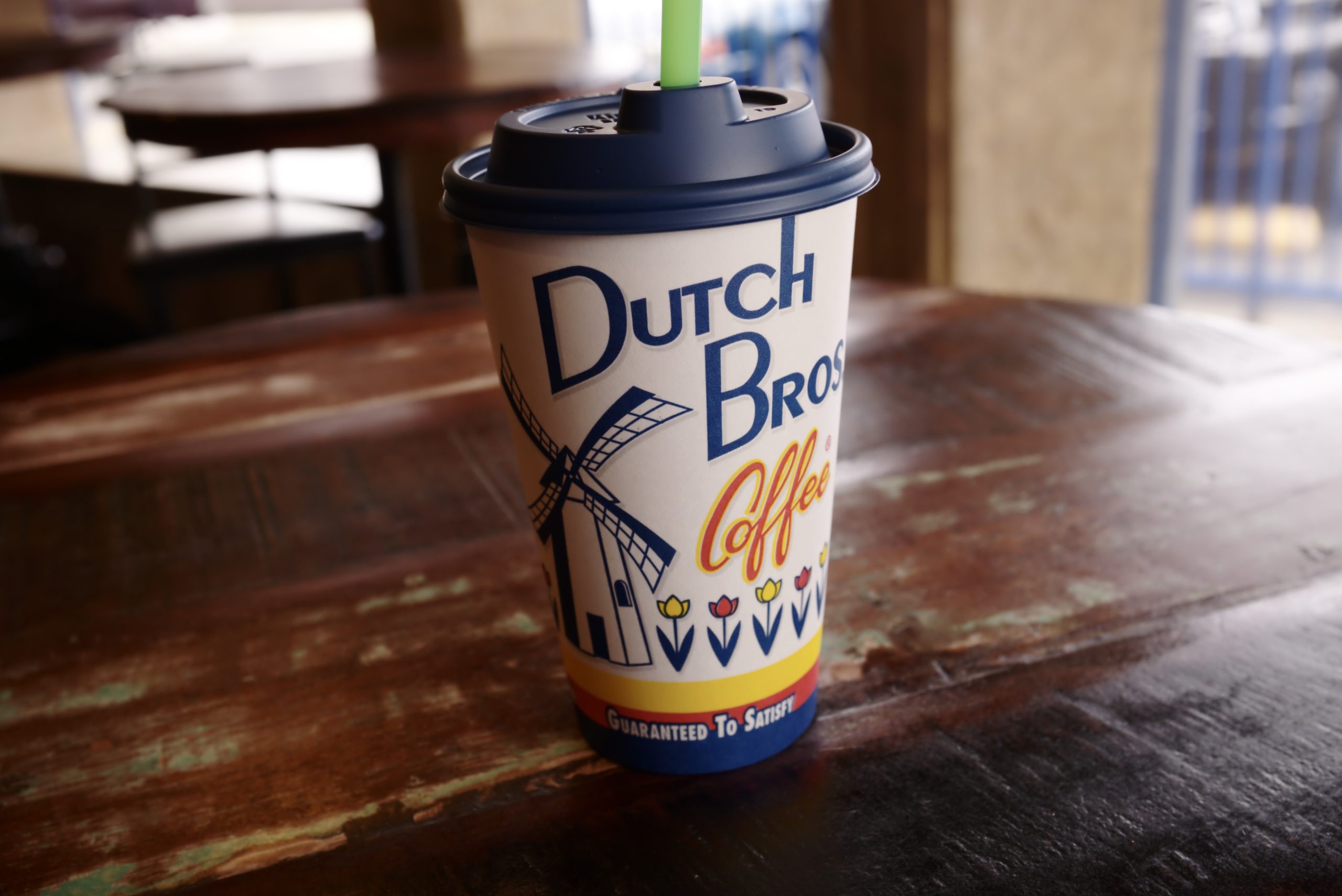
Dutch Bros reported a strong second quarter on Wednesday, August 5, 2026 — revenue up 32.5%, profit up by a third, average sales per shop at a record, its full-year forecast raised — and investors sold anyway. Shares of the coffee chain fell about 12% in extended trading that evening, measured against Wednesday’s closing price, and the slide carried into Thursday’s session.
The company itself has not said why the market turned on a report this good; every explanation on offer comes from outside it. Analysts and financial media pointed to a slower sales forecast for the current quarter and to rising coffee and rent costs that are starting to squeeze the profit made at each shop.
Key facts
- Share price: $53.33 at Thursday’s close, August 6, about 18.8% below Wednesday’s $65.67 close.
- Revenue: $550.9 million for the three months ended June 30, up 32.5% from $415.8 million a year earlier.
- Profit: net income of $51.6 million, up from $38.4 million; diluted earnings of 28 cents per share under standard accounting rules — the GAAP (Generally Accepted Accounting Principles) figure — up from 20 cents, and adjusted earnings of 33 cents, up from 26.
- Same-shop sales: up 8.3% at company-operated shops and 5.8% across the whole system — the thirteenth straight quarter of growth.
- Shop economics: of every dollar a company-run shop took in, 30.6 cents was left after the shop’s own operating costs, down from 31.1 cents a year earlier.
- Full-year outlook: raised to roughly $2.1 billion to $2.13 billion in 2026 revenue, from the prior $2.05 billion to $2.08 billion.
- Current quarter: CFO Josh Guenser guided third-quarter systemwide same-shop sales growth to about 4% to 5% on the earnings call; the written outlook the company filed contains no third-quarter numbers.
- Footprint: 1,225 locations across 25 states at the end of June, up from 1,043 a year earlier, with the full-year target of at least 185 openings in 2026 unchanged.
Timeline
- August 4, 2026: Dutch Bros agrees to acquire the real estate and related site assets of up to 65 Salad and Go locations across Arizona, Nevada, Oklahoma and Texas.
- August 5, 2026, regular session close: shares close at $65.67, up 2.43% on the day; the second-quarter results land after the market closes.
- August 5, 2026, extended trading that evening: shares slide to about $57.65, roughly 12% below that $65.67 close.
- August 6, 2026, regular session close: shares close at $53.33, about 18.8% below Wednesday’s close.
- Third quarter of 2026: the Salad and Go purchase is expected to close, subject to approvals including the bankruptcy court’s.
- 2027: trade reports — not company confirmation — put the conversion of those sites into Dutch Bros shops, if the sale closes.
Two days of selling
The timing matters, because the stock actually rose before the news. Dutch Bros closed Wednesday’s regular session at $65.67, up 2.43% on the day — the results landed after the market closed. In the extended session that followed, the shares slid to about $57.65 — a drop of roughly 12% from that $65.67 close.
Thursday brought more of the same. The stock closed August 6 at $53.33, about 18.8% below Wednesday’s $65.67 close. Both drops are measured from the same starting line, Wednesday’s close, so they do not stack. The fall had simply deepened through the day, from about $57.65 on Wednesday evening to $53.84 by midday and $53.33 at the close.
The quarter itself
Revenue for the three months ended June 30 came to $550.9 million, up 32.5% from $415.8 million a year earlier. Net income rose to $51.6 million from $38.4 million. That figure covers the whole company, including the stakes held by others; the share attributable to Dutch Bros Inc. and its Class A shareholders — the basis for the GAAP per-share figures that follow — was $37.4 million, up from $25.6 million. On a GAAP basis, diluted earnings were 28 cents per share, up from 20 cents; adjusted earnings, a measure that strips out certain costs, were 33 cents, up from 26.
Same-shop sales — growth at existing locations rather than from opening new ones — rose 8.3% at company-operated shops. Across the whole system, franchises included, the figure was 5.8%. It was the company’s thirteenth straight quarter of same-shop sales growth and its eighth straight quarter of transaction growth — more orders rung up, not just higher prices. CEO Christine Barone said average sales per shop “climbed to record levels”: about $2.19 million per year systemwide, up from roughly $2.05 million.
Why investors balked
Dutch Bros offered no explanation for the share-price drop, so the accounting for it belongs to analysts and financial media. Their reading centers on two things.
First, the outlook for the current quarter. On the earnings call, CFO Josh Guenser guided third-quarter systemwide same-shop sales growth to about 4% to 5% — a step down from the 5.8% that the same systemwide measure just delivered in the second quarter. And it was a spoken target only: the written outlook Dutch Bros filed contains no third-quarter numbers at all, so the 4% to 5% exists as something an executive said on a call — a softer commitment than the full-year figures the company put on paper. Guenser and Barone tied the slower number to the comparison against last year’s transactions and to earlier price increases lifting sales less as the year goes on.
Second, costs. The company’s quarterly filing shows beverage, food and packaging eating 26.1% of company-operated shop revenue, up 0.8 percentage point from a year ago, primarily because of higher coffee costs and the chain’s new food program. Rent and occupancy costs rose too, which Guenser tied to a shift toward build-to-suit leases — arrangements in which a landlord puts up a shop to the chain’s specifications and the cost of that construction comes back to Dutch Bros as higher rent. The result: of every dollar a company-run shop took in, 30.6 cents was left after the shop’s own operating costs — the figure the filing calls shop contribution — down from 31.1 cents a year earlier.
Half a cent on the dollar sounds like nothing, but it was not moving alone. Adjusted EBITDA — a broad gauge of operating profit, before interest, taxes and certain accounting charges — grew 27.8% to $113.7 million, yet shrank as a share of revenue, to 20.6% from 21.4%. Overhead improved, but at the shop level each dollar of sales now earns slightly less than it did a year ago.
Some commentators also folded in the capital demands of the newly announced Salad and Go deal, though no one — the company included — has tied the drop to any single cause.
The forecast went up, not down
The irony of the sell-off is that Dutch Bros raised its full-year outlook. It now projects 2026 revenue of roughly $2.1 billion to $2.13 billion, up from the prior $2.05 billion to $2.08 billion, with systemwide same-shop sales growth of 5% to 6% and adjusted EBITDA of $385 million to $390 million. The plan for at least 185 new shop openings this year is unchanged, and capital spending is put at $350 million to $370 million. Guenser credited “the performance so far this year and the recent acquisition from one of our Phoenix franchisees” for the raise.
The Salad and Go deal
Alongside the results, Dutch Bros disclosed that on August 4 it agreed to acquire the real estate and related site assets of up to 65 Salad and Go locations across Arizona, Nevada, Oklahoma and Texas. Salad and Go is a drive-thru salad chain; its operator filed for Chapter 11 bankruptcy this week and, according to media reports, closed its remaining roughly 70 locations. The deal is not done: it needs approvals, including from the bankruptcy court handling that Chapter 11 case, and is expected to close in the third quarter of 2026.
Dutch Bros’ own filing names no price and no plan for the sites. Court filings reported by trade media put the price at $105 million for the Arizona and Nevada sites — with a $10 million deposit already paid — plus a nominal sum for the Texas and Oklahoma leases, and those same reports say the plan is to convert the locations into Dutch Bros shops starting in 2027. None of that is company-confirmed, and none of it is final until the sale closes. Those same filings say the Salad and Go brand name and its intellectual property are excluded from the purchase: whatever the deal’s fate, Dutch Bros is buying places, not the salad business. The company’s raised forecast explicitly leaves this transaction out of the numbers.
What it changes for the customer
Most of this is invisible from the drive-thru window. The new food menu is one of the reasons the chain’s ingredient costs climbed this quarter, alongside coffee. On prices, Guenser told analysts that earlier increases would add less than a percentage point to sales in the back half of the year — a statement about how much past increases still lift revenue, not a promise that anything on the menu gets cheaper. And if the Salad and Go purchase clears the bankruptcy court, the trade reports put the conversion of those Arizona, Nevada, Texas and Oklahoma sites in 2027 — the nearest thing to a date for anyone waiting on a shop in those states.
Growth plans intact
Whatever the market concluded this week, the expansion has not slowed. Dutch Bros opened 48 shops in the quarter — 44 of them company-operated — and finished June with 1,225 locations across 25 states, up from 1,043 a year earlier. The target of at least 185 openings in 2026 still stands.
Sources and further reading
- Dutch Bros Inc. Reports Second Quarter 2026 Financial Results (Exhibit 99.1 to Form 8-K)
- Dutch Bros Inc. Reports Second Quarter 2026 Financial Results (Exhibit 99.1 to Form 8-K)
- Dutch Bros Inc. Form 10-Q for the quarter ended June 30, 2026, filed Aug 6, 2026
- Dutch Bros Inc. Form 8-K (Items 2.02, 7.01, 8.01, 9.01), filed Aug 5, 2026
- Dutch Bros Inc. to Host Second Quarter 2026 Conference Call and Webcast on August 5 (Form 8-K, bros-20260805.htm)