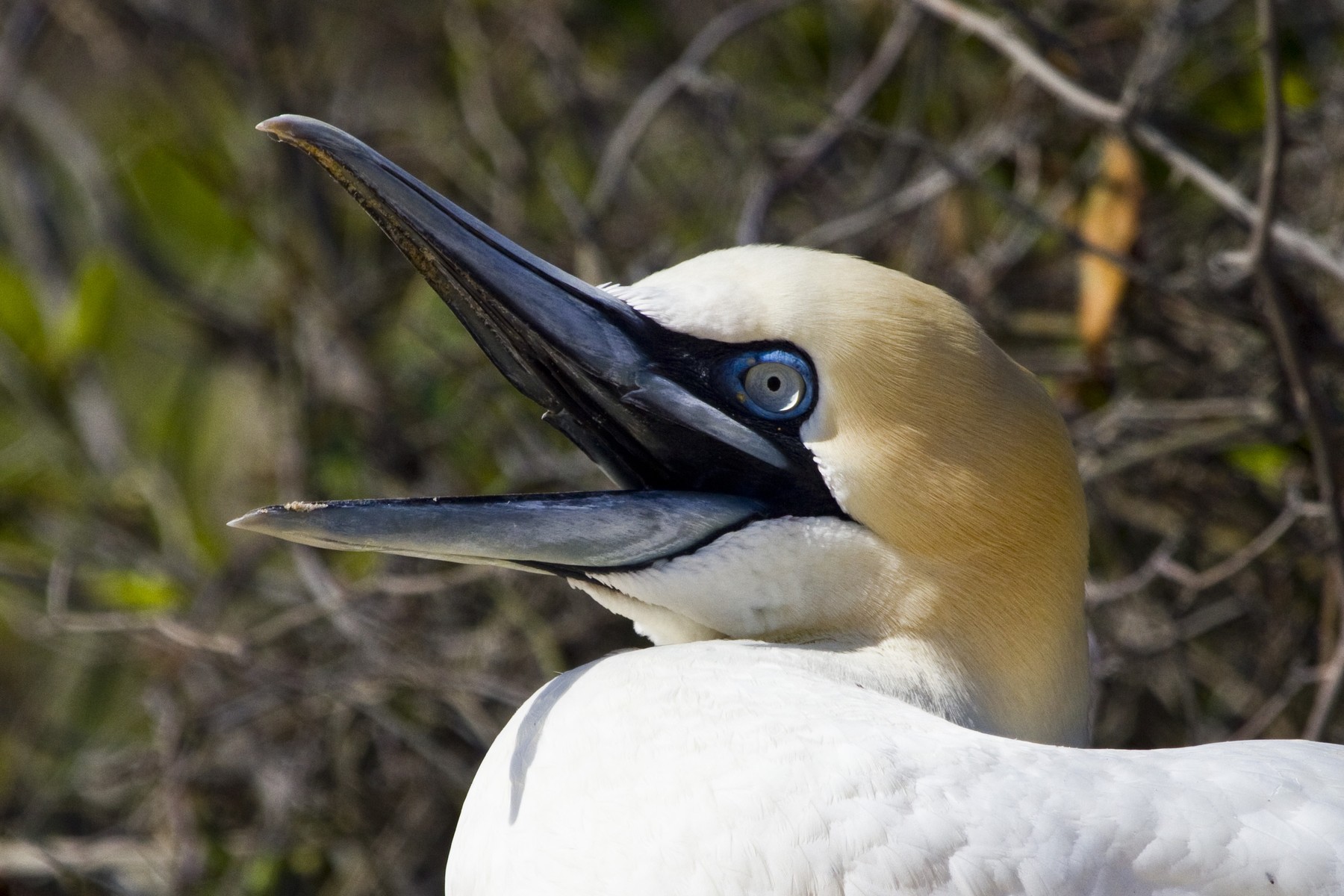
Plunge-diving means diving headfirst into water from the air. A University of Washington study found that plunge-diving birds had short, wide neck vertebrae, the individual bones of the neck. Gannets and boobies also had an extra contact surface on some of those bones that, the authors say, limits how far the neck can bend at its start. The work was published Monday, Oct. 12, in The Anatomical Record and compares neck bones from five diving and two non-diving bird species.
The university’s release opens with a northern gannet that scans the sea from about 100 feet (about 30 meters) up and hits the water at about 70 mph (about 113 kilometers per hour). The release calls this standard hunting behavior for plunge-diving seabirds.
The paper is titled Morphological adaptations of cervical vertebrae in plunge-diving sulids. Cervical means of the neck, and sulids are the family that includes gannets and boobies. According to the journal record, the lead author is Megan L. Vandenberg of the university’s Friday Harbor Laboratories; the release spells the surname differently in its text. The release names Bart Boom as senior author.
Why the neck is a puzzle
According to the release, engineers usually favor short, thick structures for things that must bear compressive force, meaning squeezing force, yet these birds have long, slender necks made of segmented vertebrae. The release says a gannet neck has 15 stacked vertebrae in a slight S-curve, and that few earlier studies had looked at the actual shape of diving birds’ neck bones.
What the study found
The abstract, which is the authors’ own summary of the paper, reports that plunge-diving birds have reinforced neck vertebrae that are short and wide, with expanded joints and thickened arches.
Gannets and boobies, which the abstract calls the most extreme plunge divers, have something more. According to the abstract, they have an additional articulating surface on the dorsal arch, the upper bony arch, of the vertebrae at the start of the neck. The release calls it an articular facet. In plain terms, that is a contact surface where neighboring vertebrae meet.
The release says the extra surface sits on the second through sixth neck vertebrae, and that the vertebrae of gannets and boobies are overall stockier than those of other birds. In the release, Vandenberg says plunge-diving birds have vertebrae that are thicker, wider and shorter, shaped more like a square.
The abstract also says all plunge-diving sulids experience similar water-impact durations, and that how the head’s radius compares with the neck’s scales with impact velocity. The abstract does not state which way that comparison changes.
What the authors say these features do
The abstract carries statements about function, and they are the authors’ statements. It says the reinforced features help distribute compressive loads and bending loads and reduce stress on the spinal column during impact. It says the extra surface limits flexion, meaning bending of the neck, in the beginning of the neck, further reinforcing it against high loads. The abstract does not describe how any of this was shown.
The abstract does not state a direction for the flexion it mentions. The release words the researchers’ view differently: they think the extra facet keeps the birds’ necks from bending backward when they hit the water at an angle, so that the load is passed down the column of neck bones. The two descriptions are not reconciled on the pages available, and the full paper was not available.
The release also reports a second idea, that this link between structure and function could help paleontologists identify plunge-diving birds from fossils. That is a proposal, not a demonstrated result.
How the work was done
According to the abstract, the team compared the neck vertebrae of five plunge-diving species and two species that do not plunge-dive, using morphometric analysis of micro-CT scans, which are three-dimensional X-ray scans. The release adds that the specimens came from the Burke Museum, and that CT scans were used to build three-dimensional models of the vertebrae. Those were compared with geometric morphometrics, a statistical method that compares shapes using landmarks on biological structures.
The release says the team considered the forces associated with various feeding styles, chose birds that represented a spectrum, and added shape data from earlier studies.
Where kingfishers fit
The release names northern gannets, boobies and kingfishers; neither the release nor the abstract lists every species sampled. The release says the researchers saw more blocklike vertebrae in other diving birds such as the kingfisher but did not detect the extra facet there. Kingfishers belong to a different family and are much smaller than gannets and boobies, and the release says their necks seem to have evolved in a similar way.
The release adds that kingfishers and the bigger plunge-divers experience the same amount of force per neck area during a dive. Total force scales with neck size, but the stress on the tissue is the same, according to the University of Washington’s copy of the release; a syndicated copy says strain. It says both groups reached peak force nearly five milliseconds after impact. The release does not explain how that force comparison was obtained.
How this relates to earlier work
An earlier study took a different route. A 2016 paper in the Proceedings of the National Academy of Sciences, by Brian Chang and colleagues, modeled the physics of muscles, head shape and speed. It reported that neck muscles contract before impact to keep the neck straight. Its main experiments used one salvaged, frozen northern gannet along with physical cone-and-beam models and museum skull specimens, and it treated the neck as an elastic beam and the head as a rigid cone.
By that paper’s model, about 80 meters per second, roughly 288 kilometers per hour, would be needed to injure a gannet’s neck. That is a model estimate, and the same paper reports observed dives at up to 24 meters per second, about 86 kilometers per hour.
The 2026 study looks at bone shape instead. A University of Washington aeronautics and astronautics feature from August 2025 describes separate engineering work by Boom, Truscott, Fish and Habtour in Ocean Engineering, in which spring-jointed models had peak forces reduced by up to 80 percent for the spring designs. Boom and Habtour are also authors of the 2026 anatomy paper.
Reported dive speeds vary by source. The release gives about 70 mph, about 113 kilometers per hour, from about 100 feet, as standard hunting behavior and does not present the figure as a result of this study. The 2016 paper reports dives at up to 24 meters per second. The Animal Diversity Web page for northern gannets gives over 100 kilometers per hour.
What is not known
The full paper was not available as of about 12:40 a.m. EDT on Tuesday; the publisher’s page returned an access error, so the paper may contain more than the abstract and the university’s release. The release text and the abstract do not give a specimen count, a full species list or force values, and they do not say which booby species were sampled. They also do not say whether kingfisher specimens were among the seven species compared.
No independent expert comment on the study had been found as of about 12:40 a.m. EDT on Tuesday. The statements in the coverage come from the study’s own authors.
What comes next
According to the release, the researchers hope to explore in more detail how force transfers down the neck. Vandenberg said in the release that she wants to look more closely at vertebrae in general, not only in birds.
A separate note on northern gannets
This is unrelated to the study. On July 3, 2026, the RSPB reported a study led by the charity and Aarhus University on bird flu in northern gannets at two UK colonies. In the 11 years before 2022, average annual mortality was 6% at Bass Rock and 11% at Grassholm. During the outbreak it was 33% and 47%.
The RSPB reported decreases in colony size of 26% at Bass Rock and 38% at Grassholm a year after the outbreak, in 2023; the underlying study describes these as predicted decreases rather than simple counts. The RSPB said the colonies are not expected to recover from the impact until 2041 at the earliest. Audubon and the RSPB both list northern gannets as Least Concern on the IUCN Red List, and the study’s authors recommend that the rating be revised in light of the high mortality and slow recovery, according to the RSPB.