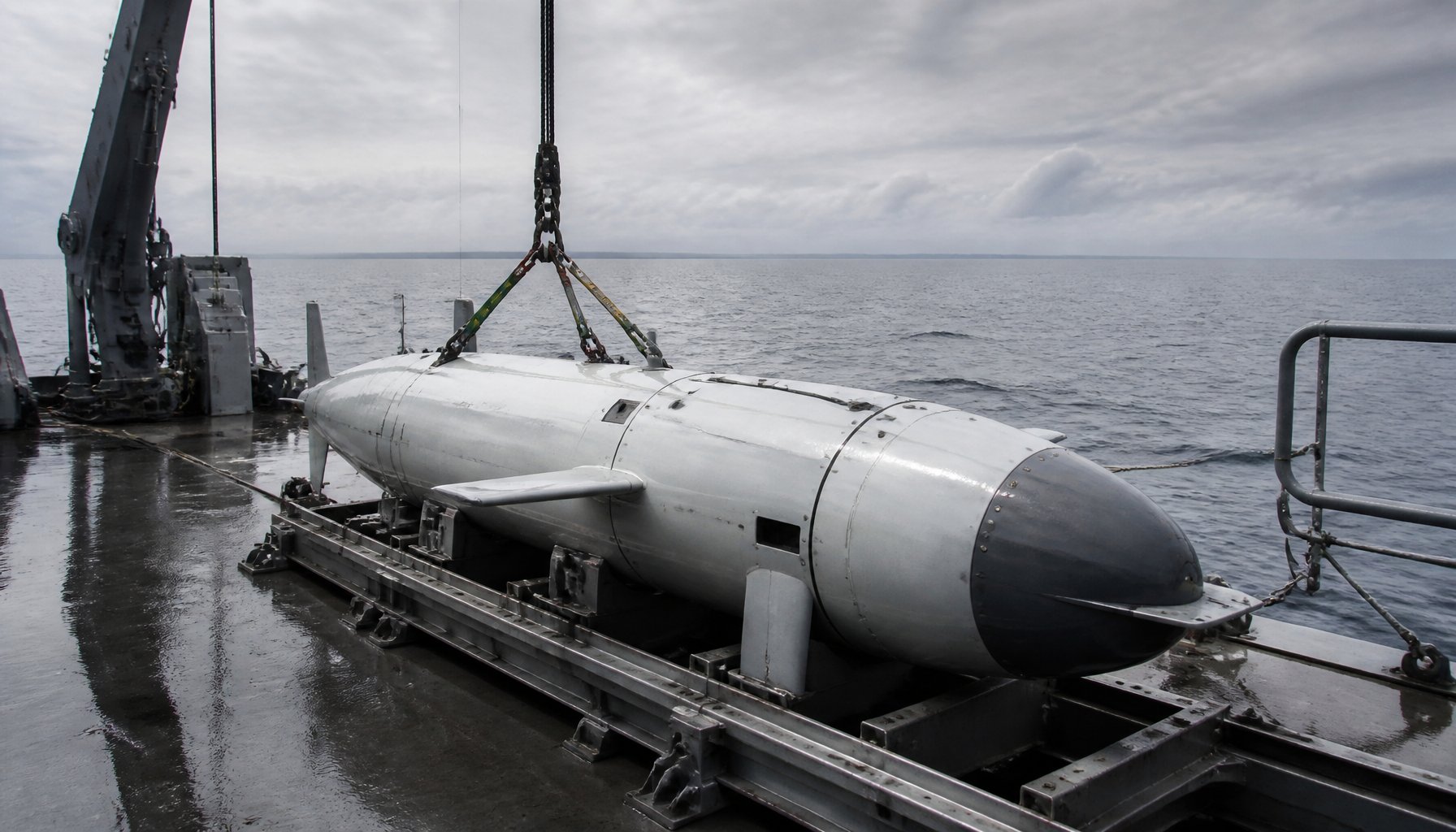
Iran’s Revolutionary Guard navy announced on the evening of September 8, 2026, that its forces had taken control of a US-operated underwater vehicle at the entrance to the Strait of Hormuz. Iranian state media called it a “complex intelligence and operational” mission and described the vessel as a “prize.”
Key facts
- What Iran seized: an unmanned Anduril Dive-LD underwater vehicle — not a manned submarine
- Size: about 19 feet (5.8 meters) long, close to three metric tons
- Capability: dives to 6,000 meters, operates independently for about 10 days; Iranian state media said it entered US Navy service in 2025
- Iran’s claim: a deliberate “complex intelligence and operational” capture, announced September 8, 2026
- Claim from US Central Command (CENTCOM): the drone malfunctioned more than a day earlier and was adrift; it carried no sensitive data or classified sonar/radar equipment
- Verification: neither government’s account has been independently confirmed
What Iran says it captured
What Iran captured was not a manned submarine. Iranian state media identified it as an Anduril Dive-LD — an unmanned, autonomous underwater vehicle built by the US defense firm Anduril Industries. It is about 19 feet (5.8 meters) long and weighs close to three metric tons. It can dive to depths of up to 6,000 meters and can operate on its own for roughly 10 days. Iranian state media said the Dive-LD entered US Navy service in 2025. It is used for tasks like mine countermeasures, seabed mapping, intelligence gathering, and inspecting underwater infrastructure such as cables and pipelines. An Anduril spokesperson has described it as an “attritable” system, built from the outset to work in dangerous places “where loss of the vehicle is an expected possibility” — precisely so sailors don’t have to.
The evidence Iran released
Iran released photographs and video, distributed through the IRGC (Islamic Revolutionary Guard Corps) and West Asia News Agency, showing the white, Anduril-marked vessel at what one outlet described as an undisclosed location inside Iran. The specialist defense outlet Naval News compared the images against known renderings of the Dive-LD and found them visually consistent with the real design. No independent, neutral party has verified where or exactly when the footage was taken.
The Pentagon’s account
CENTCOM confirmed that the drone is now out of US hands, but disputed Iran’s framing of a sophisticated, active seizure. Navy Capt. Tim Hawkins, a CENTCOM spokesperson, said the drone had “malfunctioned more than a day ago” and had been “essentially dead in the water” ever since — a sharply different picture from Iran’s version of a deliberate capture. Hawkins also said the vehicle was an older model that “neither collected sensitive data nor carried any classified sonar or radar equipment” — an assessment a separate Pentagon spokesperson echoed to reporters, confirming the drone was lost without treating it as a significant setback.
Two conflicting accounts
So the two sides agree the drone ended up with Iran. What they disagree on is how, and what it means. Iran describes trapping a sophisticated piece of US military hardware through deliberate action. Washington tells a much plainer story: a device that had already broken down, drifted for more than a day, and — in its telling — held nothing worth taking. Neither government’s account has been independently verified, and there is no outside assessment of what, if anything, Iran could actually learn from the vehicle.
A wider standoff
The incident is the latest flashpoint in a maritime standoff that has simmered in the Strait of Hormuz for months. The wider US-Iran conflict began after US and Israeli strikes on Iranian military, government and nuclear-program sites starting February 28, 2026. Washington ordered a naval blockade of Iranian ports on April 13, 2026. Since then, tankers moving through the strait have faced repeated attacks. In the days just before the drone story broke, US forces had targeted Iranian oil tankers and Iran had struck tankers and fired a missile toward US warships patrolling near the strait. This drone episode is separate from a different, unconnected Iranian claim on September 6, 2026 that it had struck a US surface vessel — a claim CENTCOM’s Hawkins told the Associated Press was “a total lie.”
Timeline
- February 28, 2026 — US and Israeli strikes hit Iranian military, government and nuclear-program sites, opening the wider conflict
- April 13, 2026 — Washington orders a naval blockade of Iranian ports
- September 6, 2026 — Iran separately claims it struck a US surface vessel; CENTCOM calls it “a total lie”
- September 8, 2026 — Iran’s IRGC navy announces it captured a US underwater drone in the Strait of Hormuz
What happens next
For now, the drone’s precise location remains undisclosed, and Washington has not said what, if anything, it plans to do in response.