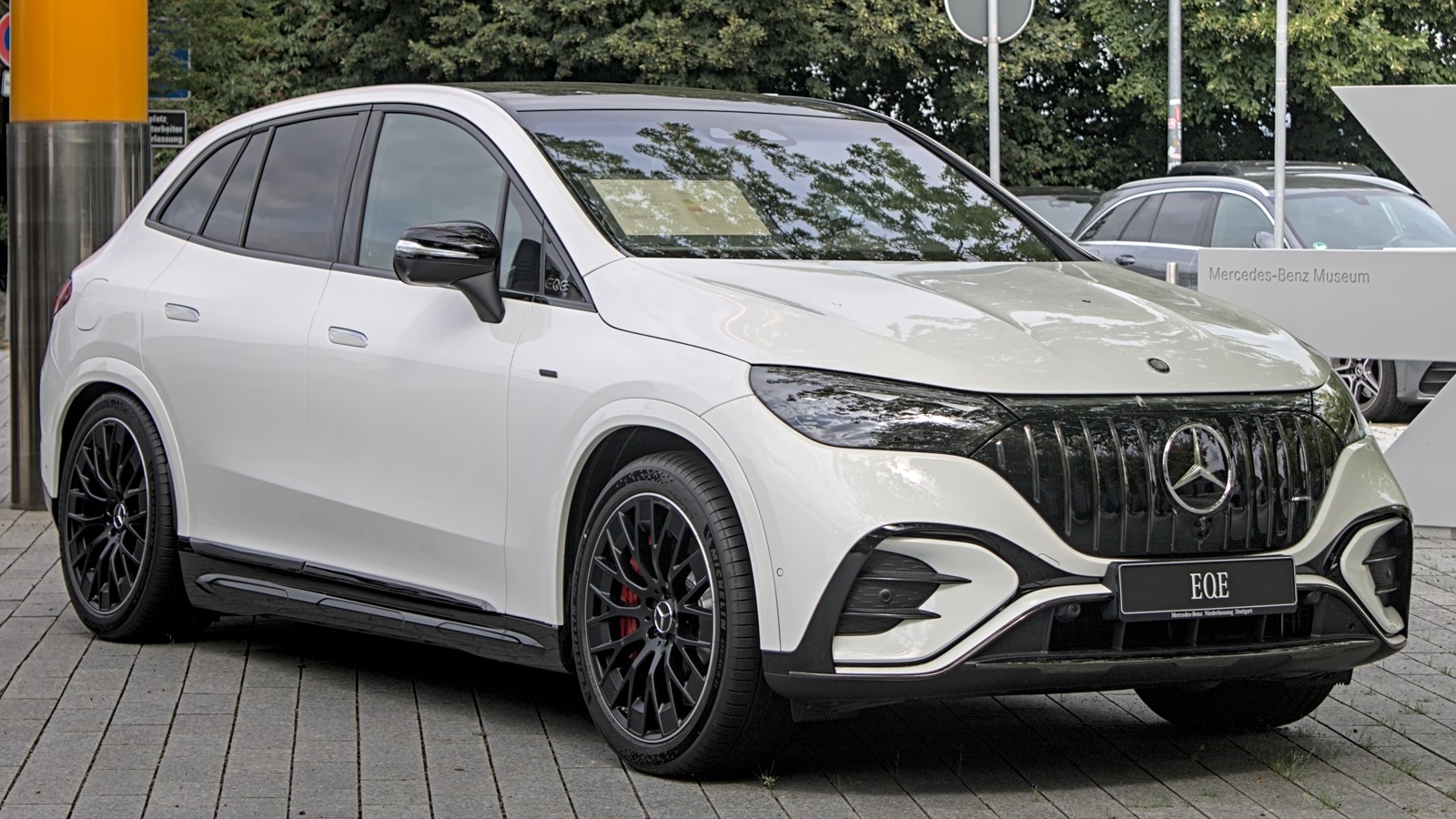
Mercedes-AMG presented what Mercedes calls its first full-size SUV developed in-house, an electric model, on Saturday, Oct. 17. The AMG GT SUV comes in three versions: the GT 63 with up to 860 kilowatts (1,169 PS) of peak output, the GT 55 and the GT 53. Mercedes quotes a charging peak of up to 710 kW with the larger battery, and says the entry GT 53 can be ordered from Oct. 20 at 113,050 euros in Germany. Unless a section says otherwise, the figures below come from Mercedes’ press release and are Mercedes’ own. Mercedes calls its charging and consumption figures preliminary: it says no confirmed values from an officially recognized testing organization and no EC type approval exist yet, and that deviations from official values are possible. It also says actual range depends on conditions.
What Mercedes announced
Mercedes says this is the first full-size SUV that AMG, its performance division, has developed itself from the ground up in the division’s 59-year history. It describes the car as “Born in Affalterbach,” after AMG’s home town, and as the second vehicle on its AMG.EA high-performance electric architecture. The first was the electric AMG GT four-door coupe, which Mercedes presented earlier this year.
The SUV is to be built at Mercedes-Benz’s Sindelfingen plant.
The three versions
Mercedes lists these figures for the three versions. In plain terms, peak is the maximum output for a short burst, and continuous is what Mercedes lists as the output the car can sustain. Mercedes also lists a boost duration for each version: 63 seconds for the GT 63, 55 for the GT 55 and 53 for the GT 53.
- GT 63 SUV: three axial-flux electric motors; up to 860 kW (1,169 PS) peak and 530 kW (721 PS) continuous; 2,000 newton-meters of torque; 0 to 100 km/h (62 mph) in 2.5 seconds (with the one-foot rollout); top speed 270 km/h (about 168 mph) with the Driver’s Package.
- GT 55 SUV: three axial-flux motors; up to 600 kW (816 PS) peak; Mercedes’ table prints 530 kW (721 PS) continuous; 1,860 newton-meters; 0 to 100 km/h in 2.8 seconds (with the one-foot rollout); top speed 270 km/h (about 168 mph) with the Driver’s Package.
- GT 53 SUV: two synchronous motors, one on each axle; 400 kW (544 PS) peak and 270 kW (367 PS) continuous; 800 newton-meters; 0 to 100 km/h in 3.8 seconds (with the one-foot rollout); top speed 250 km/h (about 155 mph) with the Driver’s Package.
The acceleration times use what is called a one-foot rollout. The timing starts after the car has already covered the first foot (30.48 centimeters), so that distance is not counted. Without the rollout, Mercedes gives 2.7 seconds for the GT 63, 3.1 for the GT 55 and 4.2 for the GT 53.
Mercedes describes an axial-flux motor as a compact, disc-shaped design in which the magnetic flux runs parallel to the axis of rotation. In the GT 63 and GT 55 the rear axle has two such motors and the front axle has one that works as a booster and is decoupled at low load. The GT 53’s front motor also acts as a boost drive that is decoupled at low load.
Mercedes lists these curb weights: about 2,525 kg for the GT 53 (the one weight in the German-language table, since it has only the smaller battery); 2,585 kg (106 kWh) or 2,695 kg (128 kWh) for the GT 63; and 2,605 or 2,715 kg for the GT 55.
Battery and charging claims
Mercedes offers two battery sizes on the GT 63 and GT 55, with usable capacity of 106 kilowatt-hours or 128 kilowatt-hours. The GT 53 is listed only with the 106 kWh battery. Both batteries run at 800 volts. The company says the cylindrical cells, each 105 millimeters tall and 26 millimeters across, are cooled by a non-conductive oil that flows around every cell. It gives an energy density of over 298 watt-hours per kilogram at the cell level.
The peak DC fast-charging power is 600 kW for the 106 kWh battery and 710 kW for the 128 kWh battery. A kilowatt figure is a rate, so 710 kW is the highest charging speed the car is designed to accept, not a speed it holds for a whole charge. Mercedes says fast charging above 700 kW is possible at 800-volt chargers rated at 1,000 amps, according to Mercedes, depending on the battery.
Mercedes’ stated charging times:
- 10 to 80 percent charge in about 11 minutes (106 kWh) or up to 12 minutes (128 kWh) at the maximum DC power.
- 14 minutes (106 kWh) or 16 minutes (128 kWh) at a 400 kW charger.
- Added WLTP range in 10 minutes: up to about 450 kilometers with the 128 kWh battery on the GT 63 and GT 55.
Mercedes’ table lists up to about 386 kilometers of added range in 10 minutes for the GT 63 and GT 55 with the 106 kWh battery, and up to about 440 kilometers for the GT 53, which also has only the 106 kWh battery. Both lines list 70 kWh added in 10 minutes in Mercedes’ table, and the GT 53 lists the lower energy consumption (21.1-18.8 versus 23.4-20.9 kWh per 100 km). The press release itself does not explain the difference.
Two conditions come with these numbers. The company says the charging figures are preliminary. It also says the range added after 11 or 12 minutes was determined at maximum DC power under ISO/SAE 12906 conditions. Mercedes’ table labels the same added-range figure as “after 10 minutes,” and the press release does not reconcile the two timings.
Mercedes also says the car can charge at 400-volt stations, switching automatically from 800-volt to 400-volt mode, which it says helps in regions with limited charging infrastructure. It says the car is designed for five fast-charging connector standards: CCS2 (Europe), GB/T (China), CHAdeMO (Japan), CCS1 (South Korea) and NACS (United States).
What the range figures mean
WLTP is the standardized laboratory test procedure used for official range figures in Europe. These are Mercedes’ own WLTP figures, and U.S. EPA range ratings come from a different test procedure, so the numbers are not directly comparable with the ranges U.S. buyers usually see. Mercedes lists a combined WLTP range of 525 to 585 kilometers for the GT 63 and GT 55 with the 106 kWh battery, and 620 to 700 kilometers with the 128 kWh battery. For the GT 53 it lists 597 to 668 kilometers.
Mercedes says actual range depends on driving style, conditions, battery ageing, auxiliary loads such as climate control, options, tires, load and route, and can differ from the WLTP value. Its energy consumption figures for the GT 63 and GT 55 run from about 21 to 24 kWh per 100 km, depending on the battery.
What is for sale, and when
Mercedes says the GT 53 can be ordered from Oct. 20 and gives a price from 113,050 euros. Mercedes describes this as the non-binding German list price, including 19 percent value-added tax. The GT 63 and GT 55 follow in spring 2027. The company’s press release does not say whether that means the start of orders or deliveries, and it gives no prices for those two versions.
The press release names no price or date for the United States or any other market. Electrek reports that the first units will reach U.S. dealers in summer 2027, without naming a source for that timing. Auto Express gives an estimate of around 110,000 pounds for the GT 53 and says UK prices and specifications are still to be announced.
Horsepower versus PS
The press release gives output in kilowatts and in PS, the German abbreviation for metric horsepower. A PS is about 1.4 percent smaller than the mechanical horsepower unit used in the United States, so 1,169 PS works out to roughly 1,153 hp. Electrek and Auto Express use the 1,153 hp figure for the top output. Outlets give differing hp figures for the smaller versions (for the GT 55: 805 at Electrek, 809 at Auto Express, 816 at Autocar India, which labels the PS figure hp); these differences are not reconciled here.
Other features
Mercedes describes a new AMG Active Ride Control+ suspension with pitch and roll stabilization, standard on the GT 63 and optional on the GT 55, along with standard active rear-axle steering. A driving program called AMGFORCE Sport+ plays back the sound of an AMG V8 (GT 63 and GT 55) or a six-cylinder (GT 53). According to Mercedes, it reproduces recorded AMG engine sounds. The program also simulates gear changes.
What is not known
Several things are not yet known:
- Official, type-approved values for the charging and consumption figures. Mercedes says no confirmed values from a recognized testing organization, no EC type approval and no certificate of conformity exist yet, and deviations are possible.
- Prices for the GT 63 and GT 55, and any U.S. price.
- A U.S. EPA range figure.
- Exactly what “spring 2027” means for the two larger versions.
- Real-world range and charging times.
- Whether markets other than Germany can order on Oct. 20.
What comes next
Mercedes says the GT 53 can be ordered from Oct. 20 and gives a German list price. The GT 63 and GT 55 are due in spring 2027. The press release does not say when official values will be published.