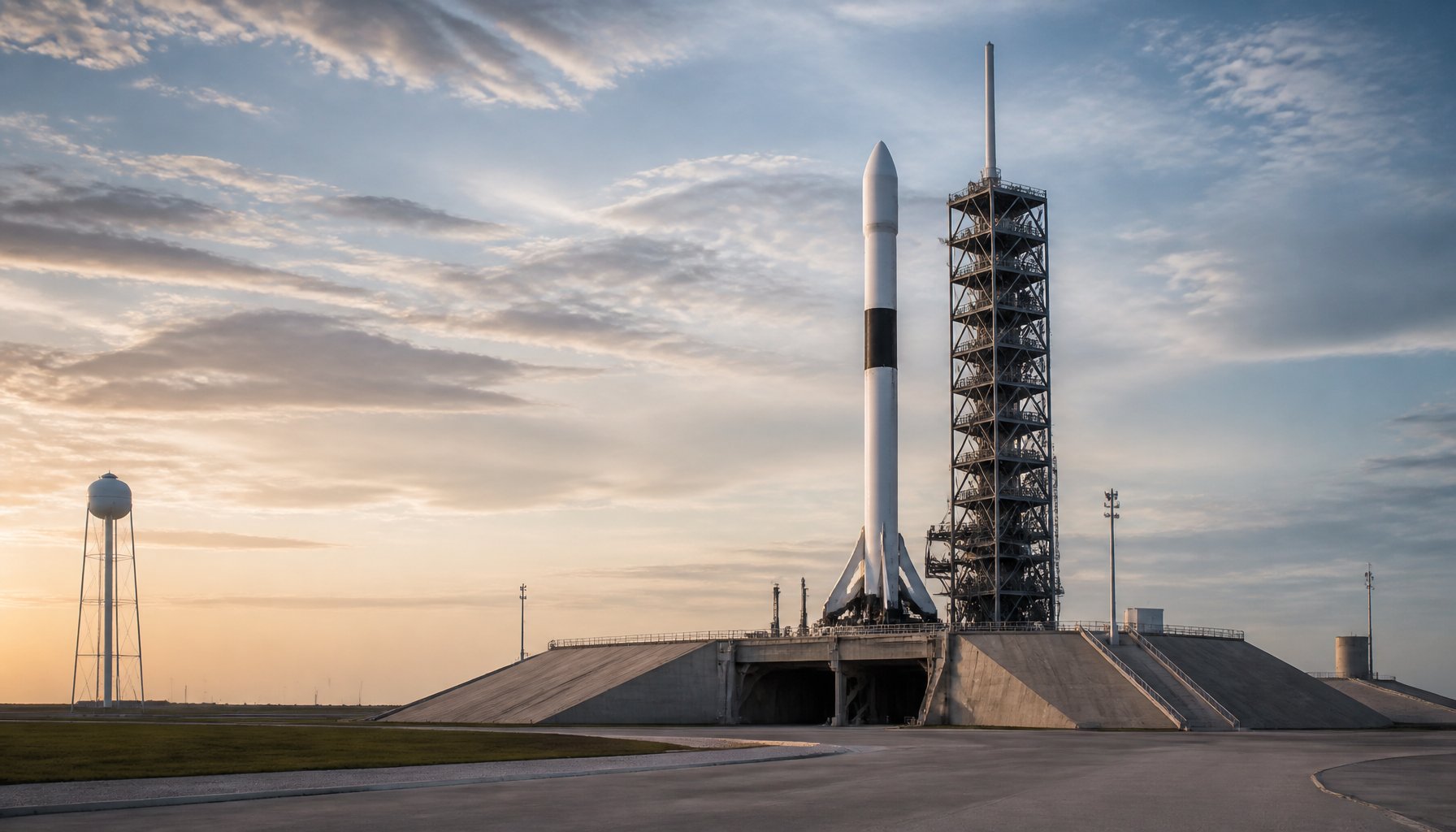
SpaceX launched two Falcon 9 rockets from opposite U.S. coasts about 38 minutes apart on Saturday, Aug. 15, 2026 — the shortest gap the company has ever managed between two orbital launches. SpaceX’s previous record was about 65 minutes, set in August 2024.
Key facts
- Date: Saturday, Aug. 15, 2026
- Gap between launches: About 38 minutes apart — a new SpaceX record, beating the previous mark of about 65 minutes set in August 2024
- First launch: 9:12 p.m. EDT from Space Launch Complex 40, Cape Canaveral Space Force Station, Florida — carried Globalstar 2-R Launch 1 (eight satellites, according to post-launch reports); booster landed at Landing Zone 40 about eight minutes later
- Second launch: 9:50 p.m. EDT (6:50 p.m. Pacific) from Space Launch Complex 4E, Vandenberg Space Force Base, California — carried USSF-366, a classified U.S. Space Force payload; booster landed on the droneship “Of Course I Still Love You”
The first rocket lifted off at 9:12 p.m. EDT from Space Launch Complex 40 at Cape Canaveral Space Force Station in Florida. It carried Globalstar 2-R Launch 1, a batch of satellites meant to replenish Globalstar’s low-Earth-orbit communications constellation. The Falcon 9’s first-stage booster, flying its 14th mission, landed back at Landing Zone 40 near the pad about eight minutes after liftoff.
About 38 minutes later, on the opposite coast, a second Falcon 9 rose from Space Launch Complex 4E at Vandenberg Space Force Base in California at 9:50 p.m. EDT (6:50 p.m. Pacific). That rocket carried USSF-366, a classified payload for the U.S. Space Force. Its booster landed on the droneship “Of Course I Still Love You” in the Pacific Ocean. It isn’t clear from the available record whether SpaceX planned the tight gap between the two launches or whether the two independently scheduled missions simply happened to line up that close together.
Post-launch reports from Spaceflight Now and MDA Space’s own announcement put the Globalstar satellite count at eight.
The eight satellites are the first of 17 second-generation Globalstar replenishment spacecraft that MDA Space is building under a contract signed in early 2022 — nine more are still being assembled, meaning at least one more SpaceX launch for Globalstar is still to come. The constellation’s expansion is tied in part to Apple: the company has committed roughly $450 million toward the satellites and their launches, and reserved a large share of Globalstar’s network capacity for the iPhone’s Emergency SOS satellite feature.
A busy stretch for Falcon 9
Saturday’s doubleheader came during one of SpaceX’s busiest stretches of the year. According to Spaceflight Now, SpaceX had completed at least 93 Falcon 9 missions in 2026 as of Aug. 11. Space.com’s report on Saturday’s doubleheader put the year-to-date total at 96 after the two launches. About three in four of this year’s Falcon 9 flights have been dedicated to launching SpaceX’s own Starlink internet satellites — among them a Starlink launch from Vandenberg on Aug. 8 and Starlink launches from both Cape Canaveral and Vandenberg on Aug. 11. Spaceflight Now has also reported that SpaceX is ramping up its West Coast launch cadence from Vandenberg even as its East Coast flight rate has slowed, a shift the outlet ties to the company concentrating resources on Starship development. The same outlet counted the Aug. 8 Vandenberg launch as SpaceX’s 50th flight from the West Coast this year.
SpaceX’s two main rivals, meanwhile, are not currently flying. United Launch Alliance’s Vulcan rocket has been grounded since a solid-rocket-booster anomaly on a February 2026 flight, and Blue Origin’s New Glenn has been out of action since a pad explosion during a static-fire test on May 28, which the company later traced to a faulty oxygen valve on one of its engines. Both companies are targeting a return to flight before the end of 2026.
SpaceX’s momentum this year hasn’t been limited to the launch pad. The company began trading on the Nasdaq under the ticker SPCX in June 2026, in what several outlets called the largest IPO in history, raising about $75 billion and valuing the company near $2.1 trillion; the stock rose about 19% on its first day of trading. The stock has been volatile since: on Aug. 10, 2026, it closed above its $135 IPO price for the first time in several weeks.
Starship’s next test remains unscheduled
SpaceX’s Starship program, tested separately from the Falcon 9 fleet, had its most recent flight on July 24, 2026. The Starship upper stage deployed 20 third-generation Starlink satellites — the program’s first payload delivery — relit an engine in space and made a controlled splashdown in the Indian Ocean. The Super Heavy booster did not fare as well: several of its engines failed to restart for the landing burn, and it was destroyed in a hard splashdown in the Gulf of Mexico instead of the tower catch SpaceX had planned.
The next Starship test, Flight 14, has no confirmed launch date. Advanced Television reported Aug. 13 that the flight was likely before the end of August but that SpaceX had not fixed a date, citing a public filing with the Federal Communications Commission describing a plan to catch both the booster and the ship with the launch tower’s arms. That flight would also be the first to carry Starlink V3 satellites, SpaceX’s third-generation design, for operational use rather than the test deployment flown in July.
What comes next for SpaceX
Published launch schedules list a Starlink mission from Vandenberg around Aug. 18-19 and another from Cape Canaveral around Aug. 20, though schedules can change. NASA’s Crew-13 mission to the International Space Station, also flying on a Falcon 9, is next listed for mid-September.