Netflix’s new true-crime drama about Lizzie Borden is streaming now, and it tells a story the historical record does not support. The series shows Lizzie committing the ax murders of her father and stepmother, then adds a fictional romance, an abusive stepmother and a link to an unrelated killing — none of which the documented case supports.
“Monster: The Lizzie Borden Story” premiered on Netflix on Sept. 17, 2026, with all eight episodes released at once. It is the fourth season of the “Monster” anthology from Ryan Murphy and Ian Brennan, and Brennan created and wrote this installment. The cast includes Ella Beatty as Lizzie Borden, Charlie Hunnam as her father Andrew, Rebecca Hall as stepmother Abby and Billie Lourd as sister Emma. It also includes Vicky Krieps as the family’s maid Bridget Sullivan, Jessica Barden as actress Nance O’Neil and Joey Pollari as Lizzie’s uncle John Morse. Sarah Paulson also appears, as Aileen Wuornos, in a framing storyline in episode four — a role plainlynow.com covered when the trailer first surfaced. Beatty has described the show’s aim as “exploring a legacy of female rage and reaction to the set of circumstances that they are presented with.”
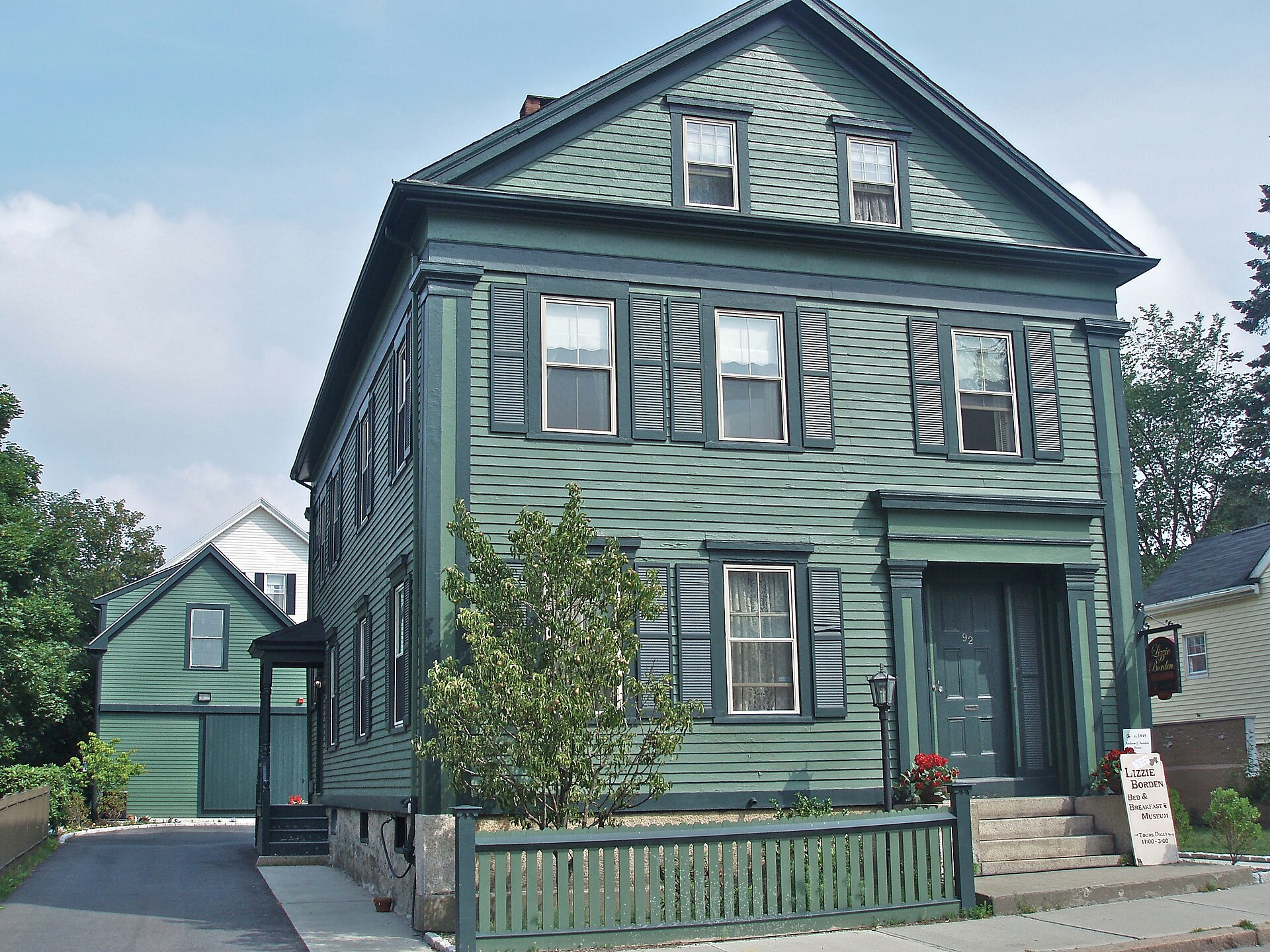
On Aug. 4, 1892, Andrew and Abby Borden were killed with a hatchet at the family’s home at 92 Second Street in Fall River, Massachusetts — Abby first, Andrew later that same morning. Lizzie was arrested on Aug. 11 after giving inconsistent accounts at an inquest. Investigators found a hatchet head with a broken handle in the cellar, but a Harvard chemist found no blood on the household’s tools. Family friend Alice Russell testified that she saw Lizzie burn a dress the Sunday after the murders; Lizzie said it was paint-stained, and Emma testified she had suggested burning it. A druggist’s claim that Lizzie tried to buy poison the day before the killings was excluded from trial, as was her own inquest testimony. The trial opened June 5, 1893, in New Bedford, and an all-male jury acquitted her on June 20, 1893, after about an hour and a half of deliberation, according to History.com. No one else was ever charged. The case remains officially unsolved. After the trial, Lizzie and her sister Emma bought a house they named Maplecroft; Lizzie went by the name “Lizbeth” and died in Fall River on June 1, 1927.
Several of the show’s central storylines have no support in that record, according to reporting from TheWrap, TV Insider and Boston.com.
The romance. The series builds toward a romance between Lizzie and Bridget Sullivan, whom TheWrap describes as her “lover” in the show. TheWrap reports there is “no historical evidence to support the pervasive theory that the real Lizzie Borden was a lesbian,” and that in real life the two “weren’t very close.” The real Bridget later moved to Montana and married, according to Boston.com.
The stepmother. The show portrays Abby Borden as abusive. TV Insider reports “there is no historical evidence that Abby Borden abused her maids or her stepdaughters.”
Andrew and a maid. The series suggests Andrew Borden had an inappropriate relationship with a household maid. TV Insider reports no historical evidence supports that either.
The Bertha Manchester connection. The show ties Lizzie to the ax murder of Bertha Manchester, a 22-year-old killed in Fall River days before Lizzie’s 1893 trial — while Lizzie was in jail. Jose Correa de Mello was convicted of that killing, and there is no Borden link, TheWrap and TV Insider report.
Nance O’Neil’s timing. The series shows the actress helping Lizzie around the time of the trial. In life, the two met in 1904, more than a decade after the acquittal, and the dinner the series places at the Second Street house actually took place at Maplecroft, the house Lizzie bought after the trial, according to TV Insider.
Guilt. The show depicts Lizzie committing the murders outright. Legally, she was acquitted, and who killed the Bordens has never been resolved.
The romance angle is not a new invention for this show. Brennan has said the series explores a theory “concocted by author Evan Hunter in his 1984 novel, ‘Lizzie,’” that Bridget Sullivan and Lizzie were in a lesbian relationship, according to Boston.com. Brennan has defended folding that theory into the series; he told Vanity Fair, as quoted by Boston.com, that “absence of evidence is not evidence of absence.” The friendship that did happen, with Nance O’Neil beginning in 1904 and lasting about two years, left no surviving letters, according to Mental Floss, though historian Cara Robertson has called it “definitely romantic, but maybe not sexual” — her interpretation, not a documented fact. Brooke Doherty, one of the private homeowners who now live at Maplecroft, told Time: “The longer we live here, the more we’re convinced she didn’t do it” — a personal view, not a finding from any historical body.
Early reviews are split. TheWrap’s Matthew Creith was critical of the show’s liberties, writing: “Murphy and Brennan have a different question: What if we just make up what happened before the axe came down?” Variety’s Aramide Tinubu was more favorable, calling it “a highly watchable depiction of one of the most gruesome crimes in American history” while noting that “the narrative, of course, bends and twists the truth of what actually occurred in the Borden home that infamous Thursday morning.” As of Sept. 18, Rotten Tomatoes showed a mixed early tally based on a small number of reviews, a number likely to shift as more critics weigh in.
What the show cannot resolve, because no one has, is who actually killed Andrew and Abby Borden. Lizzie was tried and acquitted; no one else was ever charged. More than 130 years later, the Fall River murders remain an open question — one the series answers with fiction, not with new evidence.