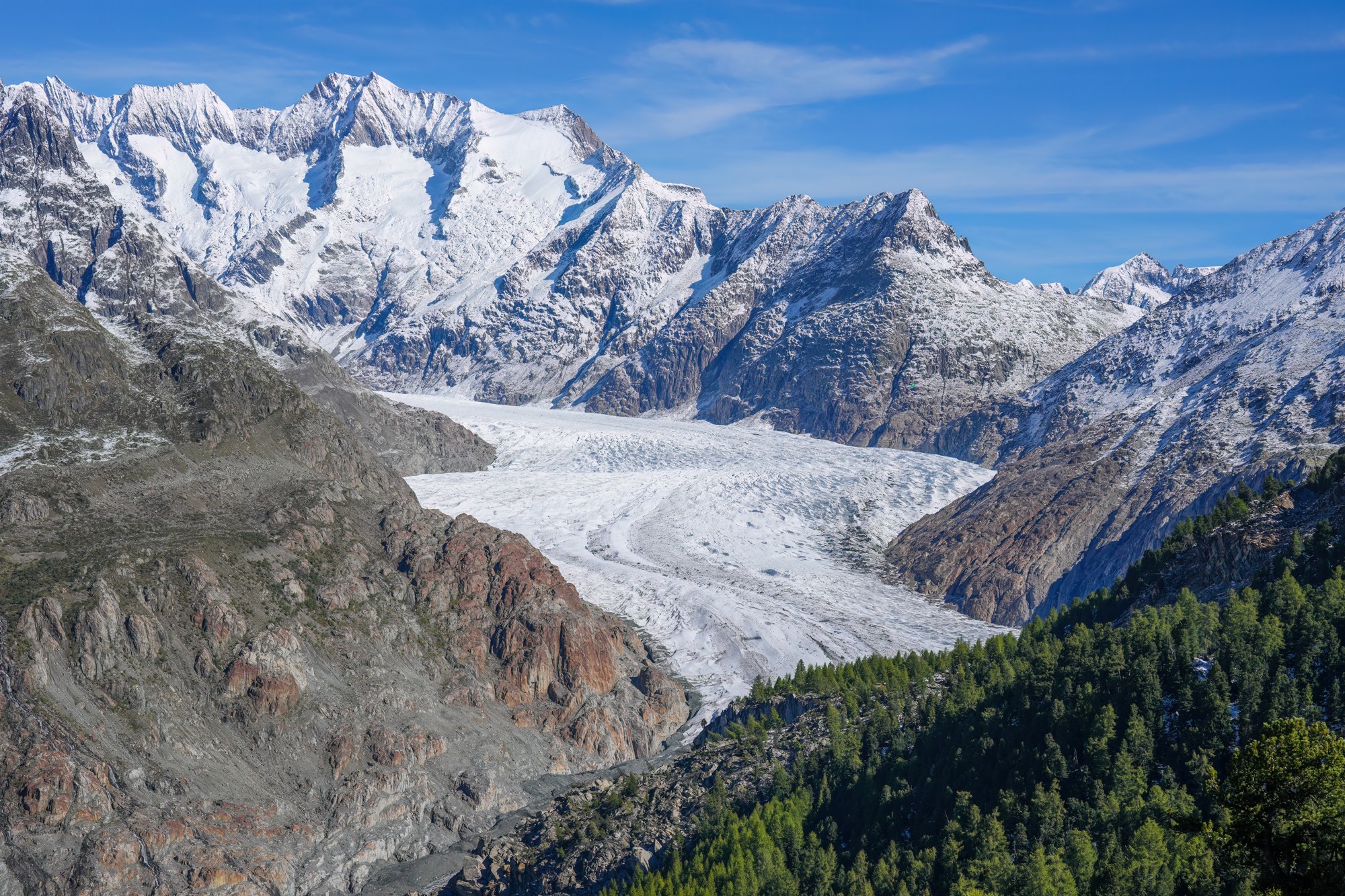
Glaciers in Switzerland lost 5.5% of their ice volume this year, the second-biggest annual drop in GLAMOS’s records, the Swiss glacier monitoring service GLAMOS reported Thursday. Only 2022 was worse. GLAMOS’s longer record shows the losses are speeding up.
What GLAMOS measured
Crews measured 23 glaciers across the Swiss Alps in September. Mass balance is the net amount of snow and ice a glacier gains or loses over a year, expressed as a layer of water. GLAMOS reports an average of about minus 2.9 meters for 2026. GLAMOS then extrapolated to all Swiss glaciers: “Extrapolated to all glaciers, this corresponds to further reduction of the Swiss ice volume by 5.5%.”
Ten of the measured glaciers lost more than 3 meters of water equivalent, among them Grosser Aletsch, Gries, Clariden and Otemma. The report says only some glaciers reached such values in the record year 2022, and none in any other year since regular observations began in 1914. At the lowest site on Grosser Aletsch, at 1,980 meters, up to about 13 meters of ice melted.
A decade-by-decade acceleration
GLAMOS gives the share of Swiss ice volume lost in each recent decade: “10% of the Swiss ice volume disappeared in the decade 1990-2000, it was 14% in 2000-2010, 17% in 2010-2020 and 27% over the last decade (2016-2026).”
The five years from 2022 to 2026 stand out even against that trend. The report says melt rates in that period “have been more than twice as high as in any previously monitored 5-year period,” resulting in an ice volume loss of almost 20% since 2021.
GLAMOS’s chart of annual change puts 2026 in context. After 2022 (minus 5.9%) and 2026 (minus 5.5%) come 2023 (minus 4.4%), 2003 (minus 3.5%), and 2017 and 2025 (minus 3.0% each). Total Swiss ice volume was 75.2 cubic kilometers in 2001; GLAMOS estimates about 42.6 cubic kilometers for 2026. By Plainly Now’s arithmetic, that is a decline of about 43% in 25 years.
What drove the 2026 losses
GLAMOS names two main drivers. The winter left a Swiss-wide snow deficit on glaciers of 25%. Then, citing MeteoSwiss, the report says “The summer months June to August were the hottest on record.”
The zero-degree line, the altitude where air temperature crosses freezing, sat above 4,000 meters for 76 days between May and September. GLAMOS calls that “more than twice as much as on average and a new record value.” Across 13 glaciers with detailed data, the previous winter’s snow was gone on average by July 2, the second-earliest date after 2022.
Less meltwater than in 2003
One finding runs against intuition. In total volume, GLAMOS estimates that 2026 lost 2.5 cubic kilometers of ice, which ranks only third in recent decades. GLAMOS says the year “provided less water to downstream areas than the year 2003,” even though in 2003 the specific melt rates were 25% lower than in 2026.
The reason is size: melt per unit of area is higher, but the glaciers cover much less area than they once did, so the total released is smaller. The report concludes that “the peak melt water release from Swiss glaciers has likely been passed with the recent extreme years.”
GLAMOS says this declining trend is expected to pose challenges for water management, including irrigation, hydropower, ecology and transportation, especially during droughts. The Associated Press notes that Switzerland gets more than half its electricity from hydropower and that Switzerland feeds the Danube, Po, Rhine and Rhone.
Glaciers that no longer exist
GLAMOS says more than 1,000 Swiss glaciers vanished between 1973 and 2016 and about 100 more between 2016 and 2023; a full count for 2026 will come with the next inventory, around 2028. GLAMOS says photographic reports already show the complete demise of two glaciers that had extensive measurement series: Bella Tola in Valais and Plattalvafirn in Glarus.
What the scientists say
GLAMOS and the Swiss Academy of Sciences said in a statement that “Alpine glaciers have no chance of surviving in the long term under such conditions,” the AP reported.
Matthias Huss, who heads GLAMOS, said, according to the AP: “The warming that we are experiencing now can be attributed 100% to anthropogenic climate change. It’s as simple as that.”