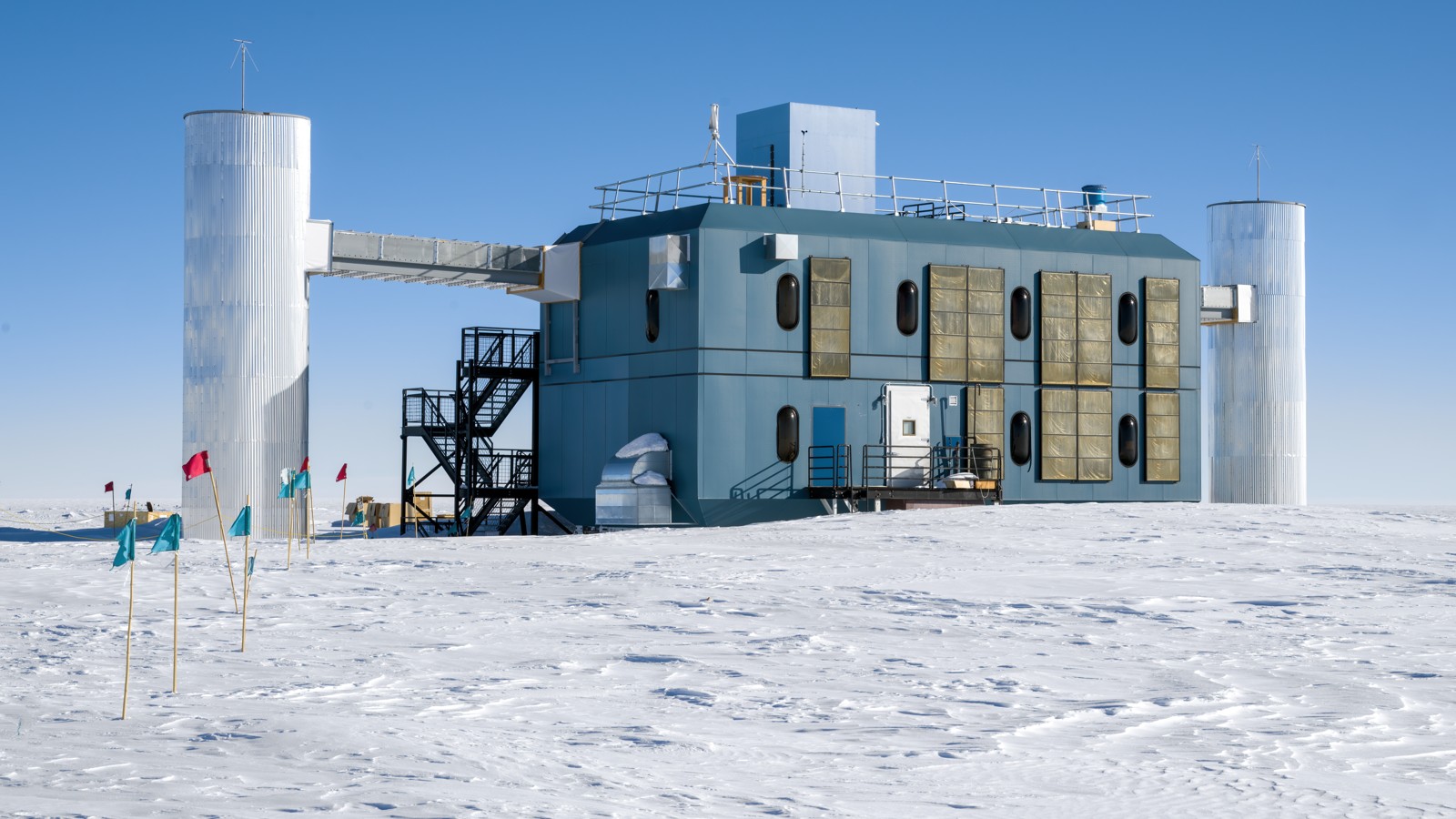
As of about 4:38 p.m. EDT Tuesday, Oct. 6, 2026, the Royal Swedish Academy of Sciences has awarded the Nobel Prize in Physics to Francis Halzen of the University of Wisconsin-Madison for his work on IceCube, a detector built in the ice at the South Pole to catch neutrinos.
Who won and for what
Ellen Moons, secretary-general of the Royal Swedish Academy of Sciences, announced the award Tuesday in Stockholm. The Associated Press (published by NBC News) calls her the first woman to head the academy and present the award.
The Academy’s citation says the prize goes to Halzen “for decisive contributions to the IceCube Neutrino Observatory and the discovery of high-energy neutrinos of astrophysical origin.” According to the Nobel announcement, he was born in 1944 in Tienen, Belgium, took his PhD at KU Leuven in 1969, and is a professor at Wisconsin-Madison. The university says he joined its physics faculty in 1972 and oversaw the design and development of IceCube and its predecessor experiment, AMANDA. The Associated Press, in its report published by NBC News on Oct. 6 (published 4:30 a.m. EDT, updated 7:19 a.m. EDT), calls him “the 82-year-old scientist.”
The prize amount is 12 million Swedish kronor, which the AP puts at about $1.2 million. Physics World, in its Oct. 6 report, says it will be awarded in Stockholm on 10 December. Physics World also says Halzen is the first sole winner of the physics prize since Georges Charpak won it in 1992, and that Pierre-Gilles de Gennes was the previous lone laureate, in 1991.
What a neutrino is, and why it is hard to catch
The Nobel press release describes neutrinos this way: “Neutrinos are everywhere, but they do not make themselves known. They pass all the way through the Earth and through our bodies without us noticing. Very rarely, a single neutrino will interact with an atomic nucleus, which makes it possible for someone with the right equipment to discover them.”
The AP, in the copy NBC News published, writes that neutrinos “spew from stars like the sun” and that trillions “zip through our bodies every second.” It says scientists “measure what happens when the tiny particles collide with other bits of matter, producing flashes of light or charged particles.”
The Nobel press release explains why that effort is worth making: “unlike other particles, neutrinos reach us without changing direction or losing energy. This means they can provide information that is not available in any other way.”
The University of Wisconsin-Madison makes a related point about cosmic rays. Unlike the neutral neutrino, it says, cosmic rays are charged particles whose paths cannot be traced directly back to their sources, while the powerful cosmic accelerators that produce them, such as supermassive black holes, also produce neutrinos. Those neutrinos, it says, travel nearly undisturbed, “giving scientists an almost direct pointer to their source.”
What IceCube is and how it works
The Nobel press release says Halzen “realised that ice at the South Pole could be used to track particles known as neutrinos.” It describes IceCube as “a cubic kilometre of ice that is equipped with light sensors.” The press release says the South Pole ice “is free from various types of interference and the area is geologically stable, with no earthquakes.”
Physics World gives the size of the instrument. It says IceCube comprised 5160 digital optical modules suspended along 86 strings, each up to 2.5 km long, at the Amundsen-Scott South Pole Station.
The University of Wisconsin-Madison calls Halzen the principal investigator of the NSF IceCube Neutrino Observatory, which it describes as “the world’s largest – and perhaps strangest – telescope.” It says the U.S. National Science Foundation-funded observatory is operated by an international collaboration of scientists led by the Wisconsin IceCube Particle Astrophysics Center, based at the university.
The sources differ on when the detector was finished. The Nobel press release says IceCube “was finished in 2011.” Physics World says it “was completed in late 2010,” after an earlier detector, AMANDA, which Physics World says was completed in 2000 but was not large enough, was expanded. The university says the recent upgrade is the observatory’s first significant expansion since its completion 15 years ago.
The Nobel press release says Halzen first presented his vision for capturing neutrinos at the South Pole in 1988. Mark Pearce, chair of the Nobel Committee for Physics, told Physics World that Halzen “had the idea together with a colleague in 1988 to use the ice at the South Pole as a medium to detect neutrinos.”
IceCube’s milestones, as the sources tell them
Physics World lays out these steps in the detector’s history:
- 2013: the IceCube Collaboration published its observation of 28 extremely high-energy particle events, “created by neutrinos with energies of at least 30 TeV.” Physics World calls this the first evidence for high-energy cosmic neutrinos. Two years later, an independent Northern Hemisphere search confirmed their cosmic origin.
- 2018: working with two gamma-ray telescopes, the collaboration found “compelling evidence” that the blazar TXS 0506+056, about 4 billion light-years away, is a source of high-energy neutrinos.
- 2021: the first spotting of a Glashow resonance, which was predicted in 1959.
- 2022: the galaxy NGC 1068 was identified as a source.
- 2023: IceCube showed that the Milky Way is a source of high-energy neutrinos.
- This year: “an upgrade of IceCube added more than 600 new light sensors in five new holes drilled in the ice near the centre of the detector.”
Physics World also notes that Halzen and colleagues won its Breakthrough of the Year award in 2013.
The University of Wisconsin-Madison’s own timeline overlaps with this one but is worded differently. It says IceCube announced the first detection of high-energy neutrinos from outside the solar system in 2013, and that “in September 2017, IceCube detected a high-energy neutrino from a supermassive black hole at the center of a distant galaxy in the direction of the constellation Orion.” It adds that IceCube provided the first evidence of high-energy neutrino emission from an active galaxy 47 million light-years away in 2022, and from the Milky Way in 2023, and that these detections “demonstrated that all three of these sources produce cosmic rays.” Physics World dates the evidence paper on the blazar to 2018; the university dates the neutrino detection to September 2017.
The collaboration behind IceCube
Pearce told Physics World that Halzen “has spearheaded an international collaboration of more than 450 people from 58 institutions in 14 countries around the world to realize this enormous neutrino detector.” In the Nobel press release, Pearce says: “Francis Halzen has led an international team of researchers and engineers who have provided us with a fantastic instrument.”
Halzen himself pointed to his collaborators. Physics World quotes him: “I want to emphasize again how lucky I was to take contributions from collaborators. It feels strange. I hope it reflects on the courageous people who joined me on this project. Many talented people joined me on this journey.”
Committee member Eva Olsson, quoted by the AP, said: “People joined him in the quest for these neutrino messengers. The messenger is bringing information from cosmos. They opened the door to distant galaxies and tell us about the processes of exploding stars.”
What the committee says it means
Pearce, in the Nobel press release: “His tenacity and scientific vision has paved the way for a new kind of astronomy.” The press release also says the data IceCube collects “will provide researchers with novel knowledge about the violent settings in which high-energy neutrinos can be created – and could even reveal previously unknown cosmic phenomena.”
Reactions
Michael Moloney, CEO of the American Institute of Physics, told the AP: “This experiment in the Antarctic is a revolutionary way of understanding the universe that we didn’t have before.”
The University of Wisconsin-Madison published its own announcement on Oct. 6. Interim Chancellor Eric M. Wilcots said in it: “IceCube is like no other telescope in the world. And there is no other scientist quite like Francis Halzen, whose idea to create a neutrino detector under almost a mile of ice has led to a remarkable multinational and multi-institutional scientific collaboration and a fundamental shift in how we think about the universe.”
Halzen’s reaction
Speaking by phone, Halzen told Physics World: “It was a great surprise and I didn’t expect it. It’s a great pleasure to hear about this prize.” In the AP’s account, he spoke to the committee by phone from Italy and said: “It was a great surprise and I obviously didn’t expect it.” The AP says he “said it was predicted before that he would win the Nobel Prize but the announcement still made him feel ‘strange.'”
He also described the project to Physics World: “This was an adventure where success was not guaranteed, but we overcame many challenges. It was a long journey.” He said he “was lucky to be in the right place” at Wisconsin when the idea to build IceCube came up.
In the university’s announcement, Halzen says: “This is a celebration of a very unusual project. It is difficult to imagine that we could have pulled this off anywhere but at UW-Madison with its unique research infrastructure. The success of this project involved some luck, and I was fortunate to be at UW, where unconventional ideas can thrive and where I had the support of a remarkable community, from talented engineers at the Physical Sciences Laboratory to long-time colleagues on the faculty and supportive administrators. It is hard to imagine this project happening anywhere else.”
Asked about aliens, he told Physics World: “I think we have enough realistic problems to deal with right now to make neutrino astronomy a reality.”
What is not yet known
- Statements from IceCube and the university. The AP report, published at 4:30 a.m. EDT and updated at 7:19 a.m. EDT on Oct. 6, said a representative from the IceCube Neutrino Observatory “did not immediately return a request for comment” and that the University of Wisconsin-Madison “did not immediately have a comment when reached by the AP.” The university has since published its own announcement, dated Oct. 6 with no time of day. The sources quoted here include no separate statement from the IceCube Collaboration or from the National Science Foundation.
- Halzen’s proposal. Both Physics World and the AP quote him saying he is working on a proposal and hopes the prize will help get it approved. Neither describes what the proposal is.
- Why one laureate. The Nobel press release says Halzen’s “vision and scientific leadership have been fundamental for the IceCube Neutrino Observatory.” Pearce’s quoted remarks say Halzen “led” the international team, “spearheaded” the collaboration, and describe his “tenacity and scientific vision.” The Nobel press release and the reports quoted here do not say why the prize was given to one person.
What comes next
The Nobel announcements continue this week. According to the AP, the announcements began Monday with the medicine prize and continue Wednesday with chemistry; physics was announced Tuesday. Last year, the AP notes, three scientists won the physics prize for quantum tunneling work. The AP says the prize money is the same 12 million kronor “whether for an individual, a small group of laureates or an organization.”
Physics World reports that this is the fifth Nobel prize related to neutrinos. It lists the earlier ones as the muon neutrino (1988), the first observation of the neutrino (1995), the detection of cosmic neutrinos (2002) and neutrino oscillations (2015). Physics World says the formal presentation of this year’s prize is set for Stockholm on 10 December.
For the university, the University of Wisconsin-Madison says Halzen becomes the sixth physicist connected to the university to earn a Nobel Prize, and that it is the 23rd Nobel Prize tied to the university overall. It says the last active faculty member to win one was Howard Temin in 1975.