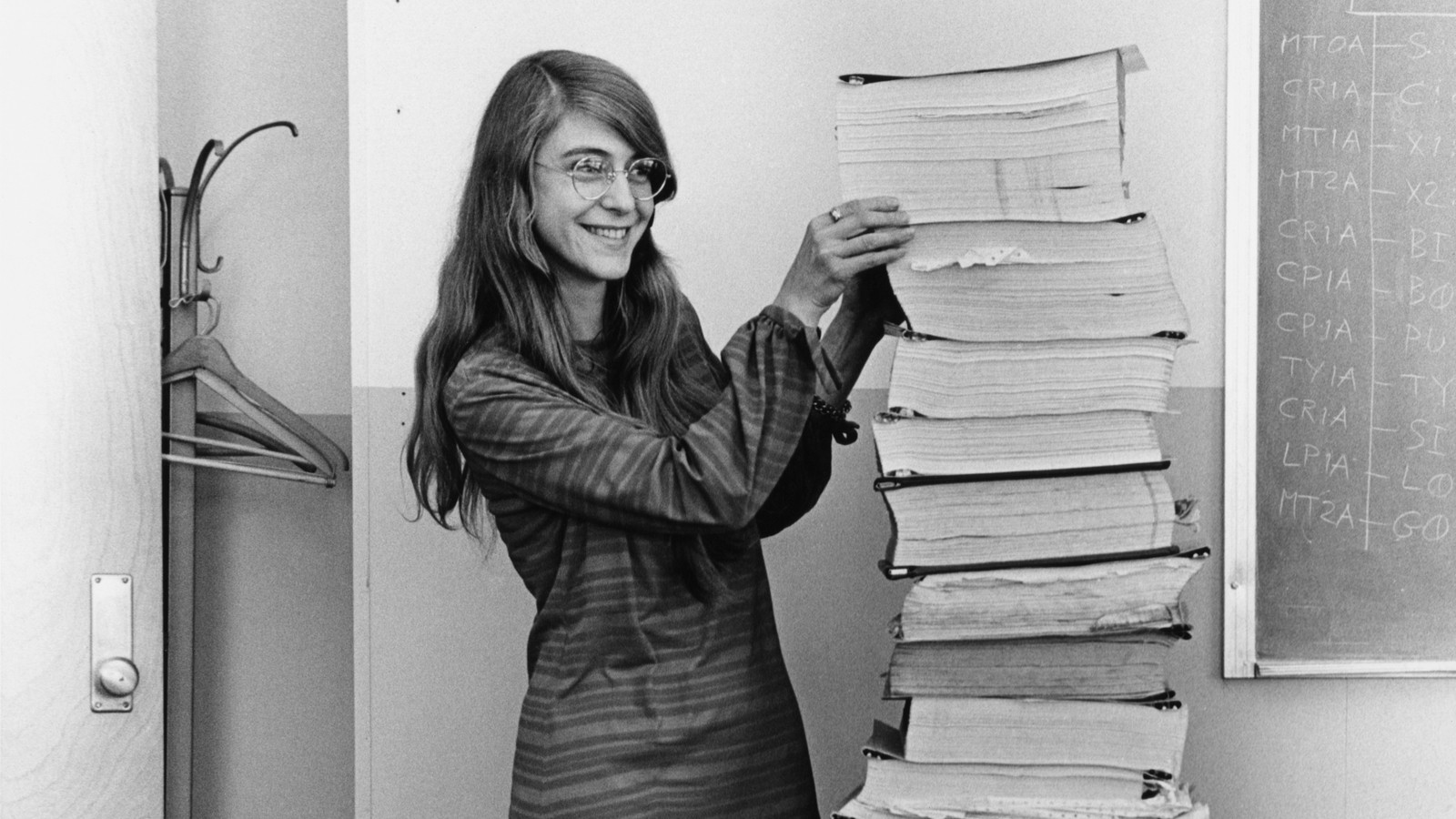
As of about 12:50 a.m. EDT Thursday, Oct. 8, 2026, MIT News has reported that Margaret Hamilton, the computer scientist who led a software engineering team at MIT’s Instrumentation Lab during NASA’s Apollo program, died on Sept. 30 at age 90.
What has been announced, and what has not
MIT announced her death on Wednesday, Oct. 7, 2026, and gives Sept. 30 as the date of death. Its text says Hamilton, “a profoundly influential computer scientist best known for leading the software engineering team at MIT’s Instrumentation Lab during NASA’s Apollo program, died on Sep. 30. She was 90.”
CNN reported that MIT “confirmed her death in a post from the department of aeronautics and astronautics” and that “the cause of her death was not disclosed.” MIT’s announcement does not give a place of death.
Draper’s president and CEO is quoted in that announcement. This account rests on MIT News and CNN. Other outlets, including The New York Times, also published obituaries on Oct. 7 that are not summarized here and may carry details MIT’s announcement does not, such as a place of death or confirmation from the family.
From weather prediction to an air-defense system
According to MIT News, Hamilton was born in Paoli, Indiana, in 1936. She began studying mathematics at the University of Michigan in 1955, then transferred to Earlham College, where she earned a bachelor’s degree in mathematics with a minor in philosophy in 1958. In 1959 she moved to Boston with her husband, who was pursuing a law degree.
MIT says Hamilton “soon found a temporary position in the meteorology department at MIT,” working with professor Edward N. Lorenz on weather prediction software. MIT calls this “her first entry point into computer programming.”
In 1961 she became a programmer at MIT Lincoln Laboratory on the Semi-Automatic Ground Environment, known as SAGE, which MIT describes as the United States’ first air defense system. There, MIT says, she began to take an interest in software reliability, “a new and largely unexplored concept at the time.”
The Apollo years
In 1965, MIT News says, her husband saw a newspaper advertisement: MIT’s Instrumentation Lab was looking for people to develop software to “send man to the moon.” Hamilton applied and was hired as the first programmer for the Apollo project at MIT, and the first female programmer in the project.
She first worked on software for the uncrewed Apollo missions, then was promoted to lead the team developing the on-board flight software for crewed missions. By 1968, MIT says, she was assistant director in charge of the Command and Service Module team, and “more than 400 people were working on Apollo’s software.” A caption on MIT’s page says: “Hamilton led both teams, and more than 400 people, working on Apollo’s software.”
CNN gives a different figure: it says she “ultimately led a team of 100 engineers that designed the software to guide NASA’s Apollo missions.”
The “Lauren error” and Apollo 8
MIT News tells a story that became known as “the Lauren error.” Hamilton’s daughter Lauren, then four years old, was playing with the command module simulator at the Instrumentation Lab when she somehow activated a pre-launch program, called P01, while the simulator was in midflight. The simulator crashed. CNN, citing MIT, also describes the episode, and quotes Hamilton’s later oral-history recollection that “Lauren’s simulation crashed and I thought, ‘Oh my god, how did that happen?'”
According to MIT, Hamilton added a warning to the technical documentation and proposed a software fix to prevent the error on a real mission. She was overruled “on the grounds that the highly trained astronauts were never going to make that same mistake.”
Then, during the Apollo 8 mission in 1968, MIT says, Jim Lovell inadvertently launched P01 during the flight, and the on-flight navigational data vanished. Hamilton and her team were called in to solve the problem, and her proposed changes were integrated into the program afterward. MIT calls this an early example of “defensive” programming, the practice of building software that can anticipate or fix errors on its own. CNN describes the result as “backstops to prevent an astronaut from running into the same problem mid-flight.”
Apollo 11 and the 1202 alarm
MIT News calls the Apollo 11 landing Hamilton’s most famous contribution. It says that moments before the Eagle was set to land in July 1969, the onboard computer raised a 1202 alarm. The computer “was overloaded due to a fault in a hardware switch, and it was possible the system would not be able to handle the complex landing procedure.” Hamilton’s team, MIT says, had engineered priority-driven software that could shut down unnecessary background tasks to prioritize mission-critical ones. “Houston trusted Hamilton’s software and allowed the mission to proceed.”
CNN reports that NASA pointed to the 1969 mission as a notable example: in CNN’s words, Hamilton’s software “overrode an errant attempt to swap the flight computer’s primary processing to a radar system.” CNN says this happened three minutes before the first touchdown on the lunar surface, and in NASA’s words it “permitted the mission to safely continue.”
NASA’s Apollo Lunar Surface Journal carries a page on the program alarms by Peter Adler, an engineer at the Instrumentation Lab who worked on the lunar module’s powered-flight software. Writing from memory (“as I recall”), he says repeated jobs to process rendezvous radar data that was not really there were scheduled “because a misconfiguration of the radar switches.” The computer’s seven “core sets” filled up and the 1202 alarm followed; a 1201 came later in the landing. Each time, he writes, the computer rebooted and restarted “the important stuff, like steering the descent engine and running the DSKY,” but did not restart the erroneously scheduled radar jobs. Flight controllers in Houston knew, he says, “because MIT had extensively tested the restart capability,” that the mission could go forward. His page does not mention Hamilton.
Neither MIT nor CNN credits Hamilton alone for the landing: MIT credits her and her team, and CNN says her code helped land the astronauts.
Who is credited with “software engineering”
Both obituaries credit Hamilton with a role in establishing software engineering, but they word it differently. MIT says she “helped to establish software engineering as a dedicated discipline.” CNN says she is “credited as one of the founders of the field of software engineering — a term she popularized.”
MIT News quotes Hamilton, in English, as telling El Pais in 2018 that she began using the term “to distinguish it from hardware and other kinds of engineering.” She added: “When I first started using this phrase, it was considered to be quite amusing. It was an ongoing joke for a long time.”
Later work and honors
As the Apollo program wound down, MIT says, the Instrumentation Lab spun out of MIT to become the independent Draper Laboratory. CNN reports that Hamilton did not join it but set out to form her own company. MIT says she worked at MIT from 1959 until the mid-1970s, created her first software company, Higher Order Software, in 1976, and a decade later founded Hamilton Technologies. MIT also says she authored over 130 publications, and that in 2015 the Apollo software she helped develop was added in its entirety to the code-sharing site GitHub.
In 2003, according to MIT News and CNN, she received NASA’s Exceptional Space Act Award. CNN says the technologist who nominated her, Paul Curto, said at the time: “I was surprised to discover she was never formally recognized for her groundbreaking work.”
In 2016 President Barack Obama awarded her the Presidential Medal of Freedom at a White House ceremony on Nov. 22, 2016. The citation, as MIT News quotes it, read: “Hamilton defined new forms of software engineering and helped launch an industry that would forever change human history. Her software architecture led to giant leaps for humankind, writing the code that helped America set foot on the moon.” In his remarks at the ceremony, Obama quoted her own words: “There was no choice but to be pioneers.”
MIT also lists the Computer History Museum Fellow Award in 2017, the Intrepid Lifetime Achievement Award in 2019 and induction into the National Aviation Hall of Fame in 2022, and notes that in 2017 she became an official Lego Minifigure in a Women of NASA set.
Tributes, survivors and a memorial
Olivier de Weck, the Apollo Program Professor and interim head of MIT’s Department of Aeronautics and Astronautics, said in the MIT announcement: “To say Margaret Hamilton was a pioneer — to say she was ahead of her time — would be a dramatic understatement.” He also said her career was “dedicated to preventing errors and what she called ‘handling the unknown.'”
Jerry M. Wohletz, Draper’s president and CEO, said in the same announcement: “Margaret left an indelible mark on Draper, and we will be forever grateful.”
Hamilton told MIT News in 2009: “Looking back, we were the luckiest people in the world; there was no choice but to be pioneers.”
MIT says she is survived by her daughter, Lauren Hamilton; her son-in-law, Richard Selesnick; two grandsons; four great grandchildren; and her siblings John, David and Kathryn. MIT said a memorial service will take place in the spring in Cambridge, Massachusetts; no date was given.
What is not known
CNN reports that the cause of death was not disclosed, and MIT’s announcement gives no place of death. The date of death comes from MIT’s announcement. Other obituaries may add details on the circumstances.