As of about 12:30 a.m. EDT Thursday, Oct. 8, 2026, the journal Nature has published two papers, dated Oct. 7, that each report a working nuclear clock, one built at TU Wien in Vienna and one by a team with authors from Tsinghua University in Beijing and other institutions.
Both clocks are built around a transition inside an atomic nucleus, not the electrons that surround it. In a News & Views piece dated Oct. 7, Akio Kawasaki of the National Metrology Institute of Japan wrote that the two papers “report the first implementations of a nuclear clock, a milestone in the field of metrology.” The rest of Kawasaki’s piece is behind Nature’s paywall.
What a nuclear clock is
Every clock needs something that repeats at a steady rate. Kawasaki’s piece says that “for decades, the most precise timekeepers have been atomic clocks,” and that their mechanism “relies on the transition of electrons between the energy levels of atoms or ions.”
A nuclear clock uses a different kind of jump. In Kawasaki’s words, “some applications require even more precise timepieces,” and he names nuclear clocks, “which depend on transitions that occur in the nuclei of atoms,” as his example of a candidate. That is a statement of need, not a measured result.
The nucleus in question is thorium-229. The Vienna paper puts its excited state at 8.4 electronvolts, an extraordinarily low energy for a nucleus. The paper says this low energy comes from “a coincidental near-cancellation” of two very large contributions to the binding energies of the nucleus’s ground and excited states. The Beijing paper describes the transition as “the only known nuclear transition that can be addressed directly with current laser technology.”
The Vienna paper adds two reasons the nucleus is attractive. It “couples only weakly to perturbative fields,” which allows a clock built in a solid material at room temperature, and the transition is highly sensitive to changes in fundamental constants, which matters for physics tests.
How the Vienna clock works
The Vienna paper, by L. Toscani De Col, T. Riebner and colleagues, is titled “A thorium-229 optical nuclear clock with feedback loop.” Its authors are mainly from the Vienna Center for Quantum Science and Technology at TU Wien and from Austria’s federal metrology office, the BEV. Its affiliation list also includes Leibniz Universitaet Hannover, the Institute of Scientific Instruments in Brno, PTB Braunschweig and the Max-Born-Institute Berlin. The paper’s DOI is 10.1038/s41586-026-11084-4.
The thorium sits inside a calcium fluoride crystal. Per the paper, the nuclei are “embedded in a millimetre-sized, room-temperature calcium fluoride crystal.” The segment used is 3.1 millimetres across.
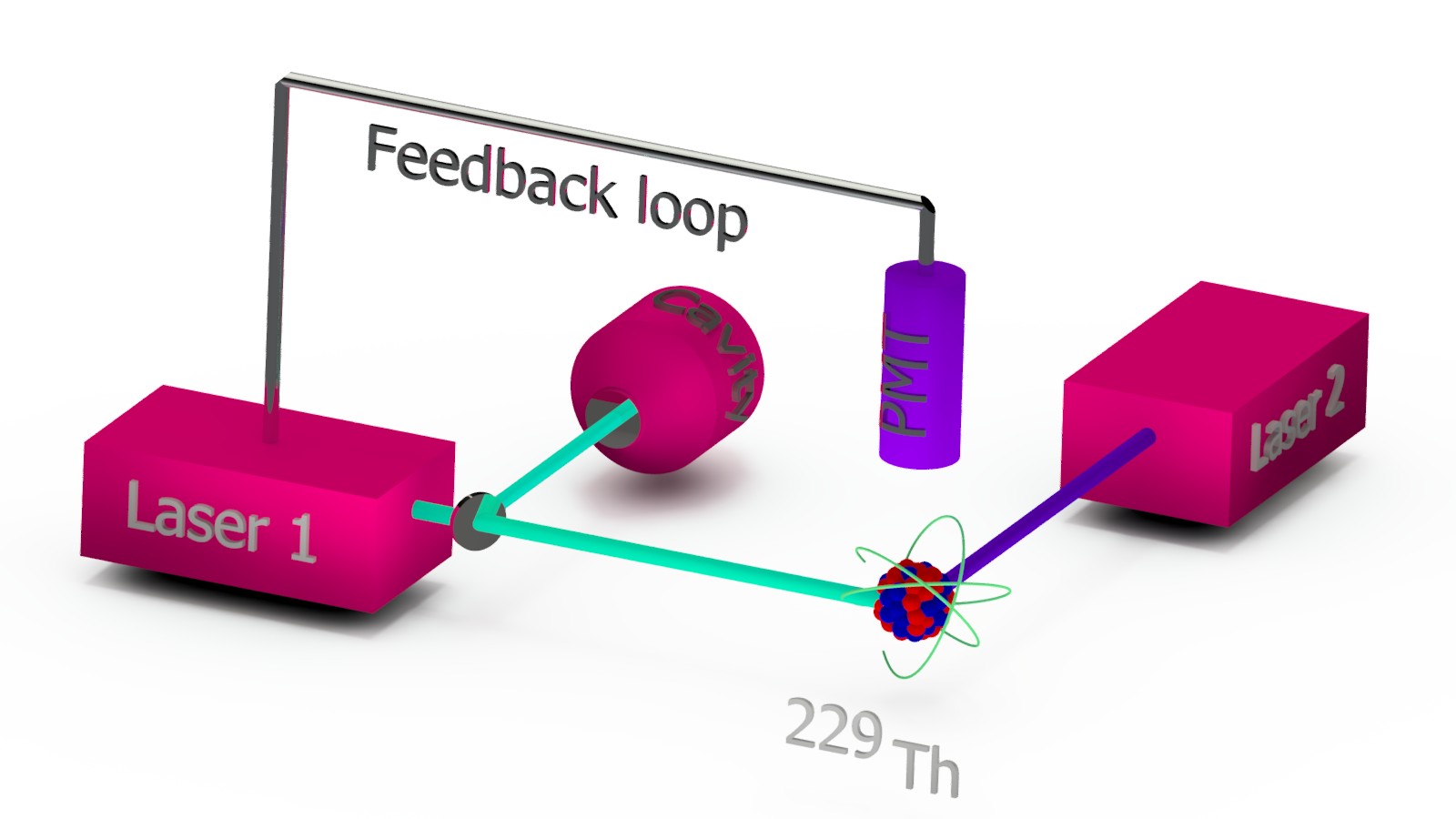
A laser at 148 nanometres, in the vacuum ultraviolet, shines through the crystal. The paper describes the source this way: “a 1,187-nm frequency-quadrupled commercial laser” followed by “a single-pass second-harmonic-generation stage using a randomly quasi-phase-matched strontium tetraborate (SBO) crystal.” That chain multiplies the frequency eightfold, taking 1,187 nanometres down to about 148.
When the laser is exactly on the nuclear transition, the crystal absorbs a tiny bit more light. In the paper’s signal-to-noise estimate, the absorption on the transition used for the clock is 0.75 percent. A photomultiplier tube behind the crystal counts the light that gets through, and an error signal derived from its readout tells the system whether the laser has drifted off the nuclear resonance. According to the Figure 1 caption, the error signal “is used as feedback to the electro-optical modulator to compensate for the long-term drift of the cavity, thus closing the nuclear clock feedback loop.”
The excited nuclear state lasts about 10 minutes, according to the paper. Earlier work detected the nucleus by waiting for it to emit light, which is slow. The absorption method, first reported in a companion Nature paper, allows continuous probing, and the paper says absorption “provides a higher detection efficiency, yielding three orders of magnitude more signal photons per second compared with fluorescence.” It also allows feedback times much shorter than the excited-state lifetime.
To measure how good the result is, the team compared it with a ytterbium single-ion clock at the BEV, connected by a fibre link between the two sites.
The Beijing clock
The Beijing paper, by Beichen Huang and colleagues, is titled “A nuclear clock synchronized to 229Th.” Its authors are from Tsinghua University, the Beijing Academy of Quantum Information Sciences, the National Institute of Metrology in Beijing, the Shanghai Institute of Optics and Fine Mechanics, Peking University and other institutions. Its DOI is 10.1038/s41586-026-11122-1. Nature’s June 2026 news report on the preprints says the Chinese team was led by Shiqian Ding of Tsinghua University.
It also uses thorium-doped calcium fluoride crystals, but a different laser. The abstract describes a 10-microwatt vacuum-ultraviolet source at 148.4 nanometres, based on four-wave mixing in cadmium vapour.
The paper describes two crystals. One, S1, was grown at the Shanghai Institute of Optics and Fine Mechanics. The other, TS1, was made through a collaboration between the Shanghai Institute of Ceramics and Tsinghua University, from a growth solution containing only 1.4 micrograms of thorium-229. The paper says the severe scarcity of the isotope “leaves essentially no room for iterative growth optimization.”
The Beijing paper notes that “a near-simultaneous independent report has also demonstrated 229Th nuclear clock operation,” a reference to the Vienna work.
The numbers each team reports
The two teams report different quantities, measured in different ways.
Vienna reports four numbers, and they measure different things. The abstract gives “a shot-noise-limited fractional frequency instability of 3×10^-12/sqrt(tau/s),” where tau is the averaging time in seconds, and says this is “approaching 10^-15 instabilities over 1 day of operation.” The main text says the clock “reaches fractional frequency instabilities in the low 10^-14 range within a continuous clock run,” and that reproducibility between runs on different days was limited to about 5 x 10^-13. The paper says the clock can run “without any intervention for 1 day.” So the four figures are the noise floor per second of averaging, the abstract’s long-averaging level, the main text’s stability within one run, and the agreement from one day to the next. The Vienna figures come from comparison with the ytterbium ion clock.
Beijing reports that “the clock reaches a fractional frequency instability of 5×10^-13/sqrt(tau/s),” “averaging down to the 10^-15 level over the measured interval.” That figure is for the optimized TS1 setup with a phototube readout and about 350 nanowatts of transmitted light. The paper’s earlier configurations gave 1×10^-11 (S1 with a photomultiplier tube), 6×10^-12 (S1 with a phototube) and 2×10^-12 (TS1 with a phototube before further optimization). The 5×10^-13 figure is in-loop: the paper says the cycle-by-cycle record of the laser frequency “is used to calculate the in-loop fractional frequency instability,” and argues that the reference laser’s own stability, below 10^-15 at 1,000 seconds, supports treating it as a faithful estimate. The paper reports an inter-crystal frequency difference of 5.6(13) x 10^2 hertz, or 2.8(6) x 10^-13, and the authors describe the two independently fabricated crystals as agreeing “at the 10^-13 level.” Both crystals are consistent with earlier measurements at JILA on other crystals.
The two sets of figures come from two papers with different lasers, crystals, detectors and reference setups. They are not a head-to-head test, and neither paper claims to beat the other.
What the Vienna team says about dark matter
The Vienna team also used its clock to constrain models of ultralight dark matter, a hypothetical class of particles. The abstract says it searched “for periodic fluctuations and slow drifts in the nuclear transition energy, on timescales between 20 s and 1 day.”
The data came from about 23 hours of operation on April 2 and 3, 2026. The paper reports: “As no amplitudes exceeded this detection threshold, we established an upper limit for the amplitude of oscillations in the investigated frequency range.” A linear fit for slow drift gave (2 ± 4) x 10^-14 per day, which the paper calls “consistent with 0.”
The authors’ claim is that “these constraints compete with the best atomic clocks concerning dark matter coupling to photons and go beyond previous measurements regarding coupling to the strong force.” The paper’s exclusion plot assumes the hypothetical particle makes up most of the observed dark matter. Kawasaki wrote that the clock “shows promise for detecting a possible form of dark matter.” Neither says dark matter has been detected.
One caveat comes from the paper itself. The thorium transition’s sensitivity to the fundamental constants rests on nuclear parameters that are unknown: “precise values of these sensitivity factors cannot at present be calculated,” though the paper says they are predicted to exceed those of the most sensitive atomic clock transitions by several orders of magnitude. The limits are shown for assumed values of those factors.
What the authors say is still limited
Vienna’s best-case figures hold within a single run. The reproducibility between runs on different days was limited to about 5 x 10^-13. Each time the laser is realigned, it passes through a slightly different spot, and the measured line centre differed by up to 1.7 kilohertz between positions, well above the 0.13 kilohertz expected from statistical fluctuations but within the uncertainty reported in previous studies. The authors write, “We conjecture that local strains induced by structural inhomogeneity causes these frequency shifts.” Measurements repeated at the same crystal position were reproducible.
The Beijing paper states its own limits. The S1 crystal transmitted about 1 percent of the vacuum-ultraviolet light, which the paper says, together with its thorium concentration, reduces the signal-to-noise ratio; TS1 transmitted 7 percent. In the optimized TS1 setup, the clock ran with a duty cycle of about 85 percent, and the remaining 15 percent dead time “arises from technical overhead in the present digital-feedback implementation and could be reduced substantially through improved feedback control.”
Neither paper claims its clock is more stable or accurate than today’s best atomic clocks. Nature’s June 2026 news report on the preprints, written by Elizabeth Gibney, calibrates the gap: both clocks drifted by about one second in three million years over a day, which that report says is still below the stability of the best optical atomic clocks, which gain or lose a second every 40 billion years (the June benchmark; Nature reported on Sept. 23, 2026 on a lutetium-atom clock it said would take more than 260 billion years to lose one second).
The Vienna paper says that with a conservative nuclear linewidth estimate of 1 kilohertz for the crystal (the paper puts the linewidth measured now at about 100 kilohertz), a crystal of similar doping density and size, a 100-picowatt laser and a high-stability cavity, an instability of approximately 10^-16/sqrt(tau/s) could be reached, which “would bring the frequency instability of the nuclear clock to the same level as state-of-the-art optical atomic clocks.” The paper adds that the linewidth of future vacuum-ultraviolet lasers would need to be narrowed equivalently. That is a projection, not a result. Separately, the Vienna paper says that for dark matter searches a solid-state nuclear clock “would already be competitive with or may even surpass the sensitivity of advanced comparable atomic clocks.”
What TU Wien and an outside physicist said about the papers
TU Wien published its own news release on Oct. 7, titled “The First Stand-Alone Nuclear Clock is Ticking in Vienna.” It says the clock “remains stable for more than 24 hours without intervention” and describes the Vienna system as the first nuclear clock that stabilizes itself. It puts the precision, measured over a day, at “approximately 10 to the power of minus 15 – corresponding to an error of roughly one second in 30 million years.” Thorsten Schumm is quoted in the release: “This is not yet at the level of the world’s best optical atomic clocks, but for a first prototype it is a fantastic result.” The release says the precision is to be improved “through several measures, such as stronger lasers and better thorium crystals,” and notes that a research group from China reported a clock in the same issue of Nature.
ABC News (Australia), in a story by Ellen Phiddian dated Oct. 8 Australian time, quoted Victor Flambaum, a University of New South Wales physicist who was not involved in the studies. He said nuclear clocks had the potential to become the “most accurate instrument humans have ever built.” The story says both clocks would be off by only a second if they ran for 30 million years, that this accuracy does not surpass the best clocks in operation now, and that both teams are confident they can improve their clocks significantly.
What outside researchers said in June
The earlier outside comment on the preprints dates from June 2026, when Nature’s news report covered the two preprints that the Oct. 7 papers cite. That report said the preprints were posted on arXiv on June 3 and 7, by teams in Europe and China.
Gilad Perez of the Weizmann Institute of Science said the results show nuclear clocks have gone from a system with “potential” to “a functioning precision instrument” that can be used to search for new physics. Thorsten Schumm of TU Wien, a lead member of the European team, called creating a nuclear clock “a dream come true.” Ekkehard Peik of PTB, who co-led the European team, said isolating thorium-229 rather than embedding it in a crystal is an “important route that remains to be explored” toward clocks more precise than the best atomic clocks. These remarks concern the preprints, not the final papers or the Vienna dark-matter limits specifically.
How it got here
- 2003: Peik and Tamm propose a nuclear clock based on thorium-229.
- 2016: The Vienna paper says the existence of the thorium-229 excited state was proven.
- 2022: Optical detection of its decay measures the energy at 8.338 electronvolts (plus or minus 0.024).
- 2024 and 2025: Lasers are reported exciting the nucleus in crystals and thin films.
- 2025: Continuous-wave 148-nanometre laser systems are developed.
- June 22-23, 2026: Nature news (Elizabeth Gibney), reproduced by Scientific American, reports the two clocks from preprints posted on arXiv on June 3 and 7.
- Sept. 16, 2026: Nature publishes the continuous-wave laser absorption spectroscopy paper by Morawetz and colleagues, which the Vienna clock builds on.
- Oct. 7, 2026: Nature publishes the two peer-reviewed papers.
What is not known
Neither paper shows these clocks in practical use. Both describe lab setups and say what could be improved. No date for any practical timekeeping use appears in either paper or in the opening paragraph of Kawasaki’s News & Views.
Nature says peer reviewer reports are available for both papers. The reviewer reports and the paywalled remainder of Kawasaki’s News & Views are not summarized here.
The dark matter limits are the Vienna authors’ own analysis. The comments quoted above, from TU Wien, ABC News (Australia) and Nature’s June report, are about the clocks in general; none assesses those dark matter limits specifically.