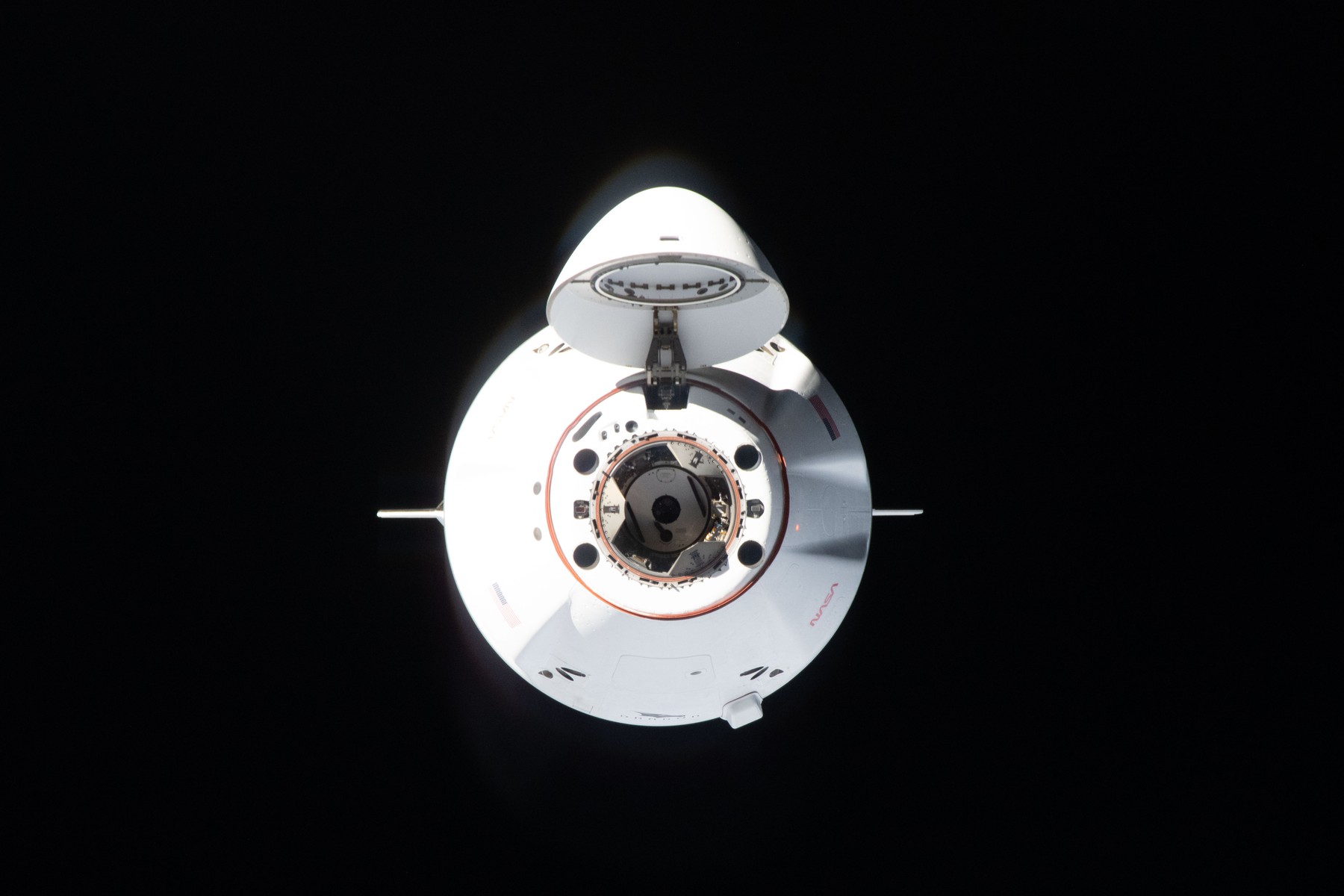
A SpaceX Dragon cargo capsule lifted off at 6:33 a.m. EDT on Tuesday, Oct. 13, from Cape Canaveral, Florida, carrying the last pair of roll-out solar arrays for the International Space Station, flexible panels that unroll from a cylinder once installed. It also carries NASA research on human brain tissue, crop disease and antibiotic-resistant bacteria. The capsule is due to reach the station on Thursday, Oct. 15. NASA calls this SpaceX’s 35th commercial resupply services mission for the agency, a count of SpaceX’s own flights under its NASA resupply contract. Northrop Grumman’s Cygnus cargo ships also fly commercial resupply missions for NASA, and one, Cygnus XL, was released from the station on Oct. 9.
What launched and when
A Falcon 9 rocket carried the Dragon from Space Launch Complex 40 at Cape Canaveral Space Force Station. NASA’s space station blog posted a liftoff report at 6:54 a.m. EDT that reports liftoff at 6:33 a.m. EDT and captions it as on time. The blog said the Dragon separated from the rocket’s second stage about nine minutes after launch, then used thruster firings to head for the station.
NASA describes more than 6,300 pounds of scientific investigations and supplies on board. No delay or scrub was reported as of about 10:30 a.m. EDT on Tuesday, Oct. 13.
NASA’s launch posts do not give booster or capsule details. Those come only from secondary reports. FOX 35 Orlando, in a pre-launch story, and Next Spaceflight report that the Falcon 9 booster was on its eighth flight and was due to land at Landing Zone 40, and that the capsule was flying for the fourth time. Next Spaceflight and two smaller outlets say the booster landed.
What the solar arrays are for
The most visible piece of cargo is the final pair of ISS Roll-Out Solar Arrays, known as IROSAs. That is two arrays. NASA’s mission overview says they are meant to complete the station’s power system upgrade. NASA also says the added power supports research and station operations, including the eventual controlled deorbit of the station, its planned descent at the end of its life.
Outlets label the shipment in different ways. NASA’s mission overview and its 6:18 a.m. EDT countdown post call them the final pair. NASA’s coverage advisory refers to the final set. SpacePolicyOnline’s launch listing says the final two sets. Next Spaceflight calls them the fourth pair, and a NASA station blog post of June 15, 2023 described a fourth set of roll-out arrays that would be the seventh and eighth installed on the station, so that label fits too. Aviation Week’s account of the Aug. 6 spacewalk also speaks of the seventh and eighth arrays. These are different names for the same two arrays.
What research is aboard
NASA Science’s release, which names NASA’s Biological and Physical Sciences division as the source of the research, lists four investigations for this flight.
- A brain tissue study sends small, lab-grown models of the human brain to the station for five weeks. Identical models stay on Earth for comparison. The aim is to learn how a short spaceflight affects the brain at the cellular level. NASA says the work could deepen understanding of how the brain responds to stress and help lay the groundwork for methods that counter risks to brain health.
- A crop disease study grows plants on Earth and on the station and infects both with a disease-causing fungus. It tests whether plant disease develops faster and more severely in microgravity, the near-weightless condition of orbit. NASA says the findings could guide the breeding of disease-resistant crops and help minimize yield losses.
- A compact microplate reader, a lab instrument that measures many small samples at once, gets its first test as part of this flight’s research. The device arrived at the station earlier this year. NASA says the Commercially Enabled Rapid Space Science initiative’s experiment tests its ability to detect and measure biomarkers such as antibodies, antigens and proteins, so scientists could analyze samples on board rather than wait for them to return to Earth. The stated aim is timely detection of infections and other health issues in astronauts.
- An antibiotic-resistance investigation, which NASA describes as returning for its fourth and final planned stay, has astronauts repeatedly sample station surfaces to monitor drug-resistant bacteria and study how they survive and evolve in microgravity. NASA says it could help protect astronauts against bacterial infections and give insight into how superbugs develop.
NASA’s mission overview and the advisory name a second set of work on the same flight, separate from those four.
- LambdaVision-1 is hardware for manufacturing artificial retinas, built one thin layer at a time.
- Stellar Spheroids involves three-dimensional heart tissue models for drug testing.
- ELF-Unconventional Glass 2 studies how a new type of glass forms in microgravity.
- MINDS uses brain organoids, small lab-grown clusters of cells that mimic part of an organ, to study inflammation linked to neurodegenerative diseases such as Alzheimer’s, Parkinson’s and multiple sclerosis. It is a different study from the five-week brain tissue investigation above.
NASA’s mission overview also lists a collapsible contingency urinal among the outbound cargo, a demonstration and test unit supporting Artemis III.
When it docks
NASA says the docking is autonomous, meaning the capsule flies itself to the station’s Harmony module, a connecting hub, and attaches to its space-facing port, the one that faces away from Earth. Arrival is targeted for about 11 a.m. EDT on Thursday, Oct. 15, and as of NASA’s 6:54 a.m. post that time was unchanged.
NASA’s live arrival coverage is scheduled to begin at 9:15 a.m. EDT that day, and NASA lists these times as subject to change.
How long it stays and how it comes home
Dragon is planned to stay docked until mid-November, about a month. It will then return to Earth and splash down in the Pacific off California. NASA’s advisory says it returns with research and cargo.
NASA’s mission overview lists the returning items. They include a failed Canadarm2 robotic arm joint that astronauts replaced during a June 30 spacewalk, which will fly home in a foam clamshell, along with a spacesuit, a pump assembly from the station’s urine processor and a filtration unit from its water processor.
Who is aboard the station
Per NASA’s Oct. 5 and 6 station blog posts, seven people remain aboard after the Crew-12 astronauts, the previous crew rotation, splashed down on Oct. 8. Four arrived with Crew-13 on Oct. 1: NASA’s Jessica Watkins and Luke Delaney, the Canadian Space Agency’s Joshua Kutryk and Roscosmos cosmonaut Sergey Teteryatnikov. The other three are NASA’s Anil Menon and Roscosmos cosmonauts Pyotr Dubrov, who took command of the station on Oct. 4, and Anna Kikina. No crew rides on this cargo Dragon.
What is not known yet
NASA’s 6:18 a.m. countdown post says astronauts plan to install the new arrays during spacewalks later this fall, and WRAL repeats that. As of about 10:30 a.m. EDT on Tuesday, no dates had been published for those spacewalks, and NASA’s launch-day posts and mission overview give no figure for how much power the final pair will add.
NASA’s blog said an Aug. 6 spacewalk by Jessica Meir and Anil Menon lasted 6 hours and 27 minutes and prepared one of the station’s power channels, called 3B, and readied hardware for later power system upgrades. Aviation Week reported that the walk assembled support structure for the seventh and eighth arrays.