University of Warwick astronomers report that some white dwarf stars would appear green, pink, purple, yellow or cyan if one could see them up close. That includes WD J1330+6435, which the Warwick release calls “the first known genuinely green star in the galaxy.” Its color is calculated from a spectrum that the paper itself calls somewhat noisy. The same study finds that the median white dwarf is white.
The work comes from Mark Hollands, Boris Gänsicke and Pier-Emmanuel Tremblay of Warwick and Detlev Koester of Kiel. It is titled “Any colour you like: The diverse chromaticities of white dwarfs.” The paper was submitted to the arXiv preprint server on Oct. 13. The Warwick release, carried by Phys.org on the evening of Oct. 14 U.S. Eastern time, lists it as published in RAS Techniques and Instruments (DOI 10.1093/rasti/rzag069); the arXiv listing says it is accepted for publication in that journal.
What the study found
White dwarfs are the dense remnants left when sun-like stars reach the end of their lives. For most stars, color tracks temperature: cooler stars look orange, stars like the sun look white, and the hottest look pale blue. White dwarfs were generally assumed to follow the same rule.
The team asked what else might be possible. Their answer is that most white dwarfs look like ordinary glowing objects of the same temperature, but a minority do not. Known stars, the paper says, “would appear yellow, green, cyan, pink, or purple if viewed close enough for their stellar discs to be resolved.”
“It turns out these incredibly dense stars can produce colors nobody expected, and some of them genuinely surprised me,” Hollands said in the release.
How color was worked out without seeing it
No white dwarf is close enough for its color to be seen directly. The team worked from a star’s spectrum, the pattern of light split by wavelength, and ran it through a model of human color vision. They used observed spectra for the carbon-rich and infrared-faint stars and model spectra for the hydrogen-, helium- and metal-rich atmospheres of the nearby sample. Here “metal-rich” means containing elements heavier than helium. The observed spectra include data from the Sloan Digital Sky Survey, a public survey, so these colors are calculated, not seen directly.
They are rendered for a standard computer display and scaled in brightness. A display cannot show every possible color, and the method clips out-of-range values to the nearest displayable one; the paper expects white dwarf colors to fall within the display’s range.
Why dense atmospheres change the color
The key is density. The coolest white dwarf atmospheres reach around 1 gram per cubic centimeter, roughly the density of water and, according to the release, millions of times denser than the sun’s visible surface layer.
In that squeezed gas, traces of elements such as carbon, calcium and sodium absorb light across a much wider range of wavelengths than they would in thinner gas. A gas that absorbs one band of light removes that band, so the remaining light tilts toward other colors.
The green star and its caveats
WD J1330+6435 has a surface temperature, the effective temperature, of about 4,240 kelvin (K), which the release gives as roughly 4,000 degrees Celsius. A star that cool would normally look orange. Its atmosphere contains lithium, sodium and calcium, and the release says the star has accreted rocky material from its planetary system.
According to the paper, a strong, broad sodium feature absorbs orange light and calcium absorbs violet, so the light that remains peaks near 500 nanometers, in the green part of the spectrum. The team calls the result chartreuse green, a yellowish green. “The traces of sodium in the atmosphere of this white dwarf absorb the orange part of the spectrum, leaving behind a ghostly green glow,” Hollands said. The color is the team’s model, not an observation.
The paper’s own claim is narrower than the release’s. It says that, to the authors’ knowledge, no other star of any kind has been claimed to exhibit a green hue. The release says: “As far as the researchers are aware, no other star, living or dead, has ever been credibly reported as green, making this the first known genuinely green star in the galaxy.”
The paper also states its limit: the spectrum of this star “is somewhat noisy, and so it is conceivable that its chromaticity may differ slightly in reality.” Here chromaticity means color. The fitted parameters are similar to those of an earlier independent analysis of the same star by Kaiser and colleagues in 2021. The team’s own earlier 2021 model, which the authors say used inadequate sodium line profiles and gave a cooler solution, shows a similar hue, which the authors say gives them confidence in the green appearance. That is a consistency check by the same team, not independent confirmation.
WD J1330+6435 is the most vivid green of the 36 metal-rich white dwarfs the paper examined. Two others, WD J0851+1543 and WD J1351+2645, also come out green but much paler. The paper says the green status of WD J0851+1543 can be claimed reliably, because its fit used a cleaner spectrum with less random noise.
The other colors
The paper’s selected samples show colors that fall into groups tied to what is in the atmosphere. Two of those samples, the infrared-faint and carbon-rich white dwarfs, were chosen to show extreme colors, and the paper says they are not representative or unbiased. They show what is possible, not how often it happens.
- Carbon-rich white dwarfs are pink or purple in the paper’s sample; the release calls them typically so. In the example the release gives, WD J0902+2010, a deep convection zone, a layer where hot gas churns, has carried carbon up from the core. Molecules made of two carbon atoms (C2) absorb blue, green and yellow light, so what gets out is mostly red, which reads as pink.
- White dwarfs enriched with debris from asteroids and comets tend toward yellow, according to the release.
- Cooler white dwarfs with mixed hydrogen and helium atmospheres often look cyan or pale blue. The release attributes this to hydrogen molecules colliding with helium atoms.
- WD J1011+2845, 48 light-years away, comes out a deep salmon-pink. The paper calls it likely the reddest star known in terms of perceived color; the release says it may be the reddest star ever recorded.
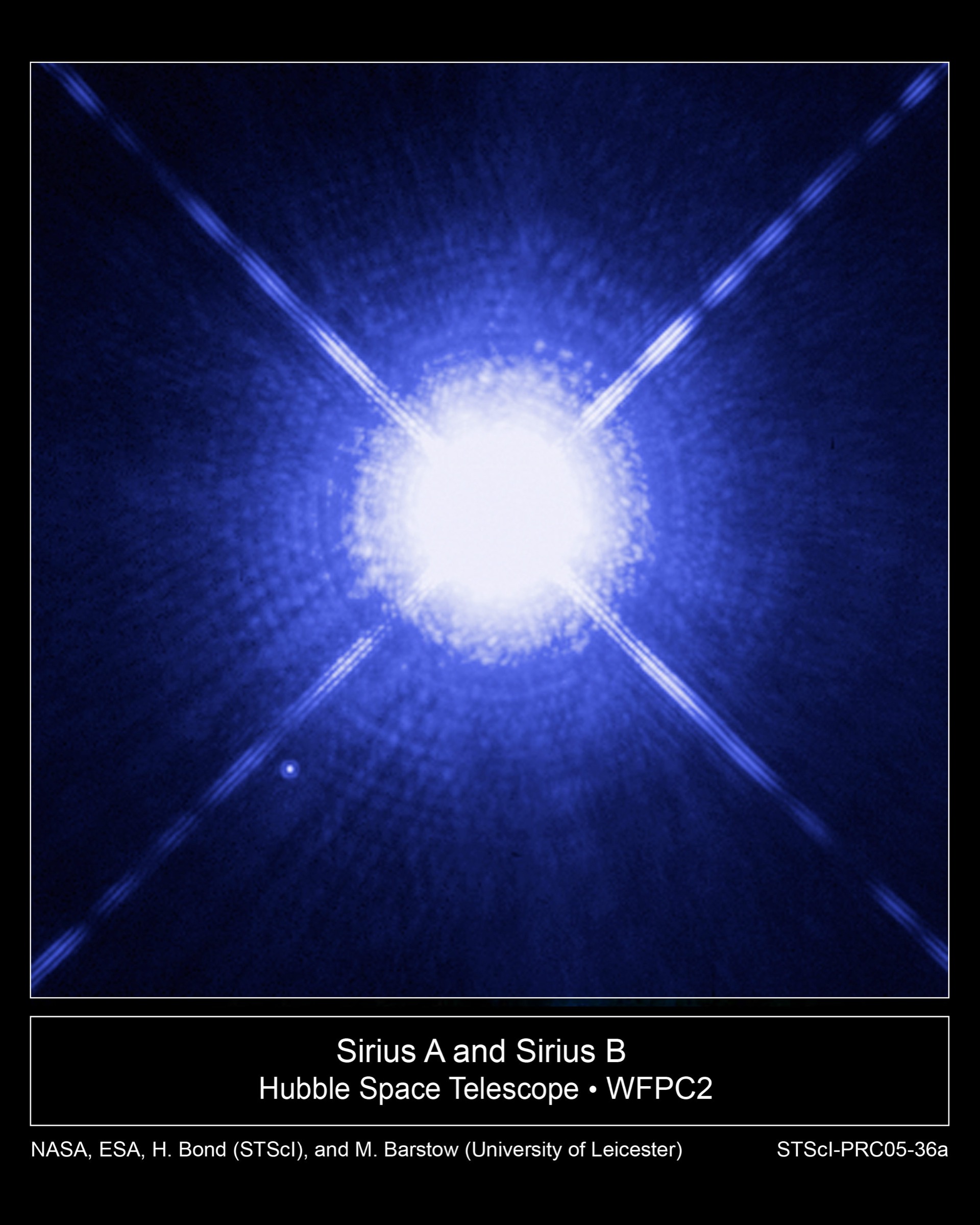
- Sirius B, the nearest white dwarf to the solar system, is pale blue because of its hot hydrogen atmosphere, according to the release.
How common the odd colors are
The estimate of how common they are comes from a different sample: white dwarfs within 20 parsecs, about 65 light-years. The paper describes it as an unbiased volume-limited sample. It counts 152 white dwarfs there; the release says 151.
Five were set aside because their color differs from that of a glowing object of any temperature by more than a small threshold: two yellow and three pink. The paper puts the share that deviates at 3.4 percent, with an uncertainty range of 1.7 points above to 1.3 below, a figure that rests on just five stars. The release rounds this to about one in 30.
That figure comes from roughly 150 nearby stars, so it is an estimate for the solar neighborhood that the team extends to white dwarfs generally. It is an estimate, not a census of all white dwarfs.
The median white dwarf is white
The remaining 147 stars in the paper’s count span colors matching glowing objects from 3,000 to 25,000 K. The paper reports a median color temperature of 6,768 K, with 95 percent of the stars between 3,800 and 18,700 K. Color temperature is the temperature of a glowing object, such as a light bulb, whose color matches the star’s; 6,500 K light looks white. The release says about 6,800 K is perceived as white, and the paper notes that the median color is very close to the standard D65 white point, whose color corresponds to about 6,504 K.
The authors say this establishes that, on average, white dwarfs are indeed white, while noting that this neglects the breadth of the distribution. The release describes this as correcting a common idea that white dwarfs are typically blue. It explains that hotter, bluer white dwarfs are brighter and visible from farther away, so they are overrepresented in surveys that rely on brightness alone.
“One in 30 might not sound like a huge fraction, but across the entire population of white dwarfs in the universe, that is still a lot of oddly colored stars out there,” Gänsicke said in the release. “Yet if we take the median across a representative population of white dwarfs, we found that the average white dwarf really is white.”
What is not known
The coverage quotes only members of the research team, so how other researchers view the results is not yet clear.
The first-green-star claim rests on one somewhat noisy spectrum plus a model, and a better spectrum of WD J1330+6435 could shift its color slightly. The paper also notes that for one similar lithium-rich star, WD J1644+1234, the team’s own model showed an unexplained excess of flux and could not be used reliably, so a published model was used instead. A single color temperature also cannot be assigned to colors such as green, and brightness is not represented in the colors.
The paper says that, given a large enough sample of cool metal-rich white dwarfs, other examples with vivid green, cyan and blue hues may be identified in future surveys. How many more unusual colors exist beyond the nearby sample is not known.