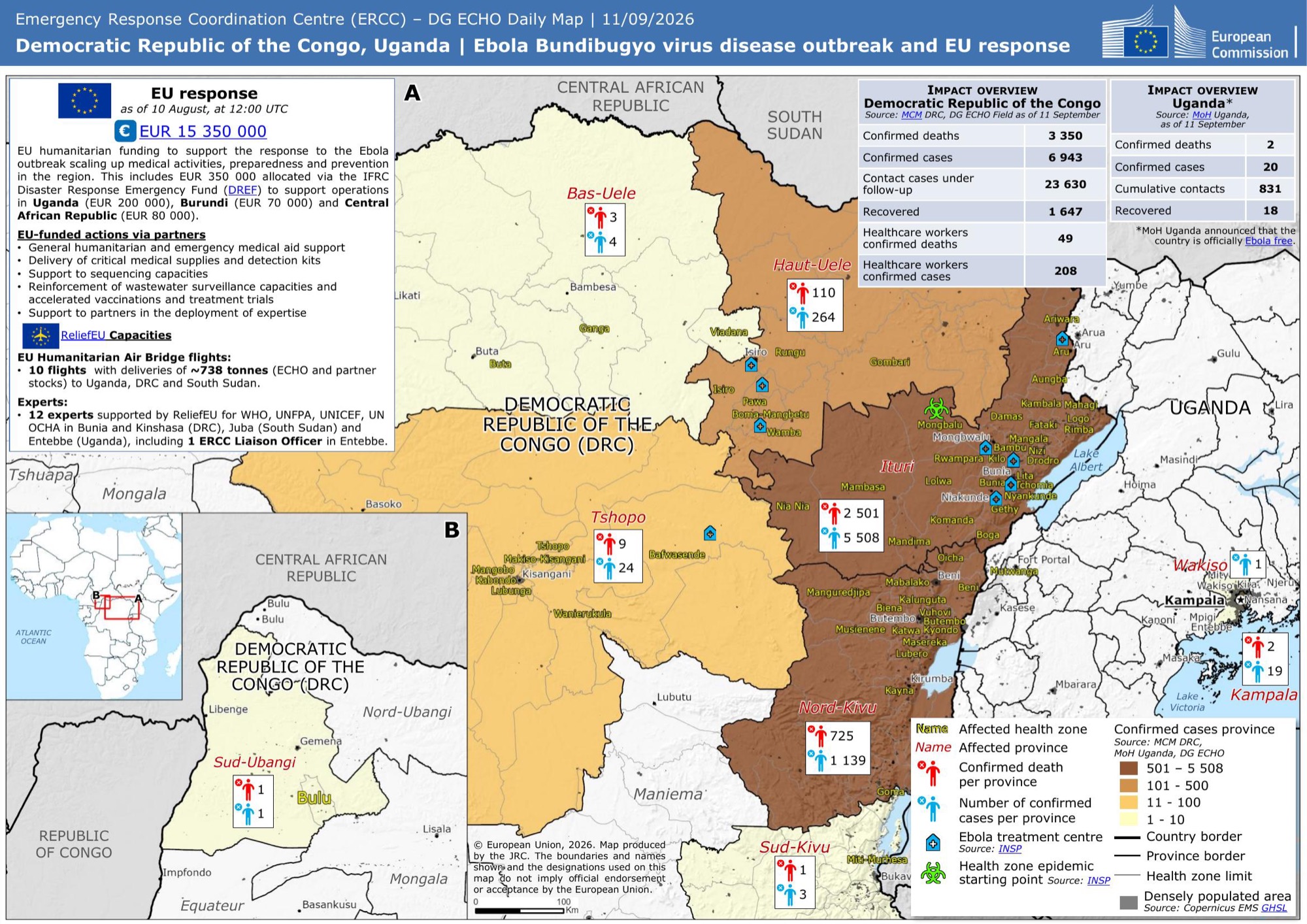
Congo’s health ministry says the outbreak has reached 8,067 confirmed cases and 3,901 deaths as of Sept. 26 across 63 health zones in seven of the country’s 26 provinces, AP reported. The World Health Organization’s count, as of Sept. 23, stood at 7,890 confirmed cases including 3,799 deaths, a crude case-fatality ratio of 48.1%, with 1,966 people recovered.
Behind the round number is a steadier story. WHO’s confirmed-case totals for Congo climbed from 515 on June 6 to 1,460 by July 1, 3,605 by July 30, 5,794 by Aug. 26, 6,757 by Sept. 7 and 7,890 by Sept. 23 — between about 71 and 81 new confirmed cases a day in each interval since July. WHO’s latest report recorded 70 new confirmed cases in the 24 hours before Sept. 23. WHO said “the number of new cases reported each day remains high,” with the seven-day average showing “a resurgence in early September followed by a decline over the most recent reporting days.”
Where it is moving
The national trend line conceals a split between provinces. Ituri, the epicenter, has recorded 6,032 cumulative confirmed cases, with 868 in the prior 21 days; WHO said incidence there is declining from a mid-August peak, “although transmission remains at elevated levels.” North Kivu has 1,480 cumulative cases, with 567 in the prior 21 days; its incidence peaked in mid-September and has since declined, but it has the outbreak’s highest case-fatality ratio, 59.7%, and WHO said “investigations are ongoing” into why.
Elsewhere, Haut-Uélé’s transmission is sustained but below its late-August peak, Tshopo has renewed transmission, Bas-Uélé’s cases are sporadic, and South Kivu has reported no new cases since May 29. Since WHO’s previous report, the virus reached two new areas: Bulu health zone in Sud Ubangi, a province in the country’s north-west that had not previously recorded a case, with one case reported Sept. 10, and Dungu in Haut-Uélé, which borders South Sudan. WHO said “this latest geographic expansion increases the risk of cross-border transmission.” Overall, 48 of the 63 affected health zones have reported a case in the last 21 days. Of 32,342 contacts requiring follow-up, 26,980, or 83.4%, were seen in the 24 hours before Sept. 23.
Why deaths stay near half
A crude case-fatality ratio of about 48%, or 60% in North Kivu, means the deaths reported so far equal roughly half — or three in five — of the confirmed cases reported so far. WHO pointed to the many deaths occurring in communities, writing: “The continuously high CFR, and especially the continuous high rate of deaths occurring in communities, highlights the seriousness of the disease and the persistent challenges in timely case detection and access to early and adequate patient care.” The report also noted “no approved vaccines or specific treatments currently exist” for Bundibugyo ebolavirus, a different species from Zaire ebolavirus, which the licensed Ervebo vaccine targets. Health workers in Ituri began receiving Ervebo on Sept. 19 under a compassionate-use program, as Plainly Now reported. WHO says control instead relies on rapid case identification, isolation and care, contact tracing, safe burials and community engagement.
WHO calls this “the largest Ebola disease outbreak ever recorded” in Congo, and only the second documented Bundibugyo outbreak there, after one in 2012. The U.S. CDC put the 2007 Bundibugyo outbreak in Uganda at 149 suspected cases and 37 deaths, and the 2012 Congo outbreak at 56 laboratory-confirmed cases and 17 deaths.
The response and the money
According to Africa CDC, as reported by AP, 50 health workers have died since the outbreak was announced, and health workers’ complaints over delayed or missing pay have triggered several strikes. WHO’s risk assessment, last updated Aug. 14, rates the outbreak very high in Congo, high for bordering countries and low elsewhere.
The State Department announced Sept. 23 that it would provide an additional $267 million in U.S. assistance for new Ebola treatment units, burial teams, protective equipment, and disease surveillance and contact tracing, and said U.S. assistance provided to date totals $887 million. The department calls the U.S. the largest provider of health and humanitarian assistance for this outbreak. Citing Africa CDC data, AP reported that, by the same point in its timeline, the 2014-2016 West Africa epidemic — which killed 11,000 people — had recorded 3,781 cases versus 7,840 here; AP reported that WHO said this outbreak is on track to surpass the West Africa outbreak.
What to watch next
WHO publishes its Disease Outbreak News on the outbreak about every two weeks, with daily and weekly updates in between. Watch whether the decline WHO saw “over the most recent reporting days” holds, and whether Bulu and Dungu — the two newest zones — stay isolated or become new clusters; Dungu borders South Sudan.
Sources and further reading
- Notes from the Field: Outbreak of Ebola Disease Caused by Bundibugyo Virus — Democratic Republic of the Congo and Uganda, May 2026
- Disease Outbreak News: Bundibugyo Virus Disease, Democratic Republic of the Congo
- United States Pledges Additional Life-Saving Health Assistance in Response to Ebola Outbreak