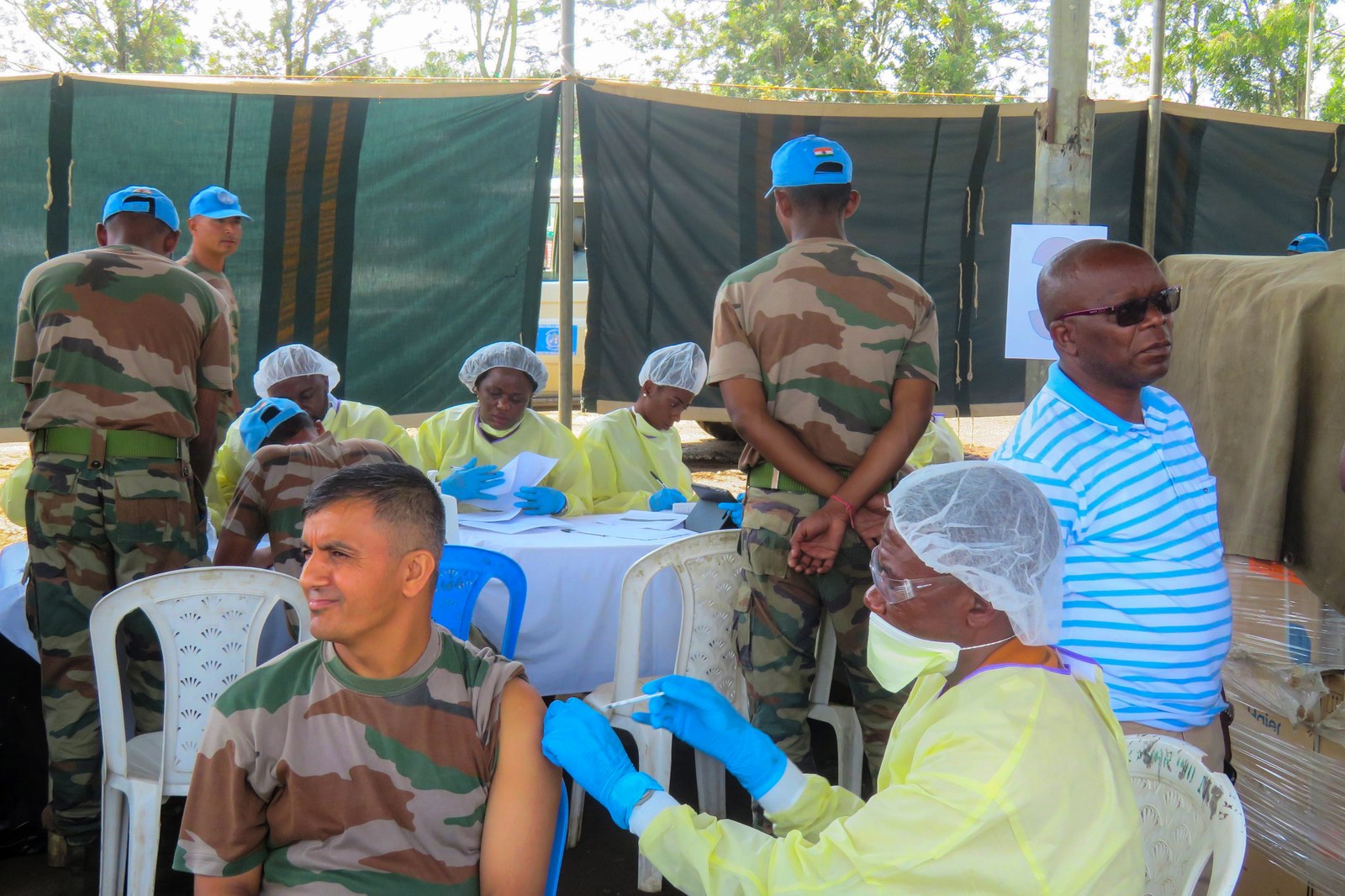
Health workers in Bunia, in DR Congo’s Ituri province, began receiving Ebola vaccinations on Saturday, Sept. 19, 2026. The vaccine going into their arms, Ervebo, is licensed by the U.S. Food and Drug Administration for Zaire ebolavirus. The virus spreading through Ituri is Bundibugyo ebolavirus, a different species.
What began Saturday
The rollout targets the Bunia and Mongbwalu health zones in Ituri, the province at the center of the outbreak. The Associated Press reports the campaign in Ituri and North Kivu is expected to cover 20,000 front-line workers over six to nine months. At the Bunia launch, Ituri’s military governor, Maj. Gen. Gaby Kasongo Mulumba, said: “Our collective duty is to protect life. Launching this vaccination drive for front-line staff in Ituri is not an arbitrary choice, as these workers are particularly exposed and deeply involved in the response.”
Saturday was not, however, this outbreak’s first vaccination. A campaign under the same compassionate-use framework began Aug. 27, 2026, in Kisangani, Tshopo province, covering 14 selected health zones across Tshopo, Bas-Uélé and Haut-Uélé, according to the World Health Organization’s Disease Outbreak News. Saturday’s launch is that same campaign reaching the epicenter province, roughly three weeks later.
What the label says
Ervebo’s FDA label states its indication plainly: “ERVEBO® is a vaccine indicated for the prevention of disease caused by Zaire ebolavirus in individuals 12 months of age and older.” The same label carries a limitations-of-use section with two sentences that bear directly on Ituri: “ERVEBO does not protect against other species of Ebolavirus or Marburgvirus” and “The duration of protection conferred by ERVEBO is unknown.” Ervebo was first approved by the FDA on Dec. 19, 2019, the first Ebola vaccine to receive that approval.
How a vaccine gets used off its license
The vaccine can still be administered against a species it is not licensed for through what the FDA calls expanded access, or compassionate use — a pathway allowing a patient with a serious or immediately life-threatening disease to obtain an investigational medical product when no comparable or satisfactory alternative therapy is available. AP describes the same mechanism this way: “The vaccine is being used under a compassionate-use program, which allows a medical product to be used in a serious disease situation even though it has not been specifically approved for that particular use.”
That is one track. A second, separate track is a formal trial. On Aug. 20, 2026, the International Coordinating Group on Vaccine Provision released 70,000 doses of Ervebo to DR Congo: 50,000 for front-line and health workers under compassionate use, and 20,000 for a trial studying whether the vaccine protects against Bundibugyo virus. That trial’s 20,000 doses are a different number from the 20,000 workers AP says the Ituri and North Kivu campaign aims to reach — the two figures should not be read as describing the same thing.
What is known, and what is not
WHO and Africa CDC addressed the open question directly on Aug. 20: “It is not known whether Ervebo may be protective against the Bundibugyo virus in humans. Early laboratory and animal data suggest it may provide some protection.” The animal data referenced comes from a peer-reviewed study in the CDC journal Emerging Infectious Diseases, by researchers at the Public Health Agency of Canada and the University of Manitoba, in which ferrets vaccinated with the same viral backbone used in Ervebo produced antibodies that cross-reacted with Bundibugyo glycoprotein — a protein on the surface of the virus that the immune system learns to recognize — but at a geometric mean endpoint titer of 16,582 against Bundibugyo, versus 56,554 against Ervebo’s own Zaire target, measured 27 days after vaccination. The higher number means a stronger antibody response, and the Bundibugyo figure was the lower of the two. That is antibody data in ferrets, not a measure of protection in people.
No vaccine specific to Bundibugyo virus is licensed anywhere. Two candidates are in early human testing: Oxford Vaccine Group’s BD-Ebov, in a Phase I trial of 50 UK adults launched in July, and Moderna’s mRNA-1469, which Health Canada cleared to begin a Phase I trial on July 30. Steve Ahuka, described by Al Jazeera as a Congolese health task force official, put the uncertainty in a single sentence: “We don’t know to what degree it might be effective against the Bundibugyo strain.”
The scale
WHO’s most recent published outbreak report, dated Sept. 10 with data as of Sept. 7, 2026, counted 6,757 confirmed cases and 3,267 deaths in DR Congo, a case-fatality ratio of 48.3% — roughly 48 of every 100 people with a confirmed case died — across 61 health zones in six provinces. AP’s wire report, dated Sept. 19, gives newer figures: according to government figures cited by the Associated Press, as of Saturday, Sept. 19, the country had recorded 7,541 confirmed cases and 3,639 deaths. A CDC report covering the outbreak’s first 100 days, through Aug. 21, found 5,458 cases and 2,606 deaths, with Ituri accounting for 84% of reported cases.
For comparison, the two previous Bundibugyo-virus outbreaks were far smaller: Uganda’s 2007-08 outbreak ended at 131 cases and 42 deaths, and DR Congo’s 2012 outbreak, in Isiro, ended at 62 cases and 34 deaths.
AP reports that the outbreak is the deadliest of the country’s 17 Ebola outbreaks, and that the World Health Organization has said it remains out of control and is on track to surpass the 2014-2016 West Africa Ebola outbreak — the deadliest on record, which killed more than 11,000 people.
The rollout problem ahead
Ervebo’s label requires storage frozen at -80°C to -60°C. A campaign AP says is expected to run six to nine months has to hold that cold chain the whole way. AP reports the outbreak “is spreading under extremely difficult conditions, fueled by insecurity, displacement, a health workers’ strike and intense population movements.”
Some workers in Bunia had already been vaccinated once before Saturday, but during an earlier outbreak, not this campaign. Dr. Jeannot Elua, a physician at a health facility in Bunia, told AP the vaccine was “beneficial.” “We healthcare workers don’t really have a choice: we are going to receive it,” he said. “Some people here had already received the previous vaccine. I received it myself, because it was mandatory.” Dr. Jean Paul Uzele, a front-line health worker, was vaccinated with Ervebo during the country’s 10th Ebola outbreak, AP reports, and said it was unclear to him whether he should get vaccinated again: “If it arrives, we will receive it too. But the question is whether we need to be vaccinated a second time.”
Sources and further reading
- Notes from the Field: Characteristics of the 2026 Ebola Disease Outbreak — Democratic Republic of the Congo (MMWR mm7535e1)
- Disease Outbreak News: Ebola disease caused by Bundibugyo virus — Democratic Republic of the Congo (2026-DON617)
- ERVEBO (Ebola Zaire Vaccine, Live) — Prescribing Information
- Disease Outbreak News: Ebola disease caused by Bundibugyo virus — Democratic Republic of the Congo (2026-DON616)
- WHO and Africa CDC welcome the allocation of Ebola vaccines to the Democratic Republic of the Congo
- Notes from the Field: First 100 Days of Five Ebola Outbreaks (MMWR mm7537e1)
- Cross-Reactive Antibody Responses to Bundibugyo Virus Glycoprotein after rVSV-EBOV Vaccination in Ferrets