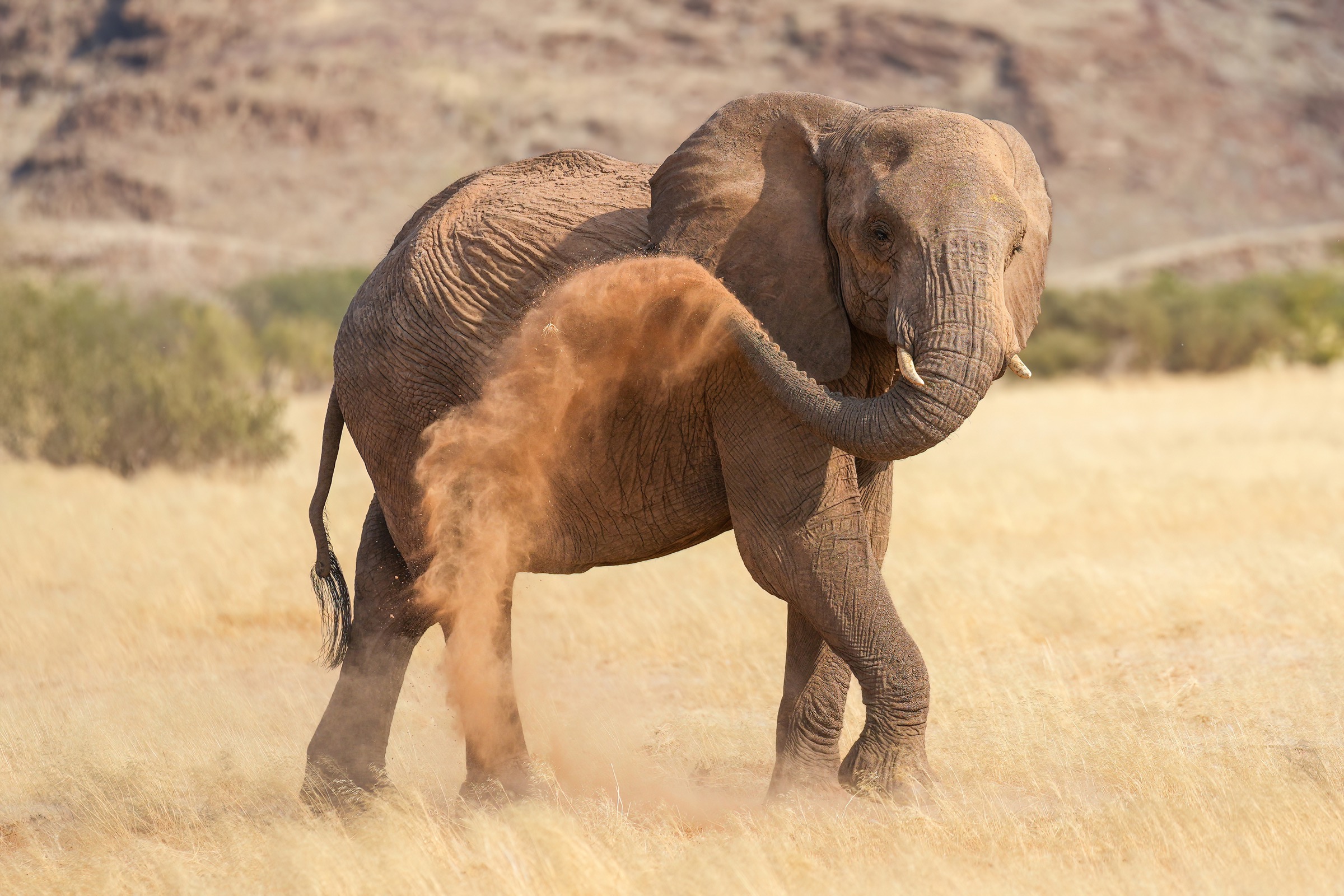
Italian photographer Federico Veronesi has won Wildlife Photographer of the Year 2026 with “The Aftermath”, a photograph of a female elephant carrying a dead calf in Namibia’s Huab River Valley. The Natural History Museum in London announced the winners on Oct. 13, selecting them from what it called a record 65,403 entries from 121 countries and territories.
The museum’s press release adds that, for the first time in the competition’s 62-year history, both the adult and young overall winners were recognised for black-and-white photography.
The photograph and how it was made
Veronesi was tracking elephants in the Huab River Valley, in Namibia’s Damaraland, when he came across an unusual pattern of drag marks in the sand of a dry riverbed. The marks led him to a family group. A female emerged carrying the calf, its leg wedged between her tusk and trunk, according to the museum’s caption.
The museum’s gallery page lists the picture as the winner of the Behaviour: Mammals category and as the Adult Grand Title winner, the competition’s top adult prize. It gives the camera as a Nikon Z8 with a 400mm lens.
Veronesi was born in Italy and moved to Kenya in 2002 to be a wildlife photographer, according to the museum. He also leads photographic safaris across sub-Saharan Africa.
What researchers told him about this elephant
The BBC reported that Veronesi first assumed the elephant was the calf’s mother. After he shared his photographs with an elephant research project working in the area, he learned that this was not certain.
According to the BBC, the researchers recognised her as a female who had lost a calf several years earlier. They also told him she had previously picked up dead calves belonging to other females.
What the museum and researchers say about elephants and death
The museum’s caption says behaviours centring on death have been observed in both Asian and African elephants. It lists vocalisations, guarding the dead, inspecting and handling bones, and carrying the deceased.
It then presents two readings. Some researchers suggest the behaviours could indicate an elephant’s journey to understanding death, while others interpret them as possible “displays of grief”.
An undated page from the Indian Institute of Science, summarising research on Asian elephants, describes mostly adult females carrying dead young and vocalising. It says the responses suggest curiosity about death and possibly grief-like responses, and it asks whether elephants truly grieve. That research concerns a different species from the African elephant in the Huab photograph.
The jury chair, Kathy Moran, gave her own opinion in the museum’s press release: “This photograph works on so many levels. Emotionally it’s a gut punch, heartbreakingly poignant. Intellectually it’s proof that animals have cognition. This photograph says it all!”
The emotional reading comes from Veronesi, as quoted by the BBC. “Of all the 20 years I’ve done photographing animals, this is the most heart-wrecking and fascinating and dramatic,” he said. He described it as “revealing of the depth and complexity of the emotions, the feelings of the animals”. The BBC adds that he hopes the image will encourage people to look beyond animals’ physical appearance and recognise them as individuals with relationships, memories and emotions. “It’s a small window that opens just a crack into the complexity of their world.”
Other winners
The BBC published a gallery of the other winning images. Among them:
- Oscar Whitfield of Zimbabwe and the UK won the Young Grand Title, the competition’s top young prize, and the 11 to 14 Years category with Labour of Love, a dung beetle pushing a ball of dung through sand in Zambezi National Park, Zimbabwe. He lay in the dust to photograph it at eye level. The museum notes that dung beetles help prevent the conditions required for methane production and reduce pests by breaking up and burying dung.
- Amelie Davis of the UK won the 10 Years and Under category with Flight of the Bumblebee, a common carder bumblebee about to land on a flower in a Surrey garden, taken on her father’s smartphone.
- James Lewin of the UK won Animals in their Environment with The Meeting Place, an infrared black-and-white image of a young bull elephant spraying zebras at a waterhole in Chyulu Hills National Park, Kenya.
- Isak Pretorius of South Africa won the Birds category with Scenes from the Swamp, two shoebill storks, likely a breeding pair collecting nesting material, in Mabamba Swamp, Uganda. The BBC notes that fewer than 5,300 mature shoebills are estimated to remain in the wild.
The exhibition
The winning photographs go on show at the Natural History Museum in London from Friday, Oct. 16, 2026. The museum’s page describes 100 award-winning photographs and says tickets are on sale. The museum’s press release gives the run as Oct. 16, 2026 to July 11, 2027.
What is not known
The research project that recognised the elephant is not named in the BBC report, the museum’s press release or its gallery page. The calf’s cause of death is not reported.