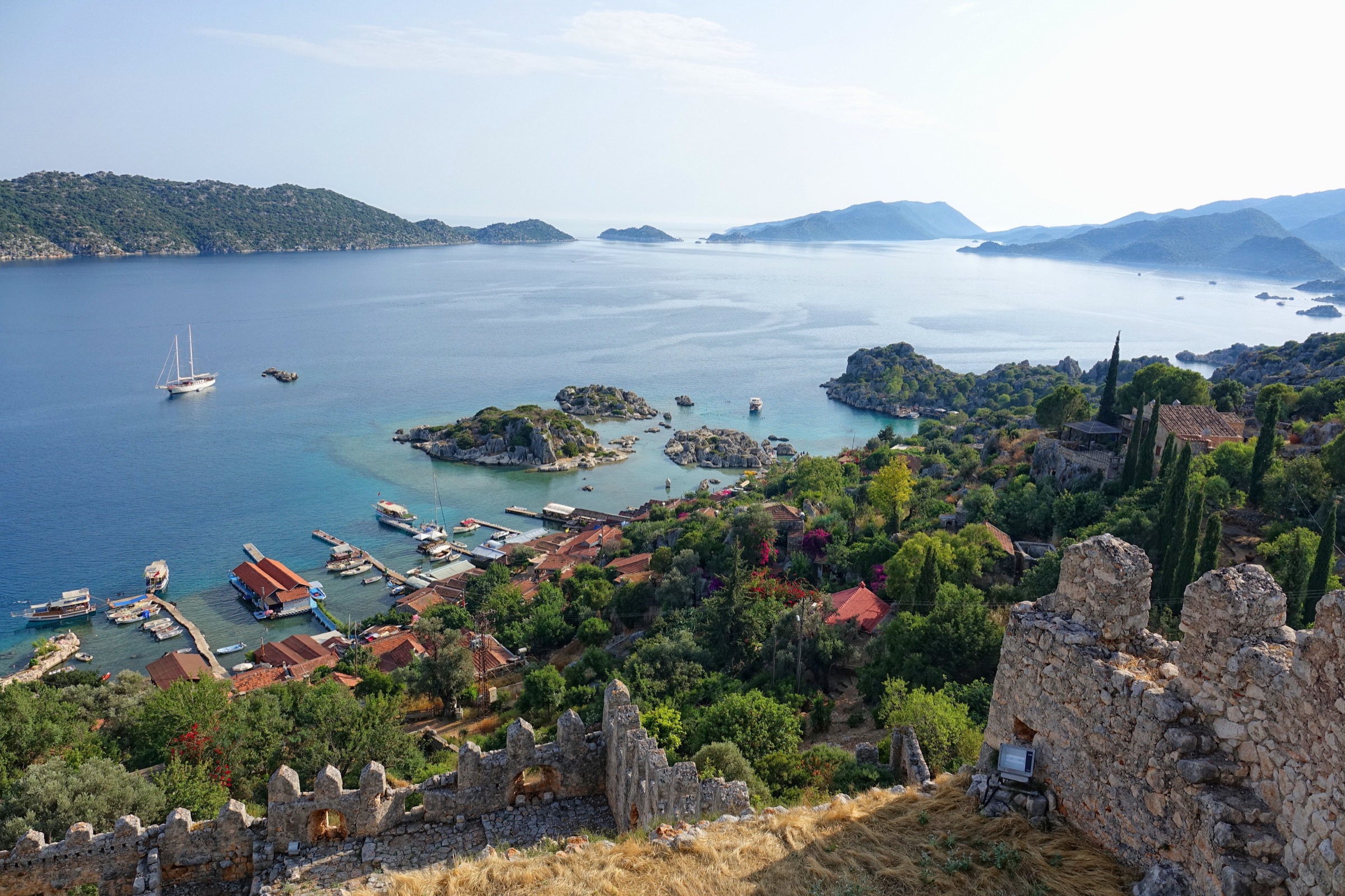
Archaeologists in Turkey say they have found the world’s oldest known shipwreck, a trading vessel of the Early Bronze Age. They date it to between 4,400 and 4,700 years ago, which the BBC says was “around the same time that the Great Pyramid was being built.” The BBC reported the find on Wednesday, Oct. 14. According to the BBC, the wreck lies about 30 meters down off Kekova Island, near Antalya, and the vessel was about 10 meters long. No wood survives, so the date rests on the style of the wreck’s pottery, not on a measurement of its age.
What was found and where
The ship’s wooden structure has not survived. What remains is scattered across an underwater slope close to the shore of Kekova Island. The archaeologists say the vessel was a trade ship carrying cargo across the Mediterranean.
The site holds three large stone anchors and more than 30 ceramic storage pots called amphorae. A BBC photo caption notes that ships carried spare anchors on long voyages. A published summary of the team’s report says it is unknown whether the anchors belong to the wreck. Divers could spend only 30 minutes at a time at that depth. Prof. Hakan Öniz of Akdeniz University, who led the Mediterranean Archaeology Association expedition, said “The shipwreck is a time capsule at the bottom of the sea.”
The Turkish Ministry of Culture owns the wreck.
How the date was worked out
Radiocarbon dating measures a form of carbon in organic material. The BBC says it could not be used because none of the ship’s wood remained. The team instead analyzed the shape of the amphorae. Pottery styles changed over time, so particular styles are linked to particular periods, a method archaeologists call typology.
The Kekova jars have two handles, a ridge in the middle and a flat base. Öniz said this design matched amphorae found in Egypt and the Middle East that are known to be 4,400 to 4,700 years old.
After comparing decoration techniques, Öniz said “we can definitely say our wreck is Early Bronze Age.” His certainty concerns the period, not the exact range. No date from a physical method such as radiocarbon has been reported; the 4,400 to 4,700 year range comes from comparing pottery styles, and it is only as firm as the dating of the pottery it is compared with.
What the jars may have held
Dr. Karin Sowada of Macquarie University in Australia examined the amphorae after they were recovered. Some were intact and still held a viscous, glossy residue. The team is working to find out what was carried, and no timetable for results has been given.
Sowada said “It could be olive oil, it could be wine, it could be tree resins.” She also said the residue could be the result of reuse of the jars, since such large jars may have been emptied on arrival and used again for many years. That means even an identified residue might show what the jars last held, not what this ship carried. What the cargo was is not known.
Where the ship may have been going
The archaeologists say the ship set out from somewhere along the eastern coast of the Mediterranean. They believe it was taking goods either to Troy, in what is now north-western Turkey, or to the Minoans, the people of Bronze Age Crete. That is the team’s belief about the voyage, not an established fact, and the BBC does not say what the belief rests on.
What the oldest claim rests on
The BBC says the Kekova wreck now tops the list of the world’s oldest shipwrecks. Its account names the previous record holder as a wreck off Dokos, an island in southern Greece, which it dates to about 4,200 years ago. It also notes that the oldest known intact shipwreck, with its wood still preserved, is in the Black Sea off Bulgaria and dates to about 2,400 years ago.
Sources date the Dokos wreck differently, so whether Kekova is older depends on which Dokos date is used.
The age claim is the team’s, reported by the BBC as what archaeologists say. The BBC quotes no expert from outside the team on the date; Sowada, the only other scientist it quotes, discusses the residue, not the age.
Daily Sabah reported on the Kekova wreck on Oct. 6, describing it as the oldest of three Antalya-coast sites studied by Öniz’s team. The BBC’s Oct. 14 report is the first report found that frames it as the world’s oldest.
The BBC report and the published paper
A preliminary report on the wreck, “Preliminary Report on the Early Bronze Age Shipwreck in the Kekova Region of Antalya” by Öniz and C. Öztosun, appears in the Journal of Maritime Archaeology (volume 21, issue 3, 2026). The published summary of the report, posted by Akdeniz University, differs from the BBC report in several ways.
The summary describes a 2024 survey that documented a wreck with Early Bronze Age amphorae. It says two amphorae had been recovered, one in 2024 and one in 2025, and that they differ in the clay they are made of and in what they were probably used for. It says three stone anchors were found at varying distances. The authors suggest a small vessel that sank while sailing from east to west. The summary gives only Early Bronze Age, with no date range and no depth. It mentions further work planned for 2026; the BBC does not say whether it has happened.
The BBC reports more than 30 amphorae and a range of 4,400 to 4,700 years, and presents the three anchors as part of the wreck. Those figures are not in the summary.
What is not known and what comes next
Several things remain open. No date from a physical method has been reported. The composition of the residue is unknown. Whether the anchors belong to the wreck is unresolved, per the published summary. No excavation schedule beyond the work planned for 2026 has been given.
The BBC reported that the culture minister, Mehmet Nuri Ersoy, said the recovered artifacts would go on display in the new Mediterranean Underwater Archaeology Museum in Antalya when it opens in the coming months. No opening date has been given. Daily Sabah’s Oct. 6 report placed that museum at Idyros in Kemer, under construction.