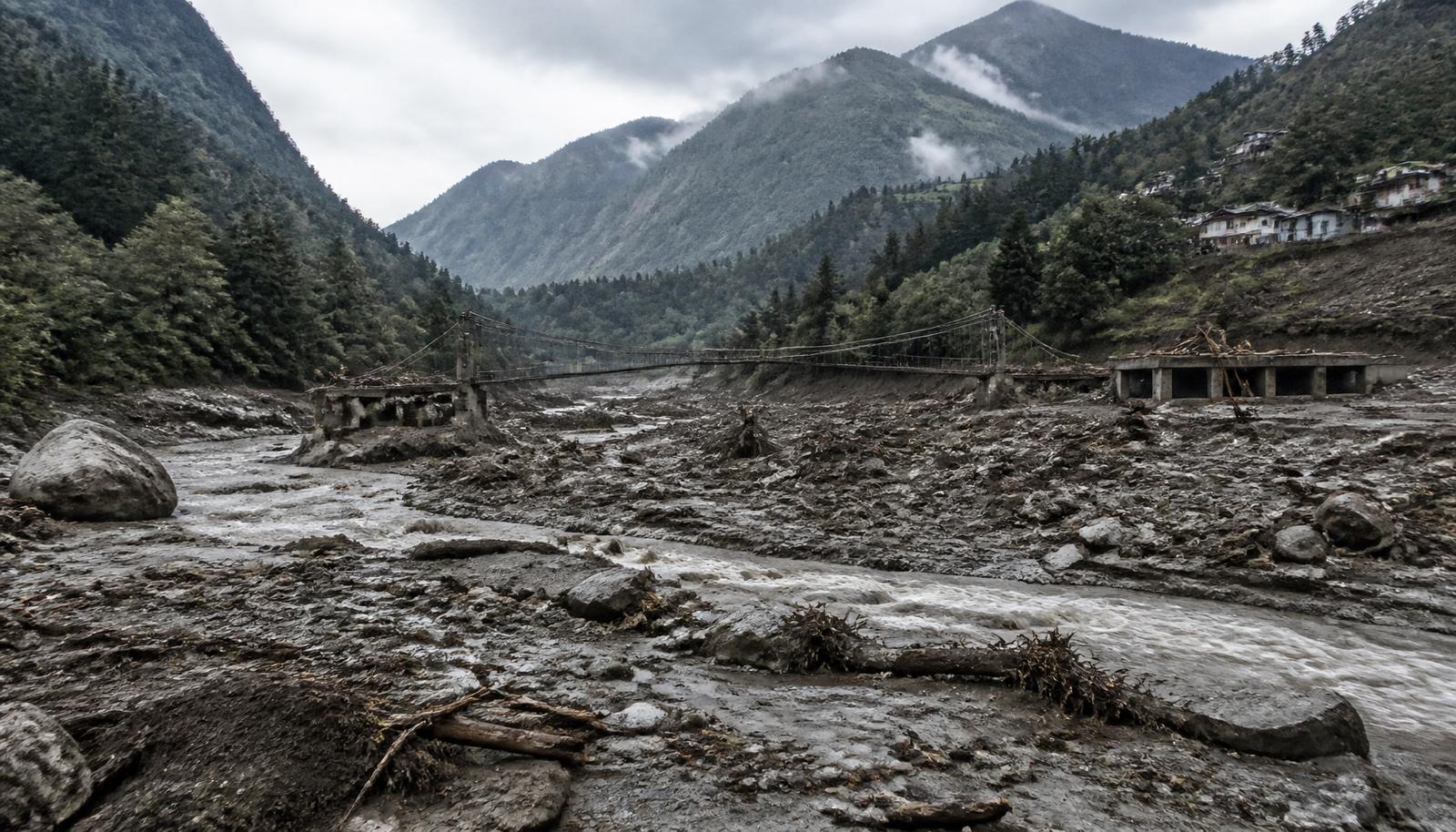
A glacier collapse in the Himalayas, not monsoon rainfall, sent a wall of ice, rock and water crashing down the Bhote Koshi and Trishuli river valleys on the morning of Aug. 26, 2026. The flash flood killed hundreds of people in Nepal and a smaller number across the border in Tibet, in China, and hundreds to thousands more remain unaccounted for as search efforts continue.
The flood struck at roughly 8:40 a.m. local time, tearing through a roughly 72-kilometer stretch of the Trishuli River across Nepal’s Rasuwa and Nuwakot districts, with damage also reported in the neighboring Dhading and Gorkha districts north of Kathmandu. It crossed into Gyirong County in China’s Tibet Autonomous Region, where it hit the Gyirong Port crossing, a major trade and tourism route between the two countries that was also damaged in the flood.
Key facts
- Cause: a glacier collapse and landslide near Langtang Lirung; Nepal’s hydrology authorities reported no significant rainfall in the affected area immediately beforehand
- When: roughly 8:40 a.m. local time on Aug. 26, 2026
- Where: Bhote Koshi and Trishuli river valleys, Rasuwa and Nuwakot districts, Nepal, with damage in Dhading and Gorkha districts and across the border in Gyirong County, Tibet, China
- Nepal death toll: reported figures ranged from roughly 359 to nearly 580 through Aug. 28
- Tibet death toll: risen from 3 to at least 5 over the same period
- Missing: Nepali figures range from under 1,000 to nearly 2,000; CBS News reported more than 2,000 still unaccounted for by Aug. 28
- Foreign nationals missing: more than 500 from roughly 32 countries; many of the missing have been described in reporting as foreign tourists, while reports on missing Americans range from roughly three dozen to about 90
- New hazard: a debris-dammed “barrier lake” holding roughly 2 to 2.5 million cubic meters of water as of Aug. 28, with the highest-risk period flagged around Sept. 1
The trigger was a glacier, not the monsoon
Nepal’s Department of Hydrology and Meteorology found no significant rainfall in the affected area immediately before the flood, according to disaster officials. Instead, investigators trace the disaster to a glacier collapse and landslide near the peak of Langtang Lirung, where a mass of snow, ice and rock broke loose into the upper Lhende river drainage. The mass movement generated a tremor of roughly magnitude 5.2, detected by seismometers in the United States and Germany. That debris and meltwater cascaded downstream into the Bhote Koshi and Trishuli rivers, producing the flash flood.
The death toll keeps changing
How many people died is still not settled. Nepal’s own count climbed unevenly through the week, and different government bodies gave different figures even on the same day, Aug. 28 — reported numbers ranged from roughly 359 to nearly 580 dead, leaving the toll unsettled. On the Tibet side, Chinese authorities have reported a smaller toll, rising from three to at least five dead over the same period.
Missing-person counts are even less settled. Nepal’s disaster agency and the prime minister’s office have given figures for the missing that range from under 1,000 to nearly 2,000, and the reported total continued to change. By Aug. 28, CBS News put the number still unaccounted for at more than 2,000, the highest count reported so far. Reports from the Tibet/China side put the number missing at 558. Separately, more than 500 foreign nationals from roughly 32 countries are reported among the missing; many of the missing have been described as foreign tourists. The number of Americans among them is unclear: CBS News has put it at around three dozen, while NPR, citing U.S. State Department figures, has put it at about 90.
Search and rescue push forward
Nepal has deployed thousands of police, army and armed-police personnel, along with more than a dozen helicopters, to search the flood zone. Helicopters have airlifted more than 3,000 people to safety in Kathmandu and other locations, according to the Red Cross, which estimated roughly 90,000 people had been affected by the flooding overall. The Nepali Army has also been working to free people trapped inside a tunnel at the Upper Trishuli-1 Hydropower Project in Rasuwa.
The flood also damaged infrastructure across the region. Local reporting cited roughly 41 damaged bridges, about 42 kilometers of roads and 20 schools, while about 431 megawatts of hydropower generation were removed from the grid in Rasuwa, Nuwakot and Dhading districts.
A new “barrier lake” threatens a second flood
The collapse left behind a new hazard: a debris-dammed lake that has been growing rapidly at the flood site. Chinese water officials estimated it held roughly 2 million to 2.5 million cubic meters of water as of Aug. 28, with another 3 million cubic meters expected to flow in by Aug. 30. Nepali and Chinese authorities have both warned the lake is unstable and at risk of bursting, which could send a second flood surge down the same valleys; Chinese state media put the period of highest risk around Sept. 1, 2026, and said rain forecast for the coming week would add to the danger.
By Aug. 28, the lake had begun overflowing, and Nepal and China both suspended some rescue operations in response — the Chinese side paused work because of rising water linked to the new lake. Separately, Nepal remains in its monsoon season, and officials have warned that continued rain on hillsides already stripped of vegetation and loaded with fresh debris raises the risk of further landslides in the same valleys in the days ahead.
False and AI-generated videos are circulating
As the disaster has unfolded, so has a wave of misinformation about it. Fact-checking organizations have identified numerous videos and photos circulating online that falsely claim to show the Nepal-Tibet floods but do not — old footage from unrelated disasters in Myanmar, the 2022 Montana floods, a 2021 mudslide in Atami, Japan, the 2025-2026 Uttarakhand floods in India, and 2022 flooding in Pakistan have all been recirculated with false captions. Fact-checkers also identified AI-generated clips, including one falsely claiming a fighter jet caused the flood; running it through an AI-detection analysis, fact-checkers found it about 97% likely to be AI-generated, and the clip had reportedly been circulating online since May 2026, months before the disaster. Fact-checkers have identified multiple widely shared clips as fake or miscaptioned, and none of the examples described here has been verified as authentic footage of this event.
Aid is arriving from abroad
Britain’s King Charles III, in a personally signed statement, said he and Queen Camilla were “heartbroken” by the flooding and offered sympathy to the families of the dead and missing, including police and armed-forces personnel who died during rescue efforts. The UK government pledged about £5 million, roughly $6.8 million, in aid.
The International Federation of Red Cross and Red Crescent Societies has launched an emergency appeal for 25 million Swiss francs, about $31 million, to support the Nepal Red Cross Society’s response. The Nepal Red Cross has activated its Emergency Operations Center and is distributing food, water, tarpaulins, blankets, first-aid kits and other emergency supplies to affected communities.