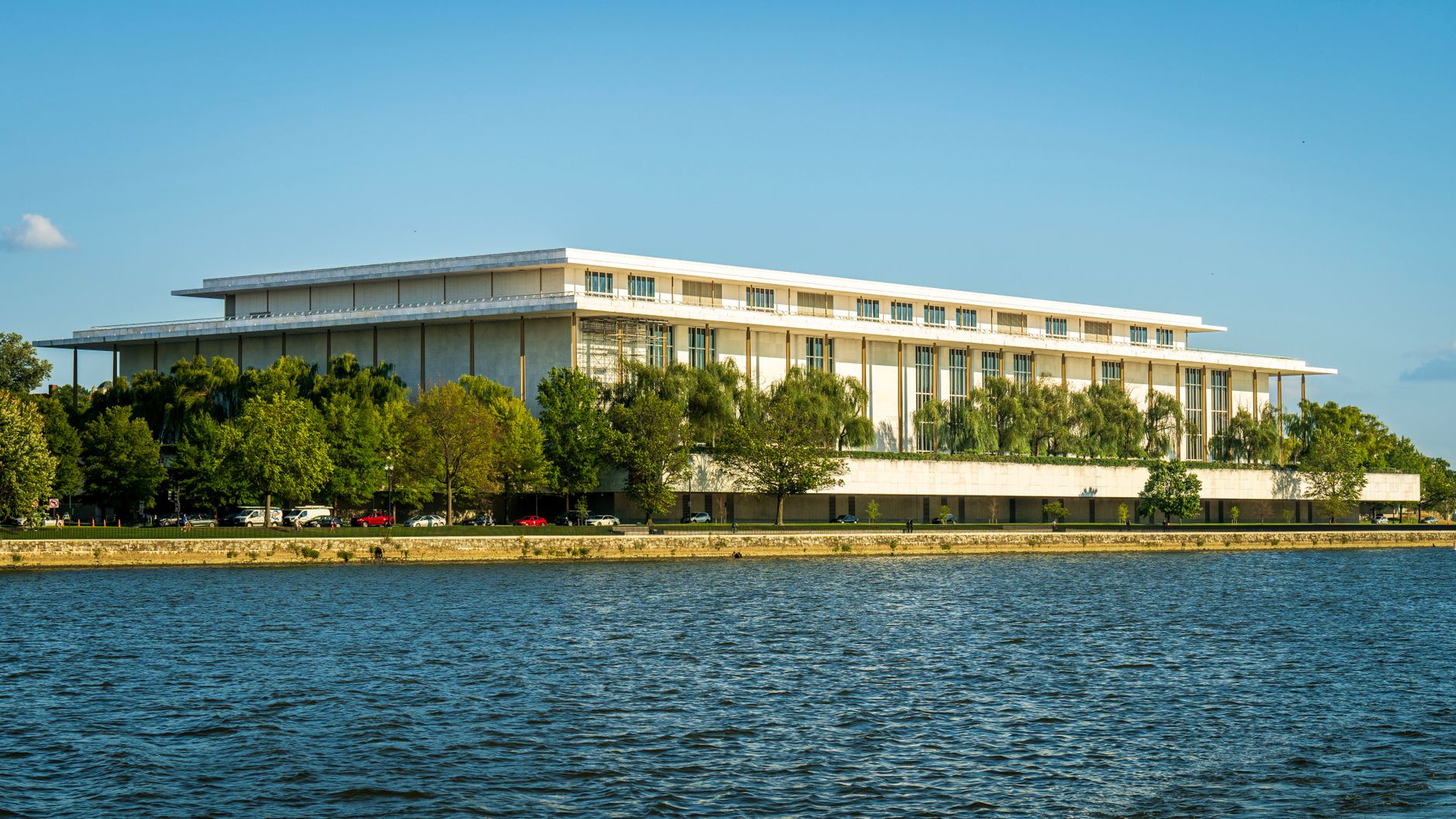
A federal judge on Tuesday blocked the Kennedy Center board’s plan to inscribe Trump’s name on the building for the second time; the board then voted to shut the building down immediately, NBC News reported, citing a source familiar with the decision.
A second order blocking Trump’s name
U.S. District Judge Christopher R. Cooper of the District of Columbia on Tuesday, Sept. 15, blocked the Kennedy Center’s board for a second time from putting President Trump’s name on the building and from renaming the campus. In a 22-page opinion, Cooper wrote that “Defendants are hereby enjoined from inscribing ‘renovated and restored by Donald J. Trump’ on the main building or renaming the campus the ‘President Donald J. Trump Plaza,’” according to CBS News. Reuters described the order as “temporarily halting the center’s latest proposal.”
Cooper wrote, in a passage quoted identically by CBS, AP, Forbes and Reuters: “Simply put, Defendants cannot install memorials for President Trump or anyone or anything else at the Kennedy Center without Congress’s blessing.” He cited his May ruling and the law that created the center, which bars “additional memorials or plaques in the nature of memorials.” Forbes reported he wrote that Congress “surely did not intend for the Board to auction off naming rights to constituent parts of the campus,” and, in a separate line, that “Linguistic gymnastics cannot extricate the Kennedy Center’s Board from an operative judicial order or the governing statute it was designed to enforce.”
The order left one piece open: whether the board can eventually place a marker reading “Endowed by the Trump Kennedy Center Fund,” tied to a $100 million fundraising goal. CBS reported Cooper declined to rule on that inscription because Rep. Joyce Beatty had not shown it would be placed “imminently, if at all”; NPR reported Cooper noted “the fund has raised nothing yet.” The order arrived, according to Forbes, just minutes before the board was scheduled to convene at 12:30 p.m. EDT; Reuters said it came shortly before the board was to vote.
The board votes to close, NBC reports
The board then met behind closed doors and voted Tuesday to shut the building down immediately, NBC News reported, citing a source familiar with the decision. NBC reported it was the third time since February that the board has voted to close the center for a two-year renovation.
According to NBC, the draft closure resolution says a construction consultant and the center’s director “consider the main building to be unsafe for continued occupancy, and anticipate further risk to the public and employees if the building is not immediately closed and renovations begun.” The board cited a partial ceiling collapse in the Grand Foyer earlier this month. Trump, the board’s chairman, joined the meeting virtually and spent several minutes criticizing both Beatty and the judge who blocked his name from the building, according to a source familiar with the meeting cited by NBC.
NBC also reported that the judge, at Tuesday’s hearing, noted — as he had before — that his earlier order barring a full closure allows for emergency repairs. Attorneys for the board have said the litigation has kept them from doing necessary work, NBC reported.
The board’s own paperwork described the meeting differently in advance. In an internal email submitted to the court by Kennedy Center lawyers, vice president for board relations Joe LaFauci said the meeting would focus “exclusively” on the “necessary closure of the Center” because of unspecified “recently exacerbated structural emergencies,” Forbes reported. A draft resolution reported by WTOP asserted “the building is unsafe for occupancy” — a claim Beatty’s filing says “incorrectly cites a consulting group’s finding, which expressly disclaimed providing any such opinion.”
NBC reported that a second, separate resolution — not expected to be taken up Tuesday — describes the center as in a “dire” financial position facing potential bankruptcy after exhausting its fiscal resources, and states that only Trump is positioned to rescue it. A draft made public in a court filing reads: “The Kennedy Center is in such a precarious fiscal position that it will not be able to support its payroll obligations, nor routine maintenance contracts within a matter of weeks.”
Beatty’s position, per NBC: the board needs congressional approval to close the venue and did not fully investigate whether parts of the center could stay open during renovations. NBC did not report a vote tally or say who voted which way. The Kennedy Center itself had not announced a closing time when this article was published; NBC’s own wording is that the board “voted … to immediately shutter” the building, not that it has closed.
The board’s money argument, and the judge’s answer
In its draft resolution, obtained by Reuters and WTOP ahead of Tuesday’s meeting, the board wrote: “The Board understands that without such appropriate recognition it is unlikely that President Trump will provide the fundamental oversight of the renovation of the main building and lead the fiscal rescue of the Center.”
Cooper had already answered that argument in his opinion. Forbes reported he found “no proof that current or future donations hinge on President Trump’s name being on the building,” and cited evidence Beatty raised that adding Trump’s name “coincided with declines in revenue and contributions, as artists cancelled performances, the Washington National Opera ended its 50-year residency, and ticket sales and viewership of the Kennedy Center Honors broadcast dropped precipitously.” He wrote that the center’s financial survival with or without Trump’s name is “beside the point” of his order. NBC News quoted a further passage: “The Board also has access to the $257 million that Congress appropriated for necessary capital improvements,” Cooper wrote, adding that it was “beside the point for present purposes,” and that the court could “not license a violation of those authorities under threat that some unidentified donors will withhold their largesse if the Board is not allowed to have its way.” Reuters reported separately that artists “canceled performances in protest,” that the Washington National Opera and the National Symphony Orchestra “were forced to find other venues,” and that “revenue cratered.”
The Trump administration has taken a different line in court. At an August hearing, the administration argued it was no longer trying to rename the building and that the inscriptions amounted to “simply a recognition” of Trump’s fundraising. The Justice Department told the court “there is no renaming here,” according to AP and CBS, and said the inscriptions were meant to honor Trump’s fundraising to supplement about $257 million appropriated by Congress for the renovation. Commerce Secretary Howard Lutnick, whose wife sits on the Kennedy Center board, compared the arrangement to the way hospitals and colleges recognize “high dollar donors,” AP reported. CBS reported the administration has separately appealed Cooper’s May ruling.
Beatty’s attorneys, Norm Eisen of Democracy Defenders Action and Nathaniel Zelinsky of Washington Litigation Group, said in a joint statement reported by NBC News: “Legal sanity has once again prevailed over Trump’s vanity.”
The statements
Beatty, an Ohio Democrat who sits on the Kennedy Center board by virtue of her House seat and who brought the lawsuit, said Tuesday: “The law is extremely clear: The John F. Kennedy Center is named for President Kennedy — and no one else. But President Trump is holding the Kennedy Center hostage unless he can put his name on this sacred memorial. The Court just rejected this proposal for the second time. This unlawfulness is as breathtaking as it is wrong, and it needs to stop.”
Trump posted on Truth Social just before Cooper’s order Tuesday, describing the Kennedy Center as in a “virtual state of collapse” and saying a “large piece of concrete and steel just dropped down, in a thud, from the ceiling of a heavily trafficked main hallway,” and that “innocent people would have been killed” had the building been open that day. He wrote that he is the “only one” who can “save” the center “because I have the ability to raise the money, and the ability to construct — that few others have,” and he called Cooper “very hostile and conflicted.”
Trump’s post followed security video Lutnick posted on X on Monday, Sept. 14, showing part of the Grand Foyer ceiling falling. Lutnick wrote: “Here is the video of the ceiling of the Kennedy Center crashing violently onto the main Lobby floor. Failing roofing, collapsing concrete supports and steel that is rotting have created completely unsafe conditions.” He added that the video was “caught on security video, missing one of the Center’s security guards by just minutes” and that “only President Trump can deliver the renovation on time and on budget, and only President Trump can raise the money to keep the Center out of bankruptcy.”
How the fight reached this point
The Kennedy Center, which first opened on Sept. 8, 1971, has been at the center of a legal fight over its identity since February 2025, when Trump removed roughly half of its trustees. The remaining board elected him chairman, David Rubenstein stepped down as chair after 14 years, and president Deborah Rutter departed; Richard Grenell was named interim president.
In December 2025, the board added Trump’s name to the building, changing the marble facade to read “The Donald J. Trump and John F. Kennedy Memorial Center for the Performing Arts.” Beatty sued that month. On May 29, 2026, Cooper issued a 94-page ruling finding the board “overstepped its statutory bounds,” writing: “May the John F. Kennedy Center for the Performing Arts be renamed absent Congressional authorization? The answer, plain from the face of the statute, is no.” He ordered the name removed within two weeks and blocked a closure the board had voted for in March, calling that vote “ill-informed and seemingly preordained.” Trump said afterward he would work with Congress to hand the building back to it.
By June 13, the center told the court it had removed the name from signage, its website and documents; the exterior remained covered by scaffolding and a tarpaulin. On Aug. 13, the board voted 20-3 to inscribe a new version of Trump’s name on the building and to name the grounds “President Donald J. Trump Plaza,” with the three no votes cast by the board’s ex officio congressional members — Beatty, Sen. Sheldon Whitehouse of Rhode Island and Rep. Rick Larsen of Washington, both Democrats. The board also voted that day to close the main building for up to two years while keeping the REACH, its newer annex, open for limited programming.
On Aug. 25, a Justice Department filing warned that without the renovation and Trump’s fundraising, the center “will deteriorate further into an unsafe, decrepit structure that will be required to be taken down.” At a hearing on Thursday, Aug. 27, before Cooper, the board agreed not to act on the name before Sept. 8.
What changes for audiences, and what is still unknown
The National Symphony Orchestra is moving its season off campus. It announced in August that its 2026-27 season of 64 concerts will be split across six venues around the Washington area — Lisner Auditorium, Strathmore, Schlesinger Concert Hall, the George Mason Center for the Arts, the Clarice, and the Lincoln Theatre — plus an eight-concert U.S. tour, opening Sept. 26, according to WTOP. The Washington National Opera ended its 50-year residency at the Kennedy Center, in Cooper’s words. REACH, the Kennedy Center’s newer building, is set to remain open for limited programming under the board’s August vote.
The underlying legal fight is over what the center’s founding law allows. That statute requires the Kennedy Center be maintained as “a living memorial to John Fitzgerald Kennedy” and states that “no additional memorials or plaques in the nature of memorials shall be designated or installed in the public areas” of the center, which the law calls the “sole national memorial” to Kennedy in Washington.
Several things remain unclear after Tuesday. NBC has not given a tally of how the board voted or named individual votes. Neither NBC nor the Kennedy Center has announced a closing time or a date the building will reopen, and no ticket, refund or subscription guidance had been reported. The money has also been reported in more than one way: about $257 million is what Congress appropriated for capital improvements, according to CBS News and the judge’s own opinion as quoted by NBC, while the board’s renovation plan has been described by ABC News, citing a court filing, as a $285 million project.