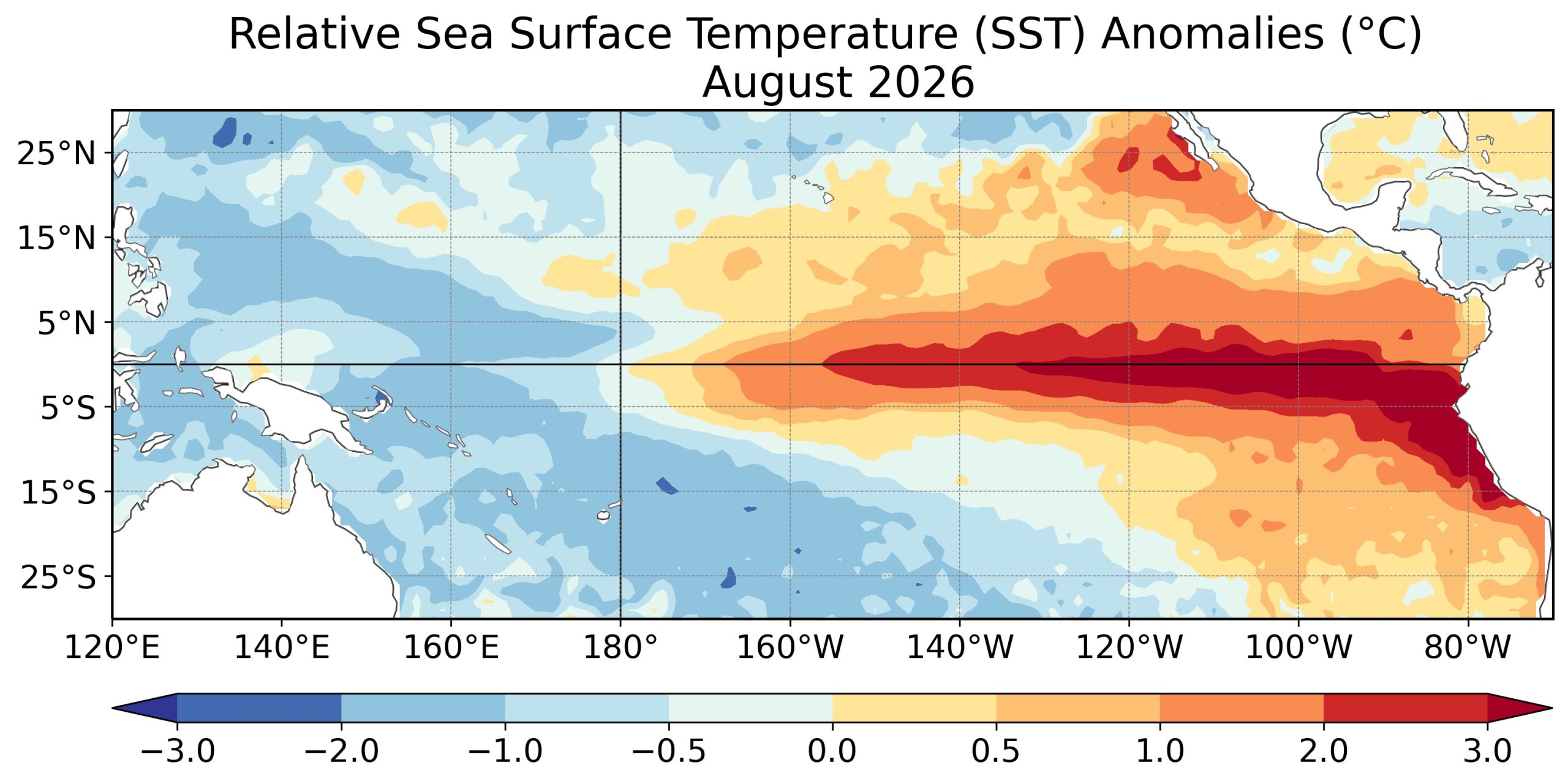
Gov. Gavin Newsom proclaimed a state of emergency to exist statewide on Monday for the developing 2026-2027 El Niño event, ahead of the winter storm season, after California had already experienced coastal flooding this year that officials attribute to the pattern. The proclamation orders state agencies to stage flood-fight supplies and speed up permits, has Caltrans plan where to pre-position equipment and has state military officials identify National Guard resources in case they are needed. Federal forecasters put the odds of a very strong event above 90%.
El Niño is a periodic warming of surface waters in the eastern Pacific Ocean that can shift winter weather patterns. The proclamation says very strong El Niño events “do not produce uniform statewide outcomes, but can be associated with exceptionally wet and destructive winter conditions in California.”
What the order does
The proclamation, signed “this 21st day of September 2026” and attested by Secretary of State Shirley Weber, was issued under section 8625 of the California Emergency Services Act. It directs state agencies to act under the coordination of the Governor’s Office of Emergency Services, which will oversee statewide preparedness. It also states: “Applicable provisions of the Government Code and the Public Contract Code, including but not limited to travel, advertising, and competitive bidding requirements, are suspended to the extent necessary to address the effects of this emergency.”
The Department of Water Resources is ordered to procure, maintain, stage, pre-position, distribute and replenish flood-fight supplies, including sandbags, riprap and other rock materials, plastic sheeting and pumps. Caltrans is directed to “develop plans to pre-position” road-closure and traffic-control equipment along with snow-removal gear — snowplows, snow blowers, graders, loaders, chain-control equipment, salt and sand. The Adjutant General and the California Military Department are to identify National Guard personnel and equipment for high-water vehicles, aviation, engineering, evacuation support and other duties “if activated or tasked.”
The California Coastal Commission is ordered to speed permitting for coastal communities. “When necessary to address an urgent need related to this emergency,” the commission is to act on emergency permit requests “as quickly as possible and within twenty-four hours of receipt.”
What the release did not mention
The governor’s public release does not mention order 18 of the proclamation, which suspends part of California’s price-gouging law. Penal Code section 396 generally makes it illegal, once a state of emergency is proclaimed, to raise prices on covered goods and services — including food, medical supplies, building materials, housing, transportation and gasoline — by more than 10% over the price charged immediately before the emergency, subject to exceptions the law lists. Order 18 states that “the restrictions set forth in Penal Code section 396, which are automatically triggered upon proclamation of a state of emergency, are suspended, and no such restrictions are imposed, with respect to this El Niño event, at this time.” The proclamation gives no reason for the suspension.
The release also omits two deadlines the proclamation sets. CalEPA and the Natural Resources Agency must submit, by Oct. 16, “a joint recommendation” on whether further action or emergency suspensions are needed to speed local flood, landslide and debris-flow work. Separately, Caltrans and the State Transportation Agency must send the Office of Emergency Services, within 30 days of the proclamation, “a prioritized list of projects to address such risks” to state highways, bridges, culverts, drainage facilities and slopes.
What the forecast says, and does not
The Climate Prediction Center’s most recent discussion, issued Sept. 10, put a “greater than 90% chance of a very strong event” this fall and winter, and said there is a 75% chance of “a historic event that would exceed the strength of previous El Niño events dating back to 1950” between October and December. The proclamation instead cites the center’s earlier, Aug. 13 report, which gave a 69% chance of a historic event — an older monthly figure, not a discrepancy in the current forecast.
The center also cautions: “With an event of this magnitude, the chances of experiencing impacts consistent with El Niño are larger, though not guaranteed.” History backs the caveat: the California Coastal Commission notes the 2015-16 El Niño was “one of the strongest of the past 145 years,” yet that winter did not bring extraordinary rainfall to California — though it did cause record coastal erosion, about 150 feet on average across Central California.
Why officials are moving now
The Coastal Commission calls the 1982-83 and 1997-98 El Niños “among the most damaging and well-documented events in the modern record.” After the 1982-83 event, the U.S. Army Corps of Engineers reported 33 oceanfront homes destroyed and another 3,000 homes and 900 coastal businesses damaged. In 1997-98, there were 17 storm-related deaths in California, and at least 27 homes were red-tagged in the coastal zone.
The state’s release says California “has already experienced coastal flooding attributed to El Niño” this year, as Kelvin waves raise sea levels and offshore Pacific hurricanes, fueled by warm water in the eastern Pacific, “drive strong waves battering the California coast.” Separately, Orange County proclaimed a local emergency on Sept. 17 over coastal damage from Hurricane Marie, after Dana Point, Laguna Beach and San Clemente each proclaimed their own, the county said. In San Diego County, Carlsbad also declared one, the Los Angeles Times reported. The release also cites a Science study published last month, describing it as finding that El Niño events are “more than 36% stronger than before the industrial era.” The study was based on fossil corals from the Galápagos Islands.
What happens next, and what residents can do
The Climate Prediction Center’s next discussion is scheduled for Oct. 8. State agencies’ joint recommendation on further flood and landslide permitting action is due Oct. 16, and Caltrans’ prioritized project list is due within 30 days of the proclamation.
The state’s release urges residents to sign up for alerts through Listos California, learn their flood risk, clear drains and gutters, and prepare an evacuation plan and kit that includes supplies for pets. It also repeats a standard warning: “Never drive through floodwater.”
Sources and further reading
- Governor Newsom proclaims state of emergency to bolster statewide El Nino preparedness, protect California
- Proclamation of a State of Emergency (El Niño, signed Sept. 21, 2026)
- ENSO Diagnostic Discussion, issued 10 September 2026
- ENSO Diagnostic Discussion, issued 13 August 2026
- California Penal Code section 396
- El Niño
- Sign up for emergency alerts