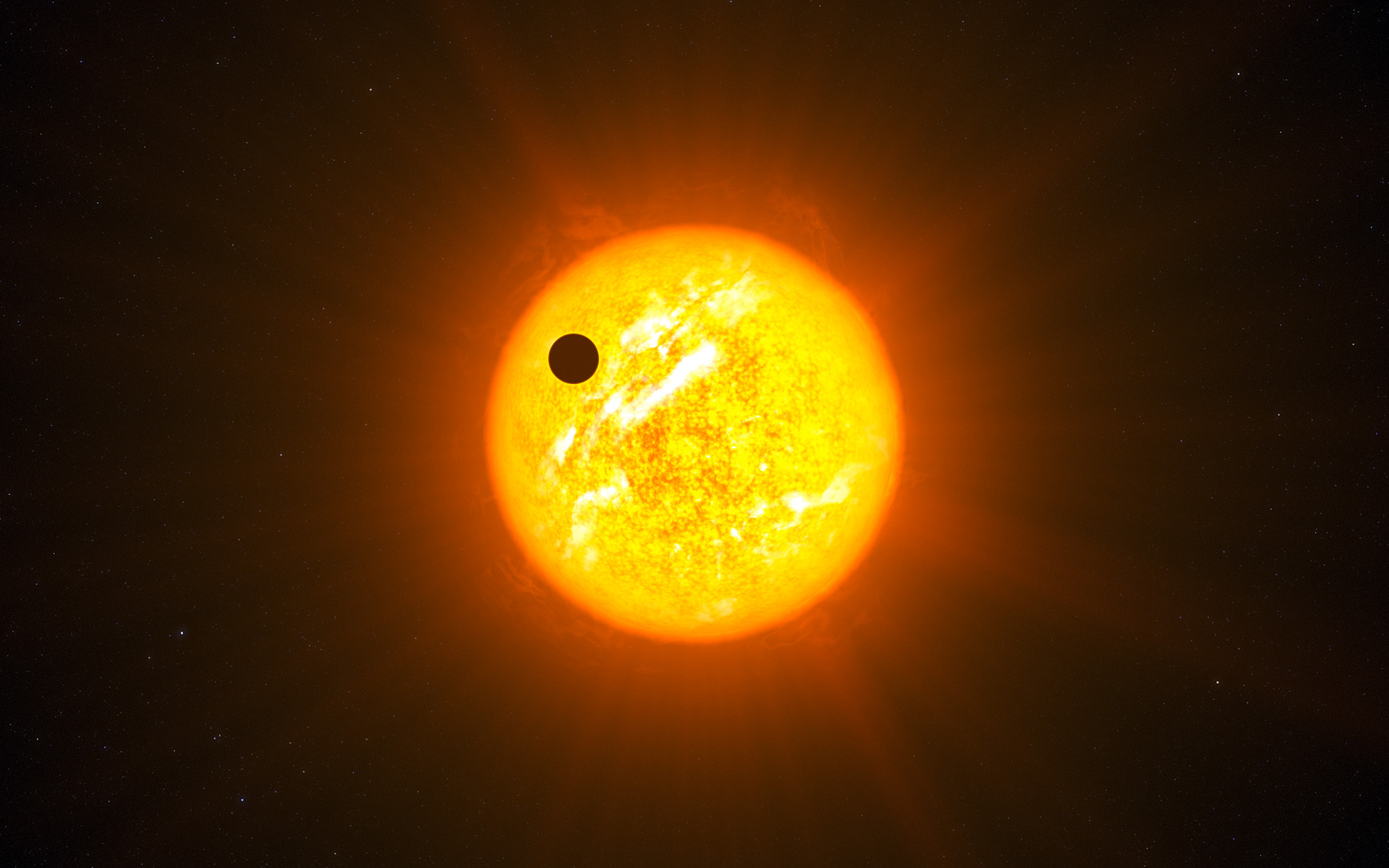
Astronomers at the University of Geneva and colleagues report that GJ 3090 b, a sub-Neptune, orbits its red dwarf star against the direction of the star’s spin (a retrograde orbit), in a paper published Monday in Astronomy & Astrophysics. The authors call it the first such planet found around an M dwarf.
What was measured
We could read only the paper’s abstract and bibliographic record. The team made six transit observations (a transit is a planet passing in front of its star) of GJ 3090 b with two spectrographs, NIRPS and HARPS, according to the paper’s abstract. The abstract calls the planet a sub-Neptune, meaning smaller than Neptune, and the star an M dwarf, which the University of Geneva’s release calls a red dwarf, cooler and smaller than the sun.
From those data the authors derive a “3D obliquity” of 136 degrees, with a stated uncertainty of plus 24 and minus 18 degrees (the abstract does not give the confidence level). The abstract describes obliquity as “the angle between stellar spin axis and planetary orbital plane”; in the standard usage, it is the angle between the star’s spin axis and the direction perpendicular to the planet’s orbit, which is why it can exceed 90 degrees. The abstract calls the orbit “retrograde”; the standard meaning is an angle above 90 degrees. Our arithmetic from those figures gives an interval of about 118 to 160 degrees. The release gives the angle as “approximately 136 degrees,” with no error bar.
Why the angle matters
The University of Geneva’s release describes a cloud of gas and dust collapsing to form a star, with a disk around the young star in which its planets form. In the ideal scenario the release describes, planets orbit in the same direction as the star spins and in the same plane as its equator, what astronomers call aligned systems. The release describes the angle, which it calls Psi, as the angle between a planet’s orbital plane and the star’s equatorial plane; for the solar system’s planets, it says, the angle “varies from approximately 3 to 7 degrees depending on the planet.” The paper’s abstract adds that measuring the angle in systems with several planets “can be used to further discriminate between different competing migration scenarios” (ideas about how planets’ orbits shift over time).
What the authors say about why
The abstract says the authors “find no evidence of massive outer planetary or wide stellar binary companions,” which “disfavors scenarios involving gravitational perturbations from a massive body and instead points toward a primordial misalignment of the protoplanetary disk” (the disk of gas and dust around a young star from which planets form). In plain terms, they point to a disk that was itself misaligned with the star’s spin.
The authors further “propose late secondary disk accretion” (the star taking in a second, later disk of material) “around GJ 3090, in which the disk is not expected to be aligned with the stellar spin axis, followed by disk-driven migration” (the disk shifting the planet’s orbit) “as the most likely mechanisms to explain the observed architecture.” In the release, co-author Vincent Bourrier says the star “could have accreted a misaligned, retrograde secondary disk in which the planets in the system then formed.” This is a proposal, not a demonstrated cause.
How the “first” is worded
The claim appears in the paper’s title and abstract. The title reads “Upside down: GJ 3090 b the first retrograde exoplanet around an M dwarf detected with NIRPS.” The abstract says the results “establish GJ 3090 b as the first planet on a retrograde orbit discovered around an M dwarf and the first highly misaligned confirmed multi-planet system without a known massive companion.” The release, as reproduced by Phys.org, makes no first-discovery claim of its own. The authors’ claim is limited to M dwarfs.
TEPCat, a public catalogue of spin-orbit measurements kept at Keele University (page last modified Sept. 9, 2026), lists true-obliquity (psi) estimates of 103 (+13/-12) degrees for GJ 436 (Bourrier et al. 2022) and 97 (+16/-11) degrees for GJ 3470 (Stefánsson et al. 2022), both cool stars. The catalogue values are above 90 degrees, but GJ 3470’s stated range reaches below 90 (97 minus 11 is 86, our arithmetic), while GJ 3090 b’s stated range (118 to 160) does not. We could not read how the paper treats these earlier estimates, and the “first” is the authors’ claim.
What differs and what we could not check
The release makes statements the abstract does not, and we did not check them: a mass 4.5 times Earth’s, a radius 2.2 times Earth’s, that NIRPS detected “two other planets,” and that only five other multiplanet systems are known to host a misaligned planet with an angle greater than 70 degrees. That is why we give no planet count: the abstract says only “confirmed multi-planet system.” We found no independent astronomers’ comment in the pages we opened. The publisher’s page for the paper returned an access error, and in a limited search we found no preprint. Quotations from the release are as carried by Phys.org, which labels the text “by ESO”; the release is the University of Geneva’s.