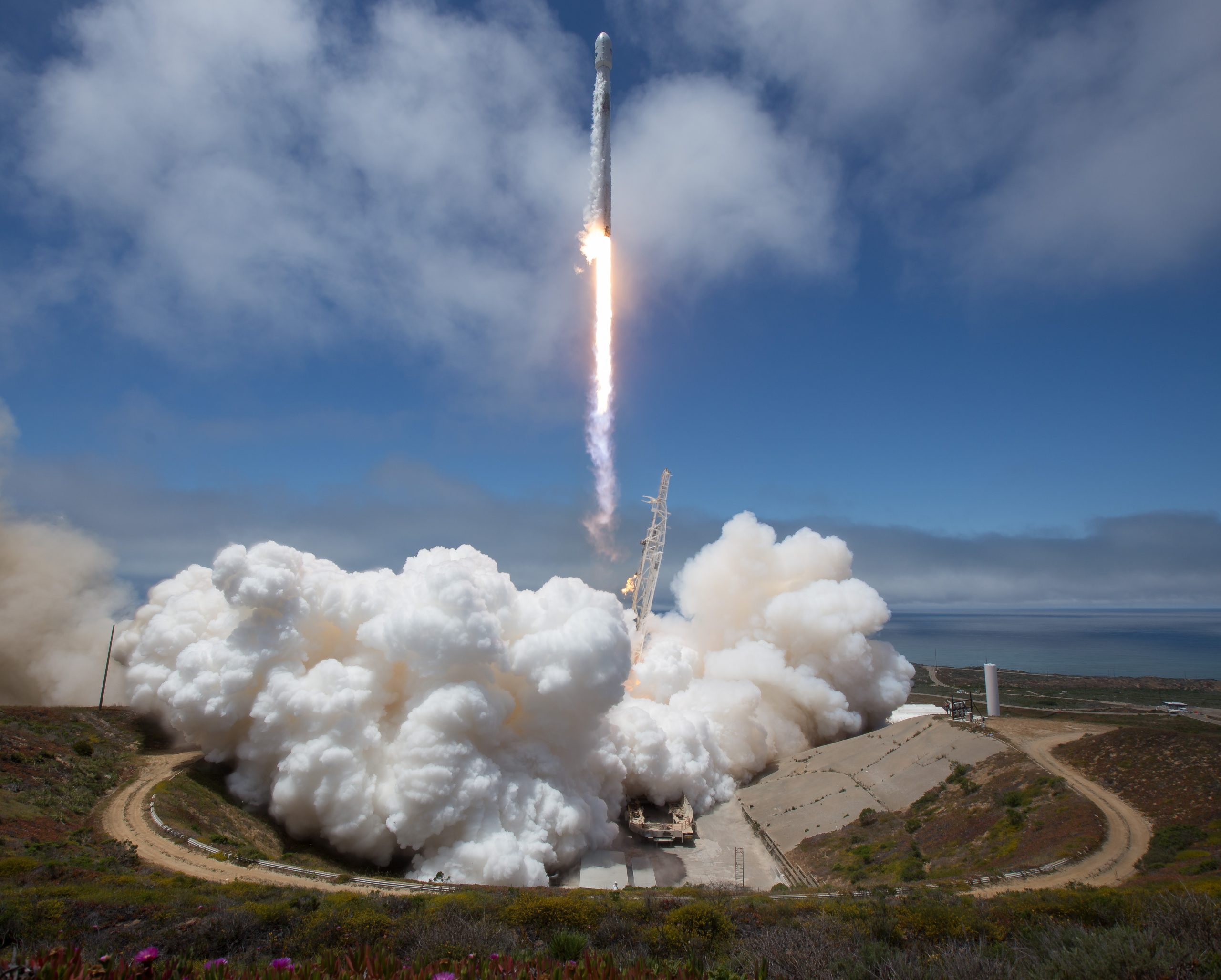
A discarded SpaceX rocket stage was due to slam into the Moon at about 2:35 a.m. Eastern time on Wednesday, August 5, 2026. For most of a day the strongest sign that it actually happened was not a photograph but a faint puff of vaporized metal, caught by one of the largest telescopes on Earth. The photograph came the next day, from a South Korean spacecraft already circling the Moon.
Carl Schmidt, a planetary scientist at Boston University, told CBS News that the Very Large Telescope — which stands at Paranal Observatory in Chile’s Atacama Desert — picked up a plume of sodium and lithium gas through its spectrograph, the kind of signal a crash like this would throw skyward. In Schmidt’s reading, the detection indicates the collision occurred. Schmidt also said a second scientist independently picked up a sodium signature from an observing site in Sudbury, Massachusetts. In a separate account, Rodrigo Palominos, a telescope operator on the same Paranal mountaintop, said he saw changes in light around the predicted moment — possibly material thrown up from the surface — calling it no more than an encouraging preliminary result.
That is where the story stood on Wednesday afternoon: the calculated moment had passed, the first telescope readings pointed toward an impact, and the picture that would settle it — a fresh mark where none existed before — had not arrived. It arrived the next day, and not from the spacecraft everyone was waiting for. On Thursday, August 6, 2026, the Korea AeroSpace Administration released before-and-after images from its Danuri orbiter showing a new dark mark spreading out from the impact site and terrain around it disturbed by debris. The impact is confirmed.
Key facts
- A SpaceX Falcon 9 upper stage was due to hit the Moon at about 2:35 a.m. Eastern time on Wednesday, August 5, 2026.
- The first evidence was not a photo — it was a plume of sodium and lithium gas picked up by the Very Large Telescope in Chile.
- Confirmed by photograph on August 6, 2026: the Korea AeroSpace Administration released before-and-after images from its Danuri orbiter showing a new dark mark at the impact site.
- Danuri imaged the site eight times around the collision at about five meters per pixel; NASA’s Lunar Reconnaissance Orbiter makes its own next pass around August 12.
- The stage was an empty shell weighing roughly four tons, expected to hit at about 5,400 mph — an impact NASA says releases energy comparable to about three tons of TNT and poses no danger to Earth.
- This is not the 2022 lunar impactor: NASA and independent astronomer Bill Gray catalog this object as Falcon 9 upper stage 2025-010D.
Why the silence is expected
From Earth, nobody was ever going to watch this happen live. The Moon is roughly a quarter-million miles away, and the strike was never expected to be visible to the naked eye. Even telescopes faced long odds. The stage was headed for sunlit ground near the craters Einstein and Bell, close to the Moon’s edge as seen from Earth, and the observation-planning study for the event warned that any flash against that bright backdrop could be too dim for any instrument to catch. Amateur astronomers watching through telescopes Wednesday morning reported seeing no sign of it — an outcome the observing plan had prepared them for, since it put the flash anywhere from faintly visible to undetectably dim.
It also means any clip claiming to show the crash deserves suspicion. The dramatic impact videos published by science outlets are computer simulations, not footage. And there is precedent for fakes: after the 2022 lunar impact, viral videos claiming to show a rocket hitting the Moon turned out to be digital effects built from old, unrelated footage. As of Wednesday afternoon, no verified footage of this impact was known to exist.
The spacecraft that can settle the question was not in position either. NASA’s Lunar Reconnaissance Orbiter photographed the impact zone on July 29 to create a “before” picture, but its orbit did not carry it over the site at the moment of impact. Brent Garry, the mission’s project scientist, told TIME the orbiter will be over the site again on August 12. NASA has said usable imagery depends on lighting, orbital timing and spacecraft position, and CBS reporting cautions the full wait for before-and-after pictures could stretch to two weeks.
South Korea’s Danuri orbiter made the boldest attempt, and on Thursday, August 6, 2026 the Korea AeroSpace Administration said it had worked. Danuri was set to sweep within a couple of miles of the falling stage about two minutes before impact and film the collision with its terrain camera. KASA said the orbiter began observing about half an hour before the strike and photographed the site eight times in all, at a resolution of about five meters per pixel, with observations running from shortly before the collision through the following morning. The images it released set the site before the impact against the site after it: a newly formed dark mark spreading outward, and terrain around it changed by debris.
How a rocket ends up crashing into the Moon
The object is the upper stage of a Falcon 9 that launched on January 15, 2025, carrying two commercial lunar landers: Firefly Aerospace’s Blue Ghost 1, which touched down successfully that March, and ispace’s Resilience, which later crashed on the lunar surface after contact was lost.
After sending the landers on their way, the stage had burned essentially all of its propellant, leaving nothing for a disposal maneuver. So it drifted, looping through the Earth-Moon system for about 19 months. “What has happened is essentially a mixture of solar activity and gravity forces have put it on a path towards the moon,” said Julianna Scheiman, SpaceX’s director of NASA Science and Dragon Programs.
By the final days, NASA’s Center for Near Earth Object Studies put the chance of a lunar impact at 100 percent — a statement about the trajectory, which left no plausible way to miss. That certainty is not in tension with the wait for confirmation: the math said where the stage was headed, but only an observation can show what happened when it got there. The stage itself was an empty shell weighing roughly four tons. It was due to arrive at about 5,400 mph by NASA’s estimate, and a crash at that speed releases energy comparable to detonating about three tons of TNT. NASA says the impact poses no danger to Earth.
As for whether rules exist to prevent this, mostly they do not. Debris-disposal requirements apply to orbits around Earth; nothing enforceable yet governs spent hardware left adrift near the Moon.
Timeline
- January 15, 2025 — A Falcon 9 launches carrying Firefly Aerospace’s Blue Ghost 1 and ispace’s Resilience lunar landers; the spent upper stage is left with no fuel for a disposal maneuver.
- March 2025 — Blue Ghost 1 lands successfully on the Moon.
- July 29, 2026 — NASA’s Lunar Reconnaissance Orbiter photographs the impact zone to create a “before” picture.
- August 5, 2026, about 2:35 a.m. ET — The Falcon 9 upper stage is due to strike the Moon near the craters Einstein and Bell.
- August 5, 2026, Wednesday afternoon — The Very Large Telescope detects a plume of sodium and lithium gas, the first sign the impact occurred; no photo confirmation yet.
- August 6, 2026 — The Korea AeroSpace Administration releases Danuri’s before-and-after images of the impact site, confirming the strike.
- August 12, 2026 — Expected date for the Lunar Reconnaissance Orbiter’s next pass over the site to capture its own “after” images.
Not the rocket from 2022
This is not a rerun of an earlier story. In March 2022, a rocket body struck the Moon’s far side and was initially reported to be a SpaceX Falcon 9 stage; University of Arizona researchers later identified it as the third stage of a Chinese Long March 3C rocket from a 2014 mission. This time the identification is solid. Both NASA and Bill Gray, the independent astronomer whose tracking pinned down the impact time, catalog the object as Falcon 9 upper stage 2025-010D.
Why scientists wanted this crash
An accidental impact turned into a rare controlled experiment. When a natural meteoroid hits the Moon, astronomers learn of it after the fact and have to guess the projectile’s size and speed. Here, the mass, dimensions, velocity and arrival time were all known in advance with unusual precision. That let a 23-member international team led by Benjamin Fernando line up observations ahead of time, from the Very Large Telescope in Chile to Apache Point Observatory in New Mexico and the Lowell Discovery Telescope in Arizona.
The payoff, if the observations hold up, is twofold: a real-world check on models of how impacts carve craters, and a chemical glimpse beneath the lunar surface. The material blasted upward carries traces of what lies underground in a little-studied region — potentially including water ice, the resource future Moon missions care about most.
That is also the honest caveat about Wednesday’s plume. The sodium and lithium in the reported readings could have boiled off the vaporized rocket, been blasted out of the lunar soil, or both — no analysis published so far separates the two after the fact. What the detection was not is a lucky coincidence: sodium is what the campaign’s instruments were set up in advance to watch for, with the Lowell Discovery Telescope assigned sodium-emission spectroscopy and the Very Large Telescope’s spectrograph tuned to sodium and potassium. Lithium was in the published plan too, but with a different suspect attached: the campaign flagged it as a possible fingerprint of the rocket stage itself, noting that lithium glow from Falcon 9 upper stages had been spotted entering Earth’s atmosphere before, and encouraged observers to watch for it. That is a lead, not proof — it does not establish that the lithium came from the rocket rather than the soil. Whether any of the readings hint at water ice has not been reported. The chemistry, like the photographs, is still ahead.
What happens next
The proof arrived with Danuri’s pictures. The Lunar Reconnaissance Orbiter will still make that next pass — KASA says Danuri’s observations will be matched against LRO’s follow-up work — and NASA says ShadowCam, a second camera aboard Danuri separate from the terrain camera that filmed the moment of impact, will also look for chances to image the site.
As for how big the new mark is: nobody has said. The figures that circulated before the crash were model predictions — NASA’s estimate and the observing campaign’s own planning study each gave its own — and KASA published no measurement when it released Danuri’s images. Every version of the models describes something modest — a scar an orbiting camera can find, not a mark anyone will see from Earth, and that is what the pictures show. The record no longer stands where Wednesday afternoon left it: the rocket found its mark, a camera has now seen it, and what is still missing is a measurement of how big it is.
Sources and further reading
- NASA Will Attempt to Observe Rocket Part’s Lunar Impact
- Impact Flash! (citizen science project)
- Observational planning for the 2026 August 5 Falcon 9 Upper Stage lunar impact
- Mitigating space debris generation
- AME Students Track Chinese Rocket on Lunar Collision Course
- Observational planning for the 2026 August 5 Falcon 9 Upper Stage lunar impact — full text
- Predicted Ejecta Dynamics and Observability of the 2026 Falcon 9 Upper Stage Lunar Impact (arXiv:2607.23904)