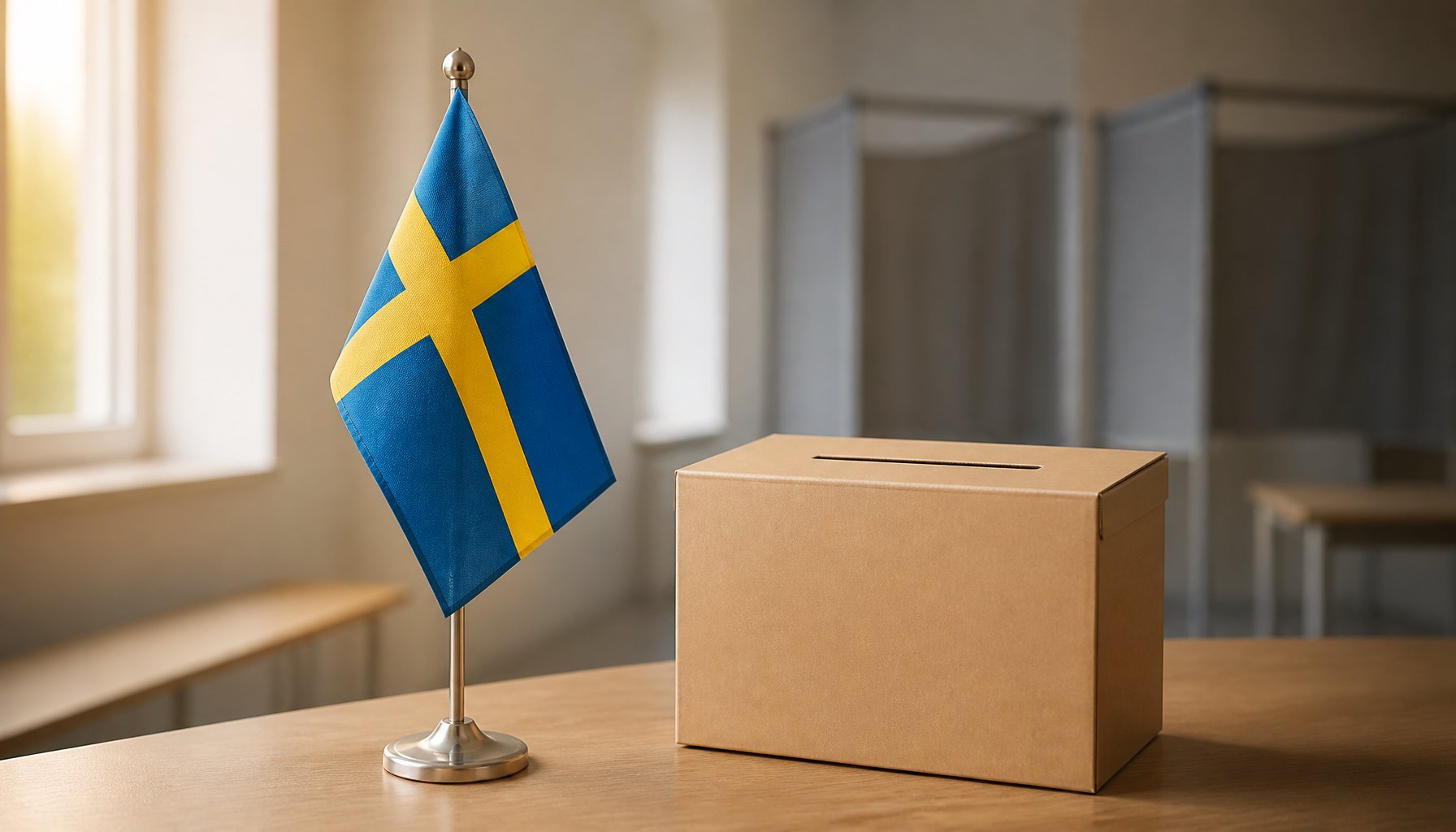
Sweden held a general election on September 13, 2026, to fill all 349 seats in the Riksdag, the country’s parliament, alongside separate votes for 21 regional and 290 municipal councils. With roughly 94-95% of election districts counted, the four-party centre-left opposition held a narrow lead over the four-party bloc that has backed Prime Minister Ulf Kristersson’s government — 176 seats to 173 in the most recent count, one seat past the 175 needed to control the chamber, according to international news agency reporting. The opposition bloc is the Social Democrats, Left Party, Centre Party and Green Party; the governing bloc is the Moderates, Sweden Democrats, Christian Democrats and Liberals. A preliminary party-by-party tally put the opposition at 100 Social Democrat, 29 Left, 25 Centre and 22 Green seats, and the governing bloc at 70 Moderate, 62 Sweden Democrat, 22 Christian Democrat and 19 Liberal seats; those figures may still change with the final count. Neither side has claimed victory.
Key facts
- Result so far: the centre-left opposition leads 176-173 with roughly 94-95% of districts counted, one seat past the 175 needed for a majority
- Sweden Democrats: fell to an estimated 17.5-17.6% of the vote (from 20.5% in 2022) — the party’s first vote-share decline since entering parliament in 2010, dropping it to third place
- Social Democrats: still the largest single party at roughly 28%, but down from 30.3% in 2022 — one of its weakest results in more than a century
- Final result expected: around September 19-20, after postal and overseas ballots are counted and an automatic recount finishes
- New Riksdag convenes: September 28, with the earliest possible prime-minister vote on September 29
- Past coalition talks: took 37 days after the 2022 election and 134 days after the 2018 election
Sweden Democrats slide to third place
A notable shift was inside the right-wing bloc: the Sweden Democrats lost vote share and fell to third place. The Sweden Democrats, the far-right party that has been the largest single party propping up Kristersson’s government, took an estimated 17.5-17.6% of the vote, down from about 20.5% in 2022. It’s the first time the party’s vote share has fallen in a parliamentary election since it entered the Riksdag in 2010, and it dropped the Sweden Democrats to third place behind the Moderates, who polled close to 20%. Party leader Jimmie Akesson said on election night that “we will not know tonight” who ends up forming the next government.
Social Democrats stay largest party despite a weak result
The Social Democrats, led by Magdalena Andersson, still finished as the single largest party with roughly 28% of the vote — but that is down from 30.3% in 2022, and international coverage described it as one of the party’s weakest results in more than a century. Andersson told supporters on election night: “For now, we are in the lead. And if that is confirmed, Sweden will have a new government.” Kristersson did not concede either. He said the question of who governs “remains an open question” and that once the final result is in, “it’s a good idea to look at possible combinations” — he did not spell out what he meant, but he has since floated exploring arrangements within his own bloc that would leave the Sweden Democrats out of government.
What’s still unsettled
No final, official result exists yet, and the size of the opposition’s lead has already shifted from one count to the next. An earlier snapshot, from The Local Sweden’s live blog, with roughly 90% of districts counted — put the opposition ahead by just one seat, 175 to 174; the 176-173 count above comes from later international agency reporting, with about 94-95% counted. Sweden’s public broadcaster SVT put its own election-night forecast at roughly 90% likely to settle at 175-174 rather than 176-173, according to one broadcaster’s election-night model, partly because overseas ballots have historically leaned more to the right. Sweden’s Election Authority says the count is expected to be finalized during the weekend after election day — around September 19-20 — after late postal ballots and votes from overseas Swedes are added starting September 16, alongside an automatic recount of all ballots by regional authorities. That means the exact seat count, and possibly even which bloc ends up ahead, could still move before results are locked in.
Why forming a government could take time
Even a confirmed lead won’t hand either side power by itself. Riksdag Speaker Andreas Norlen has said forming a government “could very well be a complicated process.” On the left, the Centre Party has refused to sit in government with the Left Party, even though Andersson’s bloc needs both parties’ seats to govern — and the Left Party is seeking policy concessions, including on wealth taxation, in exchange for backing a Social Democrat-led government. The Centre Party, part of Andersson’s opposition bloc, is also being discussed as a potential swing vote for the other side: any deal that brought it into a Kristersson-led government instead would likely require dropping the Sweden Democrats. Political analyst Mats Knutson has raised the possibility that prolonged talks could lead to a snap election if no coalition comes together. Sweden’s two most recent government formations took 37 days in 2022 and 134 days in 2018.
What happens next
The newly elected Riksdag is scheduled to convene for the first time on September 28, with its working year formally opening September 29 — the earliest date lawmakers can vote on a new prime minister. Until then, Kristersson remains in office as a caretaker prime minister while the final vote count and coalition talks play out.