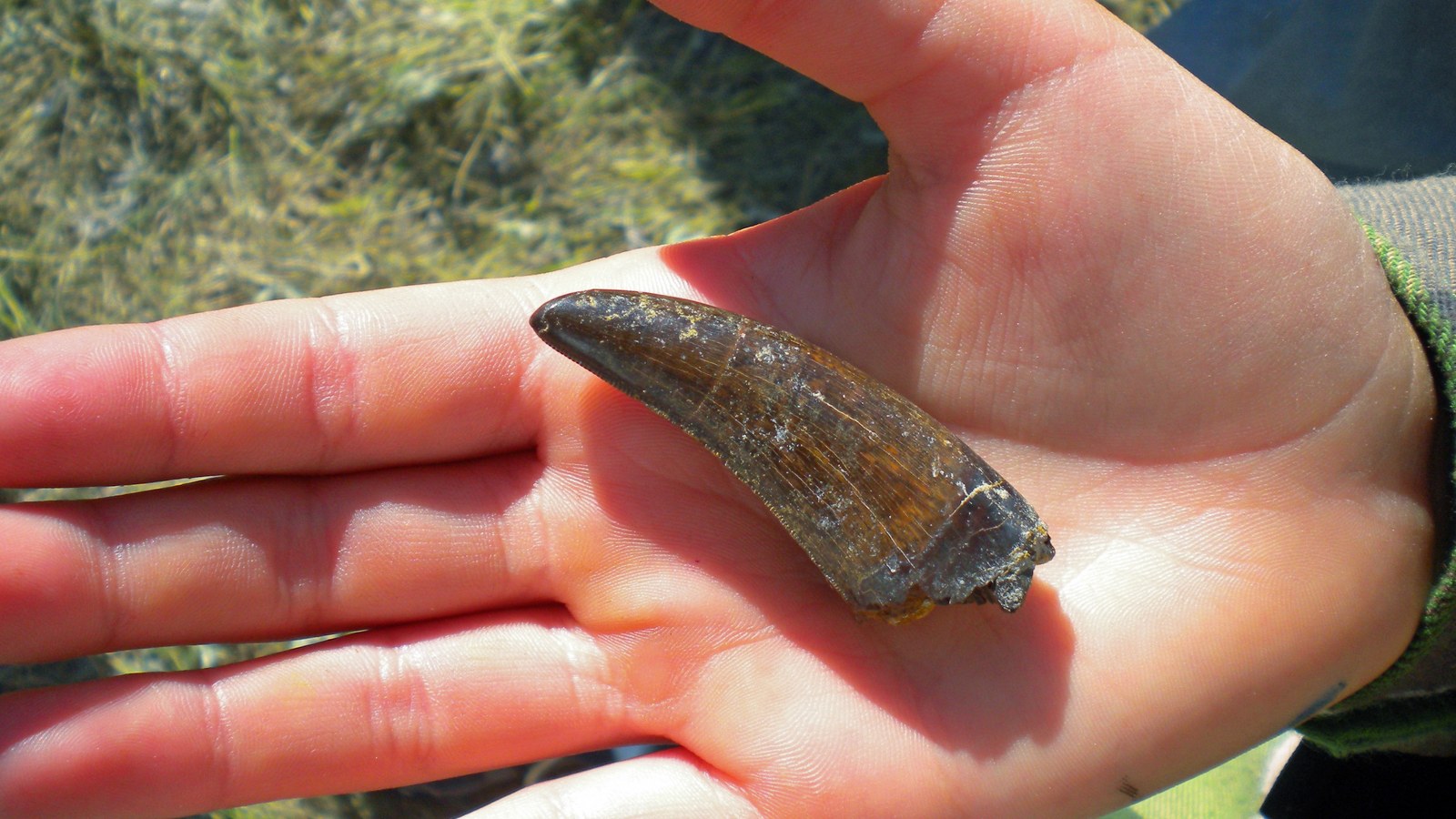
Scientists measured the body temperature of Tyrannosaurus rex from chemical signatures locked inside three fossilized teeth, recovered from the Hell Creek Formation and dated to the Late Cretaceous. The result, published online Sept. 16, 2026 in Science Advances and carrying a Sept. 18 journal date in the bibliographic record: 36.3 °C, about 97 °F, plus or minus 2.5 °C, one standard error.
That margin is not a technicality. It is the difference between a single confident number and what three teeth can actually tell you about an animal that has been extinct for 66 million years.
What the measurement rests on
The technique is called clumped isotope thermometry, applied to carbonate in the tooth enamel. Researchers have tried to read dinosaur body temperatures before, using ordinary oxygen isotopes. That older approach ran into a wall: the ratio of oxygen isotopes in a fossil depends on two things, the animal’s temperature and the isotopic makeup of the water in its body. The second of those is unknowable for an animal that died tens of millions of years ago. One such earlier attempt, by Barrick and Showers in Science in 1994, used oxygen isotopes in bone phosphate to find less than 4 °C of variation within a T. rex skeleton, which they read as evidence of homeothermy — a finding about variability, not an absolute temperature. Clumped isotope thermometry sidesteps that problem. It measures how often two heavy isotopes bond to each other within the mineral itself — a signal set by temperature rather than by body-water chemistry researchers can never recover. It is not assumption-free: the reading still depends on laboratory calibration and on the enamel having survived tens of millions of years without being chemically altered.
Robert Eagle, one of the paper’s authors, brought this technique to dinosaur research more than a decade ago. An earlier study using the same method on Jurassic sauropods found body temperatures roughly in the 36-38 °C range — evidence, going back years, that at least some dinosaurs ran warm. That work measured eleven teeth from two genera, Brachiosaurus brancai and Camarasaurus, at about 38.2 °C and 35.7 °C respectively. The new T. rex measurement extends that line of work rather than starting it; this is not the first time clumped isotopes have been used to estimate a dinosaur’s body temperature.
The comparison that gives the number meaning
A single temperature reading means little without something to measure it against, and that comparison was built into the study’s design. The same research also analyzed teeth from crocodilians that lived alongside T. rex in the same Hell Creek rock — cold-blooded reptiles whose temperature tracks their environment. Those crocodilian teeth came out significantly cooler than the T. rex teeth. Because both sets of teeth come from the same rock unit, the gap between them is the actual evidence: whatever was happening inside T. rex, it was running warmer than the reptiles sharing its world.
For a modern reference point, a 2016 study in Conservation Physiology measured core body temperatures in African elephants with seasonal means running from about 35.9 °C to about 37.1 °C. That number — not picked at random, and close enough to the T. rex figure to be the comparison every account of this study reaches for — is why headlines describe the dinosaur as running “as warm as an elephant.”
What it does not settle
The paper’s own abstract describes the T. rex measurement as “comparable to modern endotherms.” That is a narrower claim than “T. rex was warm-blooded,” and the distinction matters. A number in the high 30s Celsius is consistent with an animal that actively regulates its own body heat the way birds and mammals do. It is also consistent with an entirely different explanation: gigantothermy, sometimes called inertial homeothermy, the idea that a sufficiently large animal stays warm simply because its bulk loses heat slowly, whatever its metabolism is doing underneath. Modeling work on dinosaur body size has shown predicted temperatures climbing into the high 30s for very large animals on size alone. That is an open scientific question this measurement cannot resolve on its own: a single temperature reading cannot by itself rule out an animal running warm simply because of its bulk. Separately, there is a reporting limit: whether the new paper itself addresses gigantothermy could not be confirmed here, because the publisher’s full paper returned an error on every attempt to access it, leaving only the abstract. And there is a plainer limit: three teeth is a small sample, not a settled reading of the species.
Robert Eagle, commenting on the study’s findings, put the number in context this way: “The temperature is about what I would have guessed — higher than a reptile or a slow mammal like a sloth, but lower than an avian.”
What happens next
The abstract and the reporting around it do not lay out a specific follow-up study, and none should be invented here. What the paper does add is another data point in a research program that has been running for more than a decade — from Jurassic sauropods to a Late Cretaceous tyrannosaur — using a method built specifically to avoid the guesswork that limited earlier attempts. Where that program goes next, including whether it can be extended to more T. rex specimens or settle the gigantothermy question directly, is not something this study’s abstract addresses.