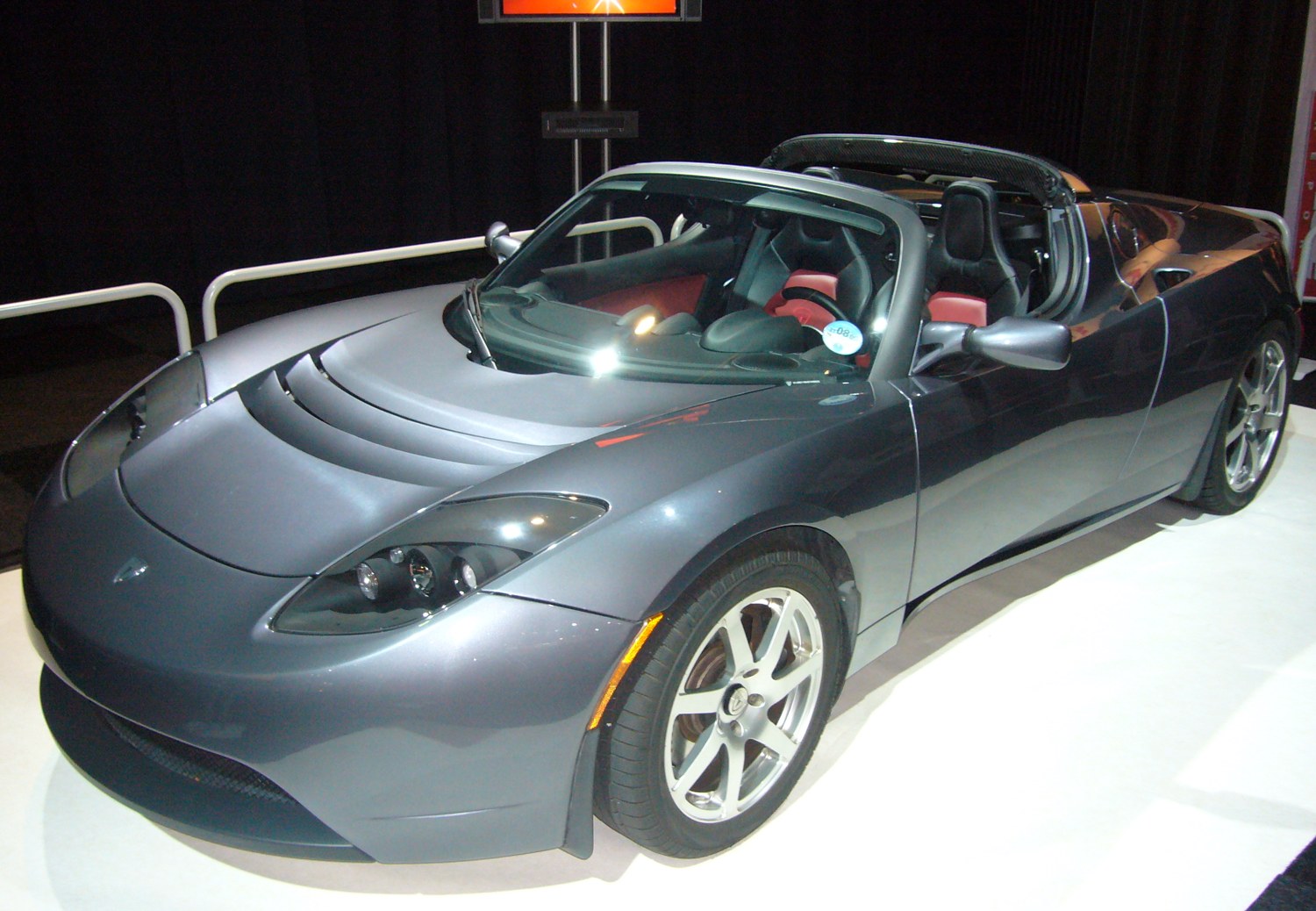
Tesla unveiled a redesigned second-generation Roadster on Thursday evening, Oct. 15, at an event outside Waco, Texas. TechCrunch reports that the car used fans and thrusters to spin and to jump over other Tesla vehicles in a demonstration; Teslarati and Electrek describe cold-gas thrusters, meaning jets fed by compressed gas (TechCrunch says compressed air). No purchase price appears in the TechCrunch, Electrek or Teslarati reports. According to TechCrunch, Musk said Tesla will build the car in 2028. Every performance figure below is Tesla’s own claim. As of Friday morning, Oct. 16, none of the reports describes an independent measurement of the car’s performance.
What Tesla showed on stage
According to TechCrunch, the car used “a mixture of high-powered fans and thrusters” to drive up an inverted ramp, spin and land. It also lifted itself over a Cybercab, a Cybertruck, a Tesla Semi, a Model Y and a Model 3 while in motion. TechCrunch also reports that Tesla showed a 0-60 mph run in one second at the event. That was Tesla’s demonstration, not an independent timing, and none of the reports says which version of the car made that run.
TechCrunch says Musk has called it “the best of the last of the human-driven cars” and quotes him at the event saying, “This will be the actual car that’s on the roads.” TechCrunch says Musk has positioned the Roadster as a halo car, and quotes him saying he is “not sure it moves the needle massively from a revenue standpoint.”
Electrek described the livestream this way: “impressive stunts but offered few details.” It said Tesla released more information on X after the event.
The three trims and Tesla’s numbers
Tesla’s posts on X, as reported by Electrek and Teslarati, describe three versions. Each figure is what Tesla says, not a measurement. The trim specifications below follow Electrek.
- Performance: Tesla calls it “road ready.” It seats two and has active aero and what Tesla calls a “multi-mode suction system.” Tesla says it reaches 0-60 mph in under 1.6 seconds. It is available by reservation.
- Thrust: Tesla calls it “race ready.” It seats two and has rear-mounted cold-gas thrusters. Tesla says 0-60 mph takes under 0.9 seconds. It is a limited release.
- Rocket: Tesla calls it “air ready,” according to TechCrunch and Teslarati. It seats one and has thrusters around the perimeter for upward and rotational movement. Tesla says 0-60 mph takes under 0.59 seconds. Tesla labels it invite only.
The reports place the top speed and range differently. TechCrunch says all three trims have 300 miles of range and can exceed 230 mph. Electrek puts the 230 mph figure on the Rocket only and says Tesla quotes a range of over 300 miles. Teslarati’s sentence places 230 mph with the Rocket figures and lists a range of more than 300 miles.
How the thrusters work
Lars Moravy, Tesla’s vice president of engineering, said at the event that the Roadster uses 10 thrusters connected to 600 liters of compressed air to lift and spin the car. He said the tank can be recharged, according to TechCrunch.
Electrek and Teslarati both report Tesla’s claim that the thrusters generate four to five times the force the tires can handle. They also report that fans pull air from under the car to hold it upside down when stationary. Both attribute the claims to Tesla.
Pressure vessels and Musk’s remarks on safety
Tesla wrote on X that “Every usable void in the car is packed with Carbon Fiber Overwrapped Pressure Vessels (COPVs).” That is Tesla’s own description of where the vessels are packed, as TechCrunch quotes it. Electrek says SpaceX is where the thrusters come from, and TechCrunch alone links this vessel type to SpaceX failures, adding in its own words that it is “the type of pressure vessel that has been at the root of multiple SpaceX rocket explosions.” TechCrunch names no incident involving this car, and none of the three pages gives an engineer’s assessment of these vessels in a car. Electrek and Teslarati say nothing on vessel safety.
Musk first talked about adding thrusters in 2018; TechCrunch quotes his post on Twitter that year: “SpaceX option package for new Tesla Roadster will include ~10 small rocket thrusters arranged seamlessly around car.”
On safety more broadly, TechCrunch quotes Musk from a podcast earlier this year: “If you buy a Ferrari, safety is not the number one goal. I say, if safety is your number one goal, do not buy the Roadster.” He said Tesla would “aspire not to kill anyone in this car.”
Design details
Electrek lists hidden headlights, a full-length taillight and flush aero. It also lists “Ano White” paint, and says the paint is said to borrow from coatings used to protect rockets. The car has yoke steering designed for steer-by-wire. Magnesium, titanium and carbon fiber are used throughout. The seat position is fixed and the controls are manual, to save weight. TechCrunch reports Tesla said in a post that the design was inspired by the SR-71 and the F-35.
Reservations and what the pages say about cost
TechCrunch reports that Tesla’s website showed Thursday that the company is taking reservations. It says Tesla is charging $50,000 just to reserve the Performance and $250,000 for the Thrust, and that the Rocket is billed as “invite only.”
Electrek describes a schedule: $5,000 is due at once, which Tesla calls fully refundable per Electrek, and $45,000 more is due within 10 days or the reservation is cancelled, $50,000 in total. Electrek calls it “the same $50,000 Tesla asked for in 2017.” Teslarati says Tesla “has reopened $50,000 reservations” in its configurator and gives no per-trim amounts.
The pages do not agree on the Thrust amount: TechCrunch gives $250,000, while Electrek and Teslarati mention only the $50,000 figure. No purchase price appears in the TechCrunch, Electrek or Teslarati reports for any trim.
A long record of dates
The Roadster has slipped many times. The dates below come from TechCrunch and Electrek.
- 2017: Tesla showed the second-generation Roadster at the end of the Tesla Semi reveal (Electrek dates the prototype to November 2017). According to TechCrunch, it took $50,000 deposits, and some paid $250,000 to reserve one of 1,000 Founders Series versions.
- 2020: Electrek says Tesla promised production this year.
- 2020, 2021, 2023 and 2024: Musk delayed the car, TechCrunch reports.
- 2025: Musk said on Joe Rogan’s podcast that he wanted to reveal it by the end of 2025. A week later, TechCrunch says, at the shareholder meeting, he set April 1, 2026. Musk said an April Fools’ Day event would give him “some deniability” if Tesla delayed the event again.
- 2026: Electrek says Musk promised an unveil in April, then late April, then “a month or so” after first-quarter earnings; the demo was later pushed to August and then to Oct. 1.
- Oct. 1, 2026: TechCrunch says Tesla attempted to hold the event on Oct. 1 but severe weather forced another delay.
- Oct. 15, 2026: the reveal.
What has not been announced or reported
- Price: No purchase price appears in the TechCrunch, Electrek or Teslarati reports.
- Production date: TechCrunch says Musk said Tesla will build the car in 2028 and did not name a price. Electrek writes that there is “still no price and no production date,” and later that there is “no production date other than ‘2028, actually’, an actual quote from Musk,” so it treats 2028 as Musk’s statement rather than an announced schedule. Teslarati alone says Giga Texas would build it “in 2027 or 2028” and that Musk said it would follow the demo by 12 to 18 months.
- Road legality: Electrek says Tesla’s Roadster page states the Rocket is not approved for public road use. Teslarati says Tesla notes the car is not approved for public road use and that the Rocket is not available in all regions. The two reports differ on how far that statement reaches.
- Regulators: No regulator’s comment appears in the TechCrunch, Electrek or Teslarati reports as of Friday morning, Oct. 16.
- Independent checks: None of the reports describes an independent measurement of the car’s performance.
What comes next
The only date on the table is the one Musk gave: 2028, which TechCrunch reports and Electrek quotes as his statement, while Teslarati says 2027 or 2028. None of the three reports cites a production schedule published by Tesla. Pricing, the road-use status of each trim and any regulatory view on thrusters would be the next details to watch.