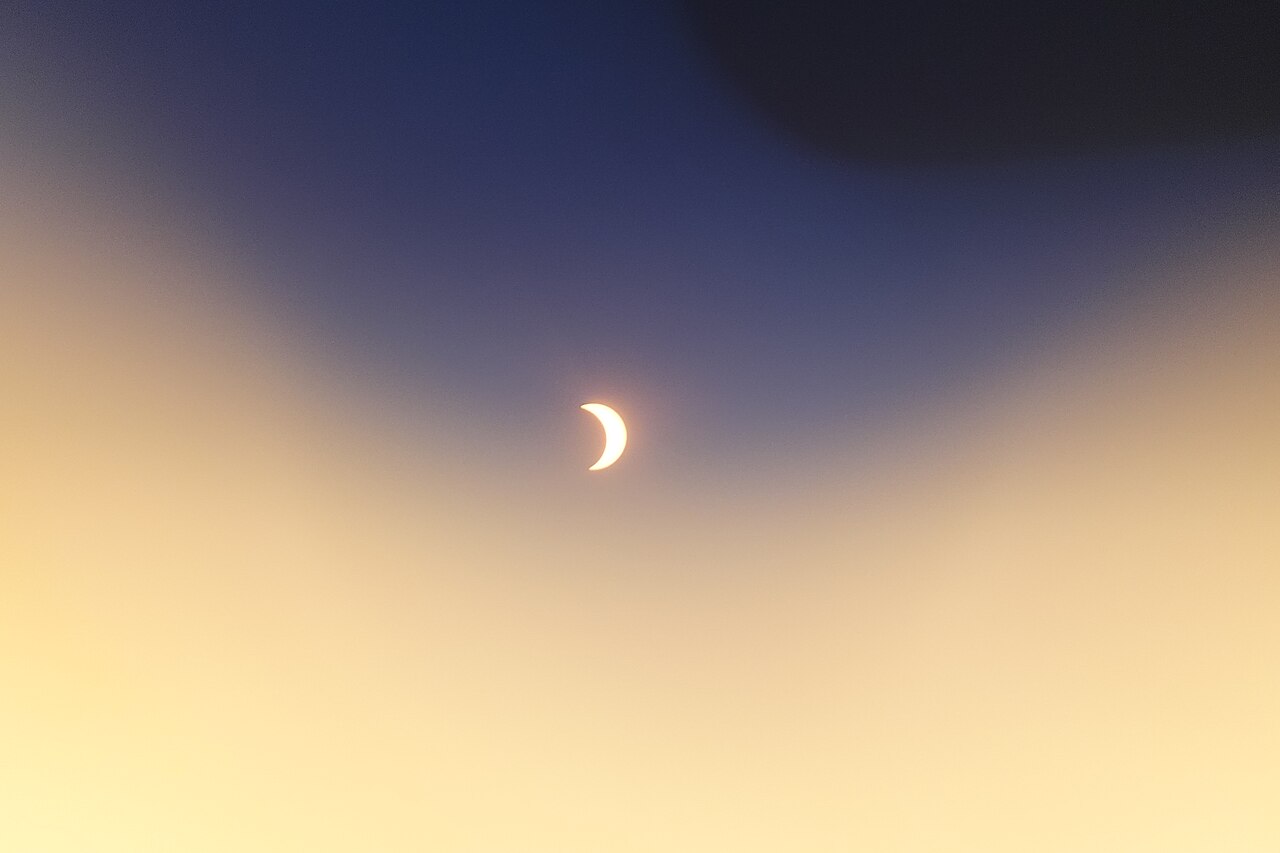
A total solar eclipse crossed the Northern Hemisphere on Wednesday, August 12, 2026 — but the path of full darkness never touched the United States. American skywatchers saw, at most, a partial eclipse that took a bite out of the Sun rather than blocking it completely. The Moon’s shadow ran from northernmost Siberia and the Arctic through Greenland, Iceland and the North Atlantic to northwestern Spain and the Balearic Islands, bringing mainland Spain its first totality since 1905 and Iceland its first since 1954. The eclipse reached its greatest point at 17:47 UTC, or 1:47 p.m. Eastern Daylight Time, over open water off Iceland’s west coast, where totality ran up to 2 minutes 18 seconds.
Key facts
- Total solar eclipse crossed the Northern Hemisphere on Wednesday, August 12, 2026
- Global peak: 17:47 UTC (1:47 p.m. EDT) — a global moment, not a local viewing time
- No part of the United States saw totality; American skywatchers saw at most a partial eclipse
- Partial eclipse visible across roughly 26 northern and northeastern U.S. states, from Alaska to North Carolina
- Longest totality: 2 minutes 18 seconds, over open water off Iceland’s west coast
- Totality path: northern Siberia, the Arctic, Greenland, Iceland, the North Atlantic, northwestern Spain (clipping a corner of northeastern Portugal), and the Balearic Islands
- First total eclipse over mainland Spain since 1905; first over Iceland since 1954
The path of totality
The Moon’s shadow traced a narrow band across northernmost Siberia and the Arctic, through Greenland, Iceland and the North Atlantic, before reaching land again in northwestern Spain. From there it arced eastward across the country — clipping a small corner of northeastern Portugal along the way — to reach the Mediterranean coast and the Balearic Islands, including Mallorca. Madrid and Barcelona both sat just outside that band — close enough for a very deep partial eclipse, with more than 99 percent of the Sun covered in Madrid, but not for totality. In Spain, totality arrived with the Sun low in the sky: no more than about 10 degrees above the horizon along the northern coast at the start of totality, dropping to roughly 3 degrees over the Balearic Islands. Totality lasted longest — up to 2 minutes 18 seconds — over open water off Iceland’s west coast, right along the center of the Moon’s shadow, where the eclipse reached its greatest point. Totality shrinks the farther a location sits from that centerline, so times on the ground were shorter:
- About 59 seconds in downtown Reykjavik, near the edge of the path — though about 1 minute 39 seconds at Keflavik, 2 minutes 3 seconds at Olafsvik and 2 minutes 13 seconds at the western tip of Iceland’s Westfjords
- About 1 minute 45 seconds in Gijon and Leon, and about 1 minute 48 seconds in Oviedo — Spanish cities closer to the path’s middle
All of these were still complete darkness — just briefer than the 2-minute-18-second maximum near the center of the path, out over open water. In clock terms, totality reached Reykjavik at about 5:48 p.m. local time (17:48 UTC) and northern Spain in the evening — about 8:28 p.m. local time in Leon, with Valencia a few minutes later at about 8:32 p.m.
It was the first time totality had reached mainland Spain since 1905, and the first time it had reached Iceland since 1954 — the only total solar eclipse Iceland will see this century.
What the U.S. actually saw
No U.S. location fell inside the path of totality, so nobody in the country saw the Sun fully blocked. Instead, a partial eclipse was visible across roughly 26 northern and northeastern states, stretching from Alaska across the northern tier of the country into the Northeast — as far south as North Carolina — during the late morning to mid-afternoon depending on location. NASA and Sky at Night magazine recorded how much of the Sun disappeared in individual cities, and it varied sharply:
- Fairbanks, Alaska — about 37% of the Sun covered, peaking around 8:27 a.m. Alaska Daylight Time
- Anchorage, Alaska — about 28% covered
- Caribou, Maine — about 29% covered, peaking around 1:50 p.m. EDT
- Acadia National Park, Maine — about 23% covered
- Burlington, Vermont — about 17% covered, peaking around 1:48 p.m. EDT
- Boston — about 16% covered, peaking around 1:55 p.m. EDT
- New York City — about 9% covered, peaking around 1:54 p.m. EDT
- Philadelphia — about 7% covered
- Detroit — about 3% covered
Coverage fell off quickly moving south and west of that band; cities outside it saw little or nothing. Beyond the United States the partial phase went much wider: Atlantic Canada saw the deepest coverage in North America, roughly half the Sun hidden at peak in some spots, and more than 90 percent of the Sun was covered across Ireland, Great Britain, Portugal, France, Italy, the Balkans and North Africa.
Live coverage
NASA streamed the eclipse with telescope views from along the path, and CNN ran special coverage with correspondents reporting from Mallorca, Spain, inside the path of totality.