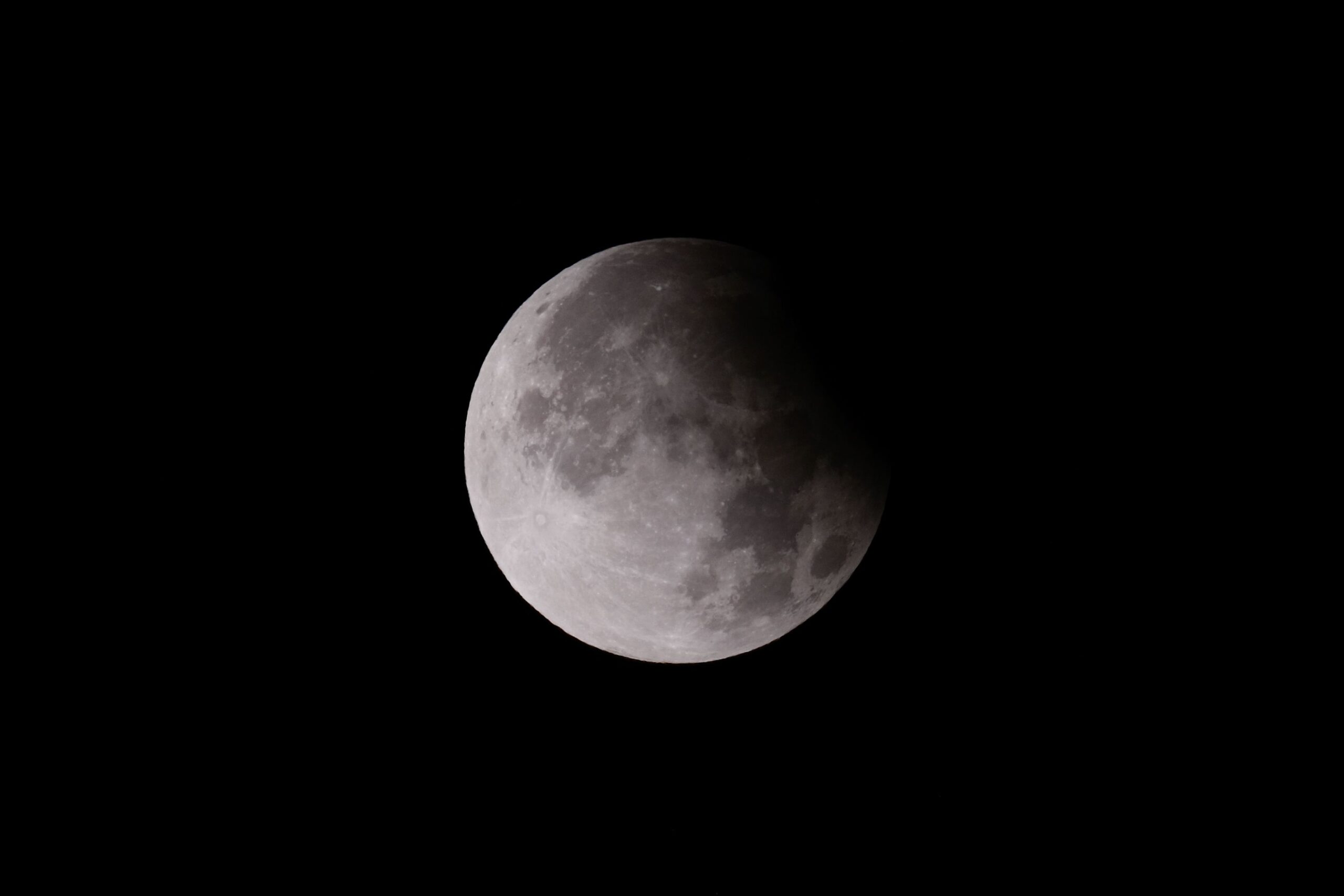
On the night of August 27 into August 28, 2026, the Moon slid through most of Earth’s shadow and took on a deep red-orange color around maximum eclipse. It was widely nicknamed a “blood moon” because the eclipse looked close to totality — but it was technically a deep partial lunar eclipse, not a total one. At maximum eclipse, a narrow sliver of the Moon remained outside Earth’s darkest shadow.
The eclipse will be visible across virtually all of North and South America, plus parts of Europe, Africa and the Pacific, weather permitting. No special equipment is needed: unlike a solar eclipse, a lunar eclipse is completely safe to watch with the naked eye. Binoculars or a small telescope can sharpen the view of the shadow’s edge and the Moon’s color, but they’re optional.
Key facts
- When: night of August 27 into August 28, 2026
- Maximum eclipse: 12:12 a.m. EDT (EarthSky, timeanddate-derived snippet) / 11:12 p.m. CDT / 10:12 p.m. MDT / 9:12 p.m. PDT, the deepest and reddest point
- Where visible: virtually all of North and South America, plus parts of Europe, Africa and the Pacific, weather permitting
- Eclipse depth: about 93% of the Moon’s diameter in shadow (NASA), or about 96% of surface area (Space.com, EarthSky) — two valid ways of measuring the same event
- Duration: partial phase lasts a little over three hours; the full event, including faint penumbral shading, runs about five and a half hours
- Equipment: none needed — safe to watch with the naked eye
- Next total lunar eclipse: December 31, 2028, though totality will mainly be visible from Alaska and far northwestern Canada
- Next total lunar eclipse widely visible across the rest of the Americas: June 26, 2029
When to look, in your time zone
The action unfolds over several hours. The faint early stage is easy to miss; the dramatic part comes later:
- Penumbral eclipse begins (faint shading, hard to notice): about 9:23 p.m. EDT / 8:23 p.m. CDT / 7:23 p.m. MDT / 6:23 p.m. PDT on August 27
- Partial eclipse begins (Earth’s shadow visibly biting into the Moon): about 10:33 p.m. EDT / 9:33 p.m. CDT / 8:33 p.m. MDT / 7:33 p.m. PDT
- Maximum eclipse (deepest, reddest point): 12:12 a.m. EDT on August 28 / 11:12 p.m. CDT / 10:12 p.m. MDT / 9:12 p.m. PDT
- Partial eclipse ends: about 1:52 a.m. EDT / 12:52 a.m. CDT / 11:52 p.m. MDT / 10:52 p.m. PDT
- Penumbral eclipse ends: about 3:02 a.m. EDT / 2:02 a.m. CDT / 1:02 a.m. MDT / 12:02 a.m. PDT on August 28
If you only plan to step outside once, aim for maximum eclipse itself — 12:12 a.m. EDT / 11:12 p.m. CDT / 10:12 p.m. MDT / 9:12 p.m. PDT — when the Moon is at its deepest and reddest.
The visible partial phase lasts a little over three hours; counting the faint penumbral shading on either side, the full event runs about five and a half hours.
On the West Coast, local moonrise affected which early phases were visible, with an unobstructed view toward the eastern horizon helping as the eclipse unfolded. Maximum eclipse and the later phases were visible from many locations in the western United States.
Why it’s a partial eclipse, not a total one
At maximum, the Moon was not fully swallowed by Earth’s shadow. A thin bright edge of the Moon remained outside Earth’s darkest shadow. You’ll see this eclipse’s depth described with two different numbers, and both are correct — they’re just measuring different things. NASA describes about 93% of the Moon’s diameter passing into the dark umbral shadow (astronomers call this figure the eclipse’s “umbral magnitude,” 0.9319). Several other outlets, including Space.com and EarthSky, instead report about 96% of the Moon’s surface area in shadow — a different way of measuring the same event, based on area rather than diameter, which is why the two numbers don’t match.
Because the term “blood moon” traditionally describes a total eclipse, a few outlets note this one falls just short of qualifying by that strict definition — even though the reddening should look dramatic to the naked eye.
Why the Moon turns red
The color comes from the same physics that paints sunrises and sunsets. As sunlight grazes Earth’s atmosphere on its way toward the Moon, the atmosphere scatters away the shorter blue wavelengths of light, a process called Rayleigh scattering. The longer red and orange wavelengths bend around Earth’s edge and continue on to the Moon, tinting the eclipsed portion a coppery red — essentially every sunrise and sunset on Earth projected onto the lunar surface at once. Since this eclipse stopped just short of totality, only the shadowed part of the disk showed the reddening; the bright uneclipsed sliver stayed closer to its normal white-gray color.
How it compares to other recent eclipses
This eclipse follows a run of three genuine total lunar eclipses — March 2025, September 2025 and March 2026 — that gave skywatchers a full “blood moon” each time. The next true total lunar eclipse isn’t until December 31, 2028. Space.com is calling the August 2026 event the best lunar eclipse until then, but that framing comes with a catch for most Americans: the December 2028 eclipse’s totality will mainly be visible from Alaska and far northwestern Canada, not the rest of the continental United States. For skywatchers elsewhere in the country, the next total lunar eclipse widely visible across the rest of the Americas isn’t expected until June 26, 2029.