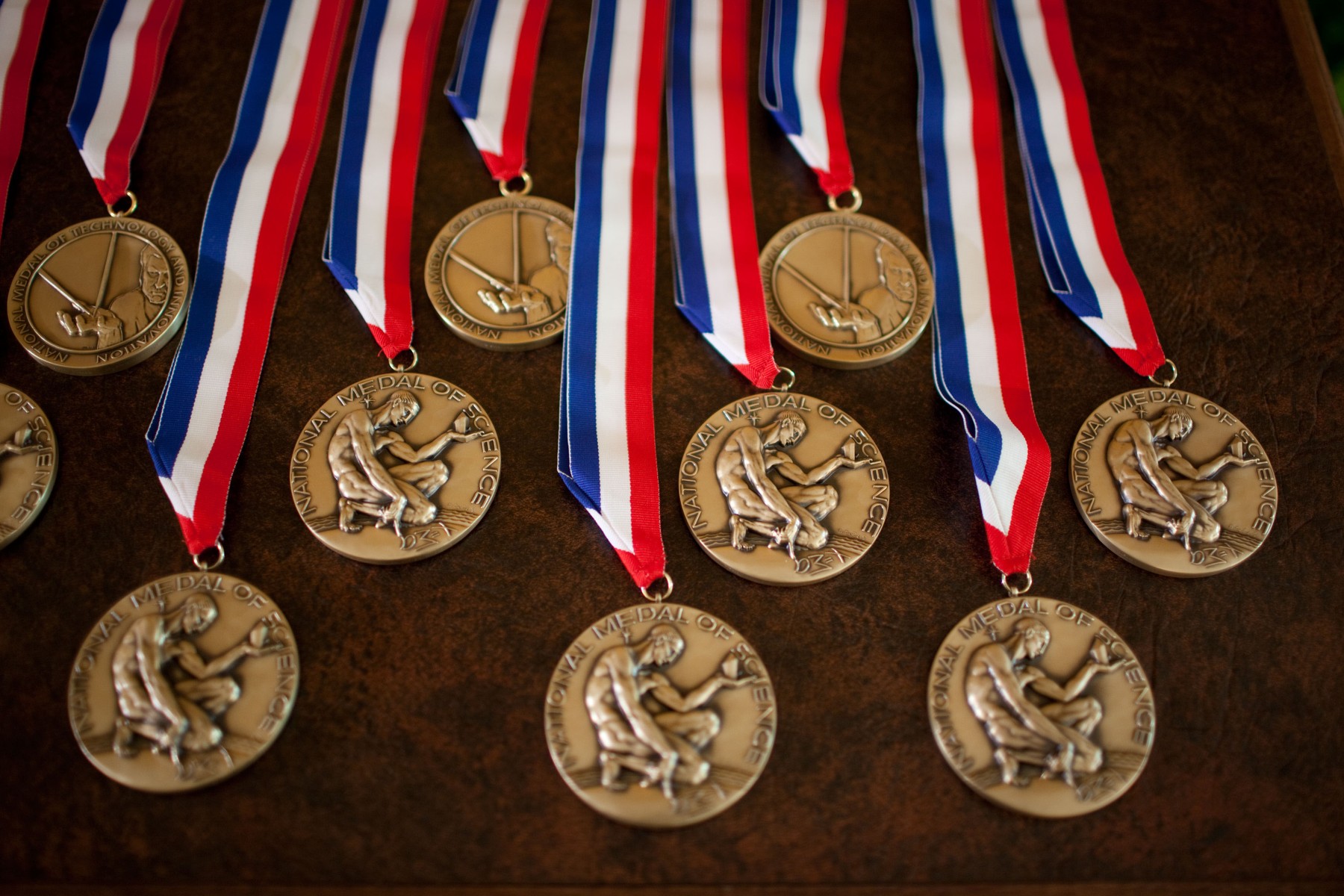
On Thursday, Oct. 8, President Donald Trump presented National Medals of Science to Elon Musk, Sergey Brin, Jensen Huang and Lisa Su, and National Medals of Technology and Innovation to Michael Dell and Satya Nadella. The ceremony took place at the White House’s “Science: A New Golden Age” summit at the U.S. Institute of Peace in Washington.
The White House published a citation for each recipient. It does not say how the six were chosen. What the law and the National Science Foundation say about that process is set out below, along with what is not known.
Who received which medal
According to the White House release, posted at 2:32 p.m. EDT on Oct. 8, these were the recipients and the citations it printed.
National Medal of Science:
- Elon Musk (SpaceX, Tesla): “For engineering achievements of extraordinary ambition and scale that have pushed the frontiers of space exploration, intelligent systems, communications, and beyond, renewing American technological leadership and opening a new chapter in American manufacturing.”
- Sergey Brin (Google co-founder): “For the development of foundational algorithms for information retrieval and data processing that revolutionized how the world accesses information across science, commerce, and in the course of everyday life.”
- Jensen Huang (Nvidia): “For advancing the graphics processing unit into a general-purpose computing architecture through innovations in processor design and software, transforming massively parallel computation and powering breakthroughs in scientific computing and super intelligence.”
- Lisa Su (AMD): “For a lifetime of leadership in semiconductor engineering and high-performance computing through innovations in processor architecture and chiplet-based integration that powered the world’s first exascale supercomputer and opened new frontiers in computational performance.”
National Medal of Technology and Innovation:
- Michael Dell (Dell Technologies): “For advancing a vision of widespread adoption of personal and enterprise computing; for his technical and business management skills building a worldwide technology company; and for his support for the next generation of American scientists, engineers, and technologists.”
- Satya Nadella (Microsoft): “For his transformative leadership of a critical American technology company, which led to its rejuvenation for a new era of cloud computing, and for his construction of the hyperscale infrastructure that enabled the training and global deployment of American super intelligence.”
The release calls the medals “our nation’s highest honors for exemplary achievement and leadership in science and technology” and says they went to “six of America’s greatest living innovators.” Michael Kratsios, director of the White House Office of Science and Technology Policy, said in it: “Each of these medalists has transformed their field or industry, laying the foundations for technologies we already can barely imagine living without.”
NBC News reported that Trump gave each recipient a medal and a certificate of honor, and later asked some of their families onstage for photos. Spectrum News said Musk was the first to receive his.
What the law says about each medal
The National Medal of Science was created by Congress in 1959. The statute, 42 U.S.C. 1881(a), says: “The President shall from time to time award the medal, on the basis of recommendations received from the National Academy of Sciences or on the basis of such other information and evidence as he deems appropriate.” Section 1881(b) says: “Not more than twenty individuals may be awarded the medal in any one calendar year.” Section 1881(c) sets citizenship rules: recipients must be U.S. citizens or nationals, or lawful permanent residents who have applied for naturalization and are not permanently ineligible to become citizens. (A neighboring section, 42 U.S.C. 1880, concerns the medal’s design, not who receives it.)
The selection committee comes from an executive order, not from the statute itself. Executive Order 11287, set out in the Code’s notes as amended, sets up the President’s Committee on the National Medal of Science, “composed of fourteen appointive members and two ex officio members” (people who sit because of the office they hold). The order says the committee is “deemed to constitute a continuation” of one established in 1961 by Executive Order 10961. The order says: “Awards of the Medal may be based upon recommendations of the Committee or upon such other information and evidence as the President deems appropriate.” It also sets a default calendar: “Unless otherwise directed by the President, announcement of the award of the Medal shall be made during the last sixty days of each calendar year and ceremonies for presentation of the Medal shall be held during the first ninety days of the calendar year following the announcement of the award.” An October ceremony differs from that default, which the order lets the President change; the NSF page says there is currently no set date for announcements.
The National Science Foundation’s page on the medal says: “A committee of distinguished scientists and engineers is appointed by the president of the United States to evaluate the nominees for the award.” Nominations are peer-nominated, and the page’s FAQ says: “With a few exceptions, anyone can submit a nomination, including individuals from the nominee’s home institution. People may not nominate themselves, nor may nominations come from immediate family members.” The committee is “composed of 14 presidential appointees … and two ex officio members: the director of the Office of Science and Technology Policy and the president of the National Academy of Sciences.” The page also says: “After committee review, the president makes the final decision on who will be awarded the National Medal of Science, and the White House makes the announcement. Currently, there is no set date for making an announcement.” It lists nine named committee members, with terms ending Dec. 31, 2026 and Dec. 31, 2027, and a chair. The Code notes list the committee’s term as extended to Sept. 30, 2025 (Executive Order 14109) and show no later extension. The federal advisory committee database’s report for the committee, run on Oct. 9, 2026, says that “the establishing E.O. 11287 for this committee was not extended and the committee terminated on 30 September 2025.” The NSF page does not say whether the committee reviewed these four recipients, and it says the call for nominations is now closed.
The National Medal of Technology and Innovation has a separate legal basis. The statute, 15 U.S.C. 3711(b), says: “The President shall periodically award the medal, on the basis of recommendations received from the Secretary or on the basis of such other information and evidence as he deems appropriate, to individuals or companies.” The text sets no annual cap. The U.S. Patent and Trademark Office, which administers the program, lists the 2024 class as the most recent on its recipients page, updated Mar. 10, 2026. The sources cited here do not show how Dell and Nadella were chosen.
What is known and not known about how these six were picked
Known: both statutes let the President award the medals on the basis of an agency or academy recommendation or “such other information and evidence as he deems appropriate.” The executive order for the Science medal says the same about its committee’s recommendations.
Not known: whether the four Science medalists came through the foundation’s nomination and committee process, whether a committee was in place in 2026 after the database’s Sept. 30, 2025 termination date (the NSF page still lists members), whether the “other information” route was used, or how Dell and Nadella were chosen. The White House release is silent on all of this. The question is simply open.
History of the medals and what is reported as new
The most recent earlier ceremony the sources document was Jan. 3, 2025, under President Joe Biden, according to a Biden White House release and the American Institute of Physics’ FYI newsletter. An Associated Press report from July 26, 2018 said none had been awarded in the first 18 months of Trump’s first term.
Fox News reported on Oct. 7, before the ceremony, that it “would be” Trump’s first time presenting either medal in either term. ANI, in a report carried by Business Standard (published Oct. 9 in India, late Oct. 8 in Washington), and Teslarati, published at 5:30 p.m. EDT, say it was. The White House release says the Science medal has been bestowed “since 1963” and the Technology and Innovation medal “was first awarded in 1985.”
What Trump said
Before presenting the awards, Trump said, as printed by Spectrum News: “From day one, my administration has taken decisive action to ensure that America continues to dominate the frontiers of science and technology.” He also said, as printed by NBC and Spectrum News: “We live in an age of American wonders and technological marvels, and with the help of the brilliant men and women here today, we will always be on top.” Spectrum News added his line “There’s nobody that can compete with us. Nobody.” He said Musk is “an industrial titan, a brilliant engineer and one of the greatest technology founders to ever live,” whose “genius and determination have made science fiction into reality.”
Al Jazeera quoted him saying of Musk, “Few Americans in history have done more to advance America’s national interest than Elon in one field after another,” and calling him “our modern-day Thomas Edison.”
ANI’s account adds that Trump congratulated SpaceX “on the safe return of Crew-12 from the International Space Station just a few hours ago” (an astronaut crew’s return, in ANI’s account), and told Musk: “You’re my friend and all of that, but you are a very, very special guy.” NBC reported that Trump told the recipients, “You’re going to go down in the annals of history as being great.”
Musk later wrote on X, as printed by Spectrum News: “Thank you on behalf of the amazing people of SpaceX, Tesla, Neuralink and Boring Company, without whom anything I have done would have been possible.”
White House assistant press secretary Liz Huston said in a statement carried by NBC and CNBC (CNBC published it Oct. 7): “The Trump Administration is grateful for the contributions of these incredible leaders in science and technology. These recipients are helping ensure America keeps leading the world in innovation.”
The summit’s announced funding
The medals were one part of an all-day summit. The White House fact sheet, posted at 11:05 a.m. EDT, says the administration launched initiatives “representing over $6 billion in investments across the Federal Government, industry, academia, and philanthropy.”
The fact sheet lists $2.4 billion in “Super intelligence (SI)” for science tools and compute credits (computing time) for the Genesis Mission Consortium (the administration’s program for AI-driven science) from eleven industry partners, including Nvidia ($1 billion), AMD ($500 million), OpenAI ($200 million), and Anthropic and Google ($150 million each). NBC reports that the administration now uses “super intelligence” for AI. The fact sheet also lists a $1 billion investment from universities, industry and the State of Georgia in scientific computing and related workforce training.
It says this “follows the expansion of the Genesis Mission in July” and “a $5 billion Federal commitment.” It gives no total that adds up to “over $6 billion,” and it mixes new items with earlier ones it labels as July or May announcements: the $5 billion federal commitment, a $400 million NSF investment in programmable cloud labs, and a $1.5 billion NSF X-Labs initiative announced in May. The fact sheet does not label other items as old or new. Nvidia and AMD, whose chief executives (Huang and Su) received Science medals, are among the partners. The fact sheet does not mention the medals, and no source cited here links the funding to the awards. The fact sheet itself also describes a NASA and Energy Department partnership to develop nuclear power and space nuclear fuels; NBC named NASA Administrator Jared Isaacman and Energy Secretary Chris Wright as announcing it.
The same-day visa action
ABC News reported at 5:40 p.m. EDT that Vice President JD Vance announced the suspension of Microsoft and Adobe from the PERM program, “a certification that allows employers to hire a foreign employee to work permanently in the U.S.” ABC’s report states that the criticism of Microsoft came hours before the ceremony, so its time stamp is not the time of the announcement. According to TechCrunch (8:42 a.m. PDT, Oct. 8), the other suspended firms were Capgemini, Cognizant, HCL, Infosys, Tata and Wipro, and Labor Secretary Keith Sonderling said the government would not accept any new or pending permanent labor certification applications involving these companies.
PERM is the Labor Department’s permanent labor certification system, an early step toward an employment-based green card. H-1B is the visa category through which skilled foreign workers get temporary work authorization. Vance said: “So if the H-1B visa is how the people get into the country, the PERM program is how they stay in the United States to begin with.” Outlets describe the program differently. Al Jazeera describes it as the H-1B visa system, and Spectrum News reported that the administration alleged Microsoft fraudulently uses the H-1B visa program to discriminate against Americans.
Vance said: “Now there has been no company in the United States, unfortunately, that has abused the system more than Microsoft.” He alleged that Microsoft laid off 6,000 American workers last year while benefiting from 6,300 H-1B visas and almost 3,000 green cards. He also said: “So we’re going to continue to support Microsoft and have a great relationship with Microsoft, but we’re also going to deny them the ability to apply for these permanent residencies until they show that they are going to get serious about putting American workers first.” Asked how long the suspension would last, he said it will “last as long as it needs to.”
Microsoft told ABC News that it “only files H-1B petitions for those who meet the rigorous standards of this visa category,” that “the vast majority of Microsoft employees in the United States are Americans,” and: “We pay our H-1B employees the same as any other employees doing comparable work.” In a statement to TechCrunch, Microsoft said: “of the approximately 6,000 H-1B visa applications we submitted in the last fiscal year, 80% percent were to extend or change the status of existing Microsoft employees.” Vance spoke of visas and Microsoft of applications; the two accounts are reported here as each gave them, and are not reconciled. TechCrunch reported that Adobe did not immediately respond to a request for comment.
NBC reported that the ceremony came “just hours after” the announcement and described Microsoft’s CEO as “a guest of honor.” Nadella received his medal that day. ABC reported that Vance acknowledged the contrast, saying: “Microsoft is a great American company, and we have a great relationship with them.” The outlets report the timing. None of the sources cited here says the two events are connected.
Immigration came up at the summit itself. Huang told NBC: “I was an immigrant, and my parents brought us here to pursue the American dream.” Carnegie Mellon University president Farnam Jahanian said: “We need to have an immigration policy that can recruit the best talent to come to this country.” At the same news conference as the visa announcement, a Labor Department inspector general said the department is investigating J-1 visa use at nine universities (ABC, TechCrunch). Spectrum News also noted a Homeland Security proposal on Oct. 7 for a $70,000 fee for international students seeking to work in the U.S.
Spectrum News and Al Jazeera both reported that five of the six recipients were born outside the United States. Birthplace is not the statute’s test, and no source cited here says whether any recipient’s citizenship was checked.
Musk, Trump and the donations reporting
Al Jazeera reported that Musk briefly served as a special adviser at the start of Trump’s second term, helping lead the Department of Government Efficiency. It said the two had “a public falling-out over the president’s tax-and-spending plans” and that “the two have since reconciled.” Al Jazeera also wrote that the ceremony “was the latest example of what critics see as an increasingly close relationship between Silicon Valley tech executives and the second Trump administration.” ANI reported that Musk is co-leading the Pentagon’s Project Meridian, a study of the future of warfare. Teslarati reported that he sat at Trump’s left at a Sept. 29 White House lunch on AI.
CNBC reported on Oct. 7 that “each of the awards recipients at Thursday’s summit has financially contributed, in some capacity, to President Trump or Republican campaigns and causes.” According to CNBC:
- Musk “was Trump’s biggest financial backer in the 2024 election cycle, contributing over $290 million.”
- Brin “contributed hundreds of thousands of dollars to the Republican National Committee in 2025.”
- Huang “donated to a fund to build Trump’s White House ballroom,” and Nvidia contributed $1 million to Trump’s inauguration ceremony.
- Dell “is a longtime Trump donor” and, with his wife Susan, committed $6.25 billion to seed Trump Accounts, which CNBC describes as designed to jumpstart savings for children. CNBC describes this as seed money for children’s savings accounts.
CNBC gives no specific contribution for Nadella and says only that AMD “is also contributing to Trump funds.”
Spectrum News gave a different Musk figure, saying he “spent at least $230 million of his own money to help elect Trump in 2024.” CNN reported in February 2025, citing year-end Federal Election Commission filings, that Musk spent more than $290 million in total on the 2024 election across several groups and candidates. The outlets’ figures are reported here as each gave them, without choosing one. CNBC does not say the medals were given because of the donations.
What is not known
The White House fact sheet gives no total that adds up to its “over $6 billion,” so how much of that figure is new money is not known. None of the sources cited here says the medals were tied to the donations or the visa suspension.
Sources and further reading
- President Trump Presents National Medals of Science and National Medals of Technology and Innovation
- Fact Sheet: Trump Administration Announces the Most Ambitious Set of Science Initiatives This Century
- National Medal of Science
- 42 U.S. Code § 1881 – Award of National Medal of Science
- 15 U.S. Code § 3711 – National Technology and Innovation Medal