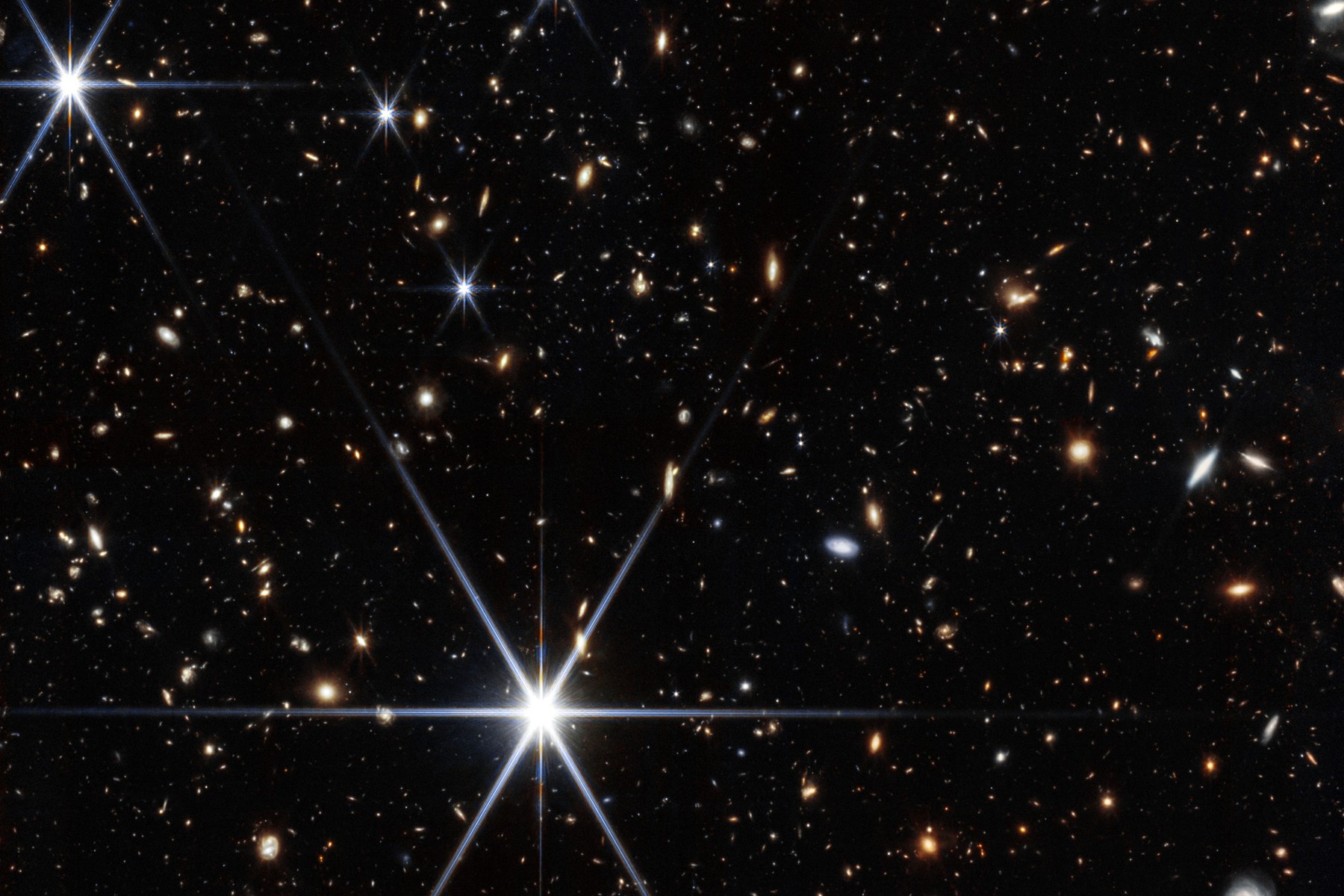
The James Webb Space Telescope has pinpointed the host galaxy of the most distant fast radio burst with an identified host galaxy, FRB 20240304B: a small dwarf galaxy seen as it was about 3 billion years after the Big Bang. The study was published Thursday, Oct. 8, in the journal Science, according to the NASA and Space Telescope Science Institute (STScI) release and a University of Sydney release. The team first posted the findings as a preprint, a study made public before peer review, on Aug. 3, 2025.
What a fast radio burst is
Fast radio bursts, or FRBs, are millisecond-long flashes of radio emission from the distant universe. The NASA and STScI release says they were first discovered in 2007 and that their origin “remains uncertain, particularly since most are seen once and never again.” ABC Science describes them as pulses that almost always come from outside our galaxy. Lead author Manisha Caleb of the University of Sydney put the gap in knowledge plainly in the NASA release: “We have theories for what objects produce them, but we don’t have conclusive proof.”
How the burst was found
The MeerTRAP team used the MeerKAT radio telescope in South Africa to detect the burst on March 4, 2024. That date gave the burst its name. The trailing “B” means it was “the second FRB to be discovered that day,” Caleb told ABC.
The radio signal itself hinted at a long journey. Different radio frequencies arrive at slightly different times after crossing charged material in space. That delay is used to calculate the dispersion measure, or DM, which counts the free electrons the signal passed through along its path. A bigger delay means more material along the line of sight, though material in the Milky Way, in foreground structures and in the host galaxy all add to the total. The team’s preprint gives the burst’s observed value as 2,462 parsecs per cubic centimetre; Caleb described it to ABC as about 2,400 units. She said typical bursts show “a few hundred DM, or maybe even a thousand,” and that “with about 2,400 units of DM we figured it had to be coming from really far away.”
How far away is it
The same burst is described in several ways, so here is how the numbers fit together. The light left the galaxy when the universe was about 3 billion years old, and it has travelled for about 10.6 billion years since. NASA’s image-data page lists 10.63 billion light-years for redshift 2.148; that is the light-travel figure. The galaxy’s distance today is larger, because the universe has expanded while the light was on its way. The team’s Conversation article says “a galaxy 10.6 billion years ago.” The other wordings are looser ways of stating that same light-travel figure, not measures of the galaxy’s distance today: ABC’s “In short” summary and The Conversation’s headline say 10 billion years, while Space.com reported around 11 billion light-years.
The Sydney release describes the burst as “the most distant FRB yet detected and more than doubling the previous distance record.” That is shorthand, and the travel time did not double. What roughly doubled is redshift reach: the team’s preprint says the result “doubles the redshift reach of localized FRBs,” and it puts the previous localized record at about redshift 1 (FRB 20220610A). The qualifier matters: this is the most distant burst with an identified host galaxy. To confirm the distance, astronomers needed to study the host galaxy, as the NASA release explains. The Conversation phrases it as “the most distant such burst whose host galaxy has yet been identified.”
Why ground telescopes failed and what Webb did
MeerKAT located the burst on the sky very precisely, but a precise spot is not a galaxy. According to the Keck Observatory release, J. Xavier Prochaska of the University of California, Santa Cruz and his team spent one hour imaging the position with LRIS, an imaging instrument on the Keck I telescope. Prochaska said: “We pointed it right at the location of the FRB and looked as deeply as we could, but there was simply nothing to see. We immediately concluded: if we wanted to find the source, we had to go to space.”
Webb’s NIRCam, its near-infrared camera, then detected a galaxy at the right location. NASA’s image-data page lists the exposure date as Dec. 26, 2024. Webb’s NIRSpec, its near-infrared spectrograph, measured the galaxy’s redshift at 2.148. Redshift is how much the expansion of the universe has stretched the galaxy’s light. At 2.148, wavelengths are stretched to about 3.1 times their original length (1 plus the redshift). It also converts to a time in cosmic history: the release says that corresponds to a time just 3 billion years after the Big Bang.
What the host galaxy is like
The galaxy is small and busy making stars. “We thought it would be a big, nicely formed galaxy with lots of stars, and instead it was a little dwarf galaxy, although it was actively forming stars,” Caleb said in the NASA release. Most FRB hosts are massive star-forming galaxies. The Keck release says this one is roughly 1,000 times less massive than the galaxies typically associated with FRBs; the NASA release says 1,000 times less massive than the team expected.
The team’s own article in The Conversation gives a number for the mass: “It contains only about 10 million times the mass of our Sun,” a tiny fraction of the Milky Way’s. Sydney’s Laura Driessen called the host “surprisingly small, metal-poor and undergoing a very active episode of star formation.” The galaxy existed at “cosmic noon,” the period when star formation across the universe was at its peak.
What it suggests about the origin
Two ideas are on the table, as the release lays them out. In one, two neutron stars spiral together and merge. That takes billions of years, so mergers should favor older galaxies with evolved stars. In the other, a single young, highly magnetic neutron star called a magnetar produces the burst, through a mechanism like starquakes, which are sudden cracks in the star’s crust. A magnetar can appear soon after a massive star explodes as a supernova, so that idea fits young galaxies like this one.
Here the release adds its estimate for the galaxy’s star formation: “the majority of its stars may have formed within just 30 million years.” That is a model-dependent estimate, and the preprint’s two fits split the ages differently. The release’s inference is that there was little delay between star formation and the objects capable of producing an FRB, and a merger channel needing billions of years fits older galaxies better.
The measurements are the galaxy’s small size, its redshift and the signs of active star formation. “Young” is an inference from fitting those data, and the reading that follows is interpretation. Caleb said: “Our work suggests that it’s very unlikely that this FRB was produced by a merger.” The release text goes further. The Friends of NASA copy says “This indicates FRBs likely are caused by young neutron stars known as magnetars,” and the Keck release says “This indicates that FRBs likely are caused by young neutron stars known as magnetars.” The STScI copy is more hedged: it says an FRB “might occur relatively quickly” after a supernova and that FRBs “would also be expected to be found in younger galaxies.” Sydney’s release is also measured, calling it “fresh evidence that at least some FRBs may originate from young magnetars,” and Paris Observatory says the results “lend support to the hypothesis.” The institutions’ confidence differs. The releases do not report a direct detection of a magnetar.
The team is more cautious about the whole population. In The Conversation, the authors write that “we don’t think all of them necessarily have the same kind of origin.” Ryan Shannon of Swinburne University, who was not involved in the study, told ABC that a magnetar in our own galaxy emitted a pulse that looked like an FRB, but added: “I wouldn’t rule out having more than one way to produce an FRB.”
What the burst revealed on its way
An FRB can also act as a probe of the space it crosses. “A fast radio burst is almost like a cosmic flashlight,” Prochaska said in the NASA release. “It lights up everything along the path.”
The burst’s signal carried the mark of two structures. One is a previously unknown galaxy cluster at a redshift of 0.3, about 3.5 billion light-years from Earth, in the release’s words (a light-travel figure). The other is the nearby Virgo Cluster, about 54 million light-years away. The team’s August 2025 preprint calls the more distant structure a galaxy group rather than a cluster, so the label differs by document.
What comes next, and what is not known
The release says the team estimates that MeerKAT “may be able to detect and localize several FRBs per year at a redshift greater than 1.0,” meaning more than halfway back to the start of the universe. The release adds that Webb “will be essential for characterizing those distant host galaxies.” Ben Stappers of the University of Manchester, principal investigator of MeerTRAP, said: “The next step is to push this frontier further and see how close we can get to the first generations of stars.”
Several things remain open. The magnetar explanation rests on one burst from one host, and there is still no conclusive proof of what produces these bursts, as Caleb said in the NASA release. The peer-reviewed paper’s own text was not checked for this article. The numbers here come from the NASA, Keck, Sydney and Paris Observatory releases, the team’s own article in The Conversation, ABC Science and Space.com and, for a few details, the team’s August 2025 preprint, whose fits differ, so treat the detailed values as approximate.
Sources and further reading
- Webb Measures Distance to Farthest Fast Radio Burst, Suggesting Origin
- FRB 20240304B (NIRCam Image)
- Astronomers Pinpoint Host Galaxy of the Most Distant Fast Radio Burst to Date
- Identification of the host galaxy of the most distant fast radio burst ever observed
- A fast radio burst from the first 3 billion years of the Universe (preprint)