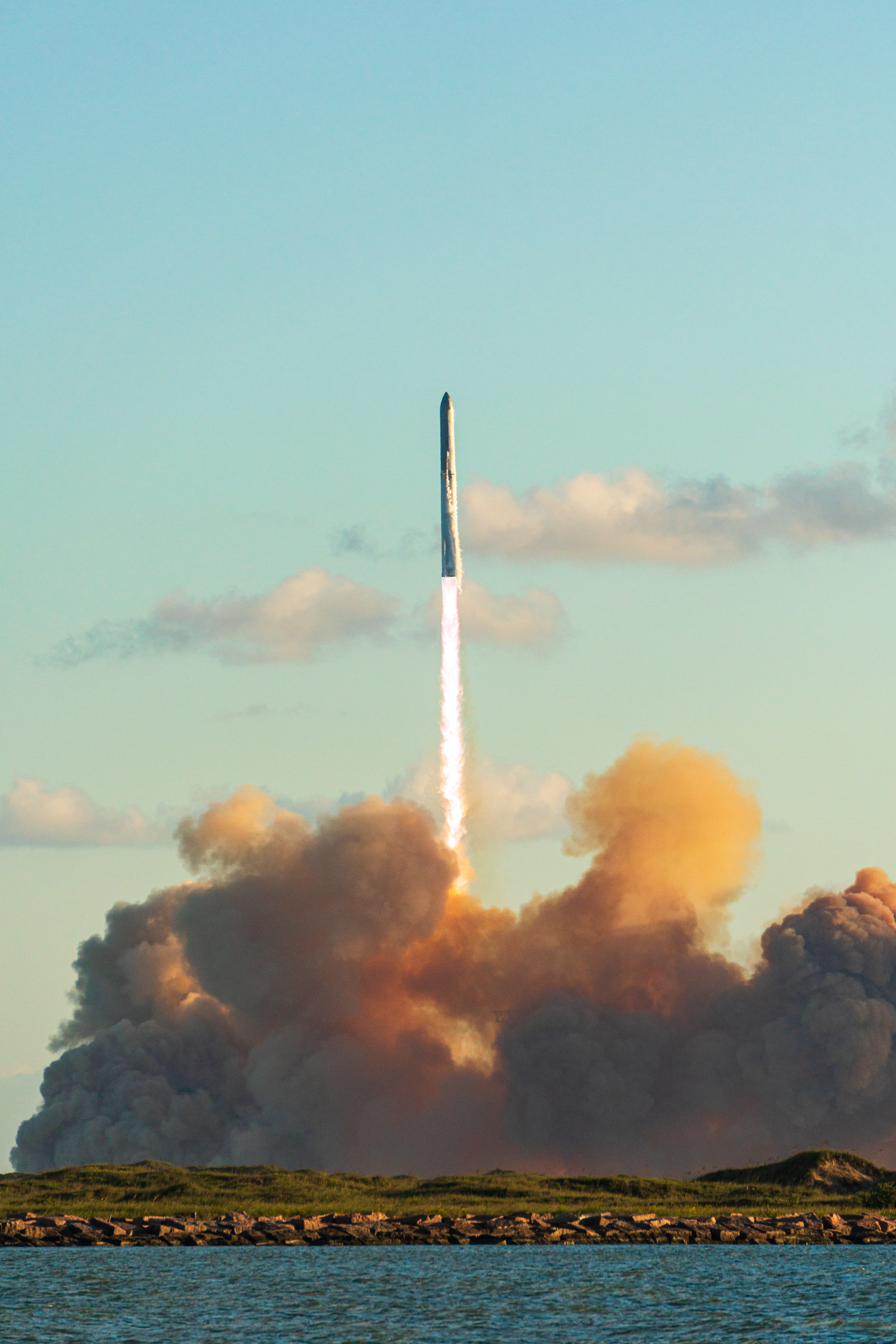
SpaceX’s Starship reached orbit for the first time Monday, then splashed down nearly seven hours earlier than the company’s own pre-launch timeline called for, after one of the ship’s engines shut down early in ascent.
Flight 14 lifted off at 7:48 a.m. CT Monday (about 8:48 a.m. EDT; Spaceflight Now logged 8:49 a.m.) from Starbase, Texas — its 14th flight and the first attempt to reach orbit, according to SpaceX. It carried the program’s first “meaningful payload,” a batch of 26 Starlink V3 satellites.
The plan versus the flight
SpaceX’s pre-launch timeline called for orbit insertion about 25 minutes after liftoff, payload deployment between roughly 34 minutes and 1 hour 5 minutes, a deorbit burn around 8 hours 53 minutes in, and landing about 9 hours 50 minutes after liftoff. Spaceflight Now reported the flight was initially expected to complete six orbits, with splashdown off the coast of Chile around 6:40 p.m. EDT.
- Planned splashdown: roughly 9 hours 50 minutes after liftoff, off Chile
- Actual splashdown: 11:57 a.m. EDT, about 3 hours 9 minutes after liftoff, north of Hawaii, according to Spaceflight Now
The engine issue and the decision
During the climb, one of the ship’s Raptor vacuum engines shut down early, SpaceX said, while its remaining five engines burned longer than planned. The ship still reached its intended suborbital path. SpaceX said its team judged the three sea-level engines healthy, and one of them relit to put the ship into orbit for the first time.
“Out of an abundance of caution given the engine issue experienced during ascent, the flight control team decided to limit the duration spent on orbit,” SpaceX said. The ship then flew a deorbit burn — a maneuver that slows a spacecraft enough to drop it out of orbit and back into the atmosphere — for the first time in the program’s history, aiming for what SpaceX called “one of two pre-coordinated landing zones” in the northern Pacific. SpaceX said the splashdown was “on target.” Spaceflight Now reported the ship tipped over and exploded after splashdown, as is usual for ocean splashdowns.
On the booster, SpaceX said, one Raptor shut down during the climb; 31 of the planned 33 engines relit for the boostback burn, which was designed to test the booster’s limits, and 11 of the planned 13 for the landing burn. SpaceX said the booster splashed down in the Gulf and that, upon landing-burn shutdown, its flight termination system was triggered as a demonstration of the safety hardware. Spaceflight Now noted that the previous flight’s booster suffered a “hard” splashdown after engine problems, while this booster had what the outlet called a “seemingly normal vertical splashdown” despite an apparent second engine shutdown during boostback.
What Flight 14 achieved for the first time
SpaceX’s summary lists three firsts: reaching orbit, carrying a meaningful payload into orbit, and executing a deorbit burn. All 26 Starlink satellites deployed successfully, and SpaceX said it made contact with every one. Spaceflight Now reported the ship climbed into an orbit about 180 miles high and said each V3 satellite carries 10 times the capacity of the previous Starlink generation. SpaceX said the satellites will now run on-orbit checkouts and raise their orbits before entering service.
NASA Administrator Jared Isaacman congratulated SpaceX on X, calling it a “Gorgeous launch, getting Ship to orbit and managing every step in a safe, responsible, and especially inspirational way,” Spaceflight Now reported.
What’s still ahead
Catching the ship at the launch pad has not yet been attempted; SpaceX has caught the booster that way four times, Spaceflight Now reported. A Starship variant is to serve as the lander for NASA’s Artemis IV moon landing, targeted for 2028. Spaceflight Now reported it is not yet known whether SpaceX can meet that date; the landing will require up to 15 or so tanker flights to refuel the lunar lander before it can head for the moon.
As Plainly Now reported Sunday, SpaceX had been targeting Monday for the vehicle’s first attempt to reach orbit.
The FAA’s statements page listed no statement on Flight 14 as of early Tuesday; its most recent Starship item, dated July 13, closed the investigation into the Flight 12 booster loss.