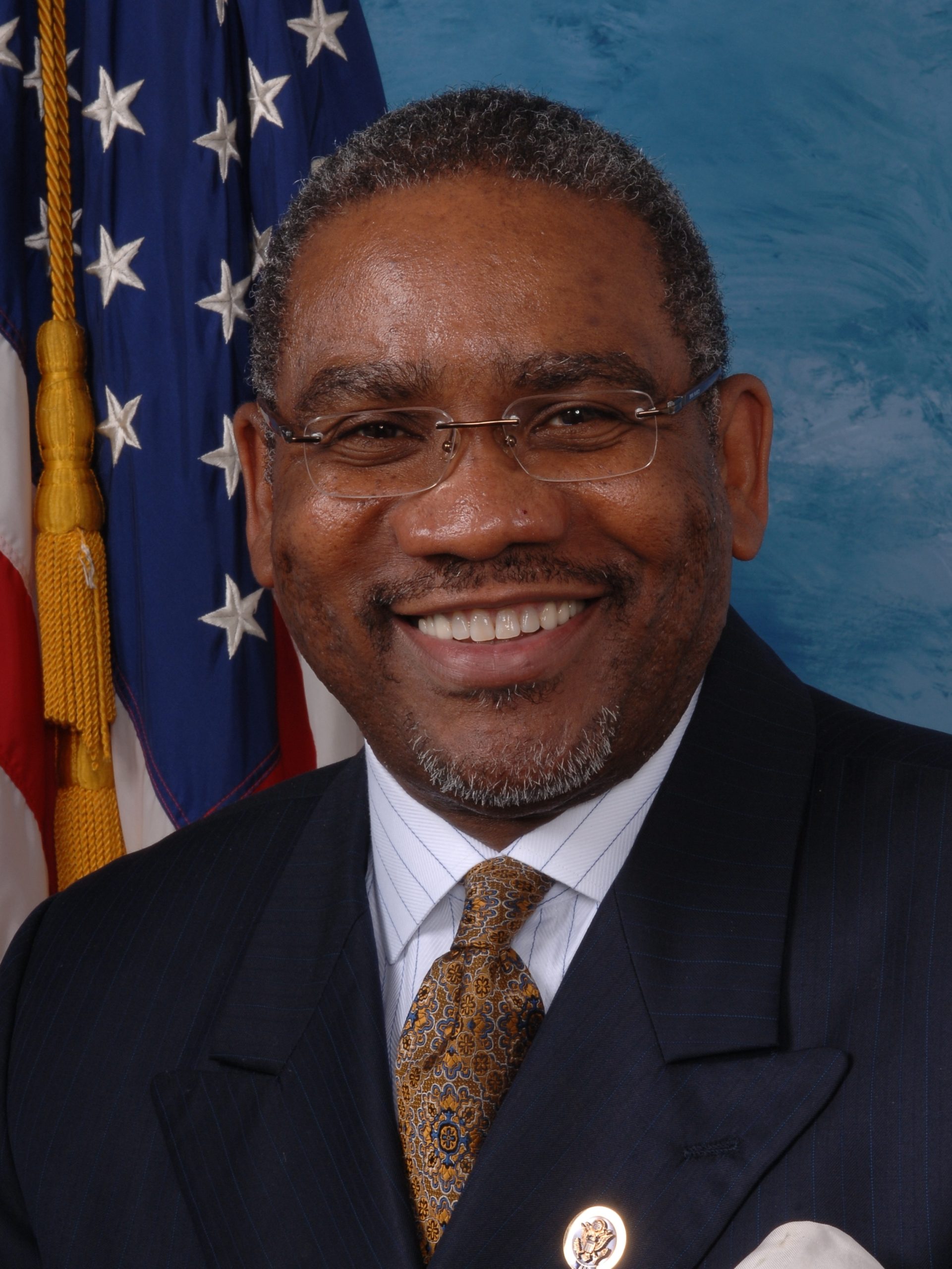
Rep. Gregory Meeks, the ranking Democrat on the House Foreign Affairs Committee, has placed a hold on the Trump administration’s proposed $2.8 billion sale of 40,000 2,000-pound bombs to Israel, citing unresolved concerns about how the munitions would be used.
“I remain firmly committed to Israel’s security and its ability to defend itself against serious regional threats,” Meeks said in a statement released by House Foreign Affairs Committee Democrats on Sept. 16. “But the Trump administration’s proposed sale of 40,000 2,000-pound bombs, some of the most destructive munitions in our arsenal, raises grave, unresolved concerns about how these munitions could be used in densely populated areas of Gaza and Lebanon. The Trump administration has not provided sufficient assurances that these weapons will be used by the Netanyahu government in accordance with U.S. law and with appropriate protections for civilians. I therefore will not clear this sale at this time.”
Meeks added that the decision “does not diminish Congressional support for Israel’s legitimate defense needs” but reflects “Congress’s responsibility to ensure that U.S.-funded weapons are used lawfully, responsibly, and with meaningful safeguards for human life.” The quote has circulated identically across multiple outlets, including The Hill and the Boston Globe.
The Washington Post first reported the administration’s plan on Sept. 15. Reporting on the package’s composition, drawing on a Washington Post breakdown, describes it as roughly 20,000 MK-84 and 20,000 BLU-117 bombs, funded largely through Foreign Military Financing. This is a separate, later package from the bomb shipment the Biden administration paused in May 2024 over the Rafah offensive.
What a “hold” actually does
Meeks’s move sounds like a block, and reporting elsewhere has largely left it there. But the mechanism behind it is narrower — and more revealing — than the word “hold” suggests, according to a Congressional Research Service report on the Arms Export Control Act (AECA).
Because Israel is classified as a major non-NATO ally, an arms sale above certain dollar thresholds eventually requires formal notification to Congress and a 15-day review period. Before that formal stage even begins, however, State Department practice since 2012 has built in an informal pre-notification review — 20 to 40 days in which the leaders of the House Foreign Affairs and Senate Foreign Relations committees can flag objections. That is the stage where Meeks’s hold sits.
Crucially, this informal hold is a custom, not a statute. The CRS report states directly that the State Department “generally will not formally notify an arms transfer if a member of Congress raises significant concerns by placing a hold during the informal review stage” — but the executive branch “is not precluded from proceeding with an arms transfer subject to a congressional hold.” In other words, Meeks can slow the sale and force the administration to negotiate, but he cannot unilaterally stop it. It is deference, not law.
The AECA also gives the administration a formal way around a hold entirely: the Secretary of State can determine that “an emergency exists” in the national security interests of the United States and waive the notification waiting period, so long as Congress receives a written justification. This administration has used that option before. On March 1, 2025, Secretary of State Marco Rubio invoked the emergency waiver to bypass a hold on a munitions package to Israel that included roughly 35,529 BLU-117 2,000-pound bombs, according to the Arms Control Association, which put the deal’s value near $4 billion; other reporting at the time described it as “nearly $3 billion.” The two figures may describe overlapping or sequential actions rather than identical transactions, and no source has reconciled them precisely. Nothing in current reporting indicates the administration has invoked, or announced any intent to invoke, that bypass for this $2.8 billion sale — as of the most recent reporting, it remains on hold through Meeks’s objection alone.
Meeks’s statement is also notably unspecific on one point: he says the weapons must be used “in accordance with U.S. law,” but neither his statement nor any other source identifies which law. No reporting ties the hold to the Leahy Law, which restricts assistance to foreign security units implicated in gross human-rights violations, or to any other named statute. It remains a general standard, not a cited legal trigger.
Not the first time
This is the third round of controversy over 2,000-pound bombs to Israel in roughly 28 months. The Biden administration paused a shipment of 1,800 such bombs and 1,700 500-pound bombs in May 2024 amid concern over a full-scale invasion of Rafah, with then-Defense Secretary Lloyd Austin citing “collateral damage” risk in a densely populated area. President Trump reversed that pause shortly after taking office in January 2025, releasing the withheld shipment.
Meeks himself has been here before. He held an F-15 sale in April 2024, and in February 2025 he blocked a roughly $1 billion package of bombs and armored bulldozers — only for the State Department to announce a separate, larger $7.4 billion package two days later, following a Netanyahu-Trump meeting. Meeks said at the time the administration told him the move would “abrogate Congressional oversight and years of standing practice.”
Reactions, and what’s missing
Congressional reaction has broken down largely along party lines, with one exception. Sen. Chris Van Hollen (D-MD) called the sale “sending bombs paid for by American taxpayers to a government led by a wanted war criminal.” Sen. Jeff Merkley (D-OR) reposted coverage of the sale with the caption “Hell NO.” Rep. Marjorie Taylor Greene (R-GA) wrote, “We did not vote for this. America does not support this” — a reaction to the sale itself, not specifically to Meeks’s hold. Commentator Tucker Carlson called the sale “a gift.” Kenneth Roth, Human Rights Watch’s former executive director, warned Trump could face “International Criminal Court prosecution for aiding and abetting war crimes” — a personal statement, not an institutional HRW position.
No current statement from Human Rights Watch as an organization, and no statement from AIPAC, has surfaced on this specific hold. Nor has any other Republican lawmaker, including House Foreign Affairs Chairman Michael McCaul or Senate Foreign Relations ranking member Jim Risch, commented on it directly. The Boston Globe reported that the State Department did not respond to requests for comment as of Sept. 16. Whether the administration answers Meeks’s concerns, waits him out, or invokes the emergency bypass it has used before is, for now, an open question.
Meeks’s hold is one of two separate moves Congress made against the war that same week: the House also passed its third non-binding resolution directing Trump to end US involvement. See Plainly Now’s explainers on that House vote and on the war itself, six months in.